Iran’s naval power: Fusion of military strength, diplomacy, technology, and human ethics
-
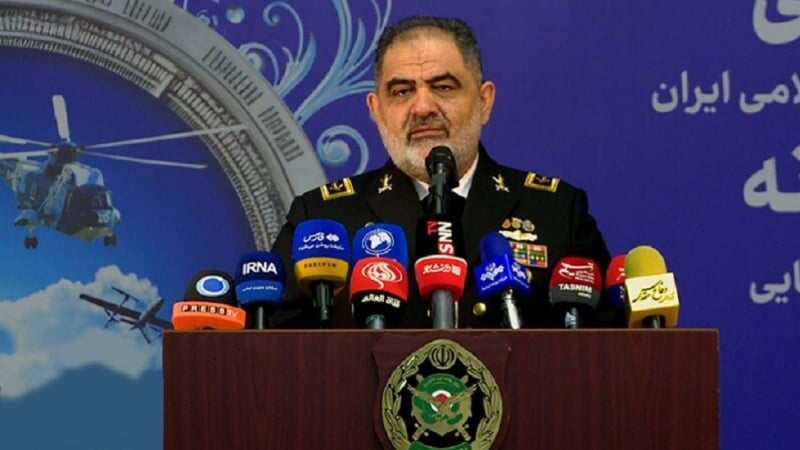
Rear Admiral Shahram Irani, Commander of the Navy of the Islamic Republic of Iran Army
Pars Today — The commander of the Iranian Army Navy emphasized that the presence of Iranian vessels in oceans and international waters represents a combination of military power and maritime diplomacy.
Rear Admiral Shahram Irani, Commander of the Navy of the Islamic Republic of Iran Army, explaining various aspects of the recent missions of Iranian naval flotillas in extra-regional arenas, stated that the presence of Iranian ships in oceans and open seas does not merely signify a military deployment. Rather, it reflects a fusion of military strength with maritime diplomacy, scientific and technological capability, human ethics, and the transmission of Islam’s cultural message to the global community.
He added that this readiness and authority in the precise execution of missions—especially in international waters and in safeguarding vital maritime communication lines—has been clearly demonstrated, highlighting the navy’s significant capacity to protect national interests.
Rear Admiral Shahram Irani, referring to the role of the strategic guidance of the Commander-in-Chief, emphasized that a large part of these advances and achievements is owed to the wise and prudent leadership of the Leader, who, by outlining clear horizons, has paved the way for the growth and advancement of the navy.
From a strategic perspective, the long-duration missions of the Iranian Army Navy’s flotillas in the oceans—including transits through straits and presence in international waters—strengthen Iran’s deterrent power. Active participation in humanitarian assistance, counter-piracy operations, and international cooperation presents Iran not merely as a deployed military force, but as a stability-promoting actor.
The presence of Iranian naval vessels in open waters should be regarded as a symbol of the strategic depth and multidimensional maturity of the Army Navy. Beyond ensuring security and demonstrating power, this presence serves as an effective tool for showcasing the Islamic Republic of Iran’s scientific, diplomatic, and cultural capabilities on the global stage. At a time when the geopolitics of the Persian Gulf and the Strait of Hormuz represent one of the most sensitive hubs of global energy and trade, the development of Iran’s extra-regional naval capabilities is not merely symbolic but constitutes a strategic defensive approach.
This presence sends a clear message to extra-regional powers that Iran is capable of safeguarding its national interests and the security of its maritime routes anywhere in international waters, without reliance on other countries. Particularly in light of acknowledgments by U.S. and Western officials regarding the growth of Iran’s naval capabilities, this reflects a form of effective deterrence and defensive self-confidence.
The domestic design, construction, and maintenance of naval vessels and submarines demonstrate mastery over the full cycle of indigenous defense knowledge and advanced engineering. This scientific capability has enabled the Navy of the Islamic Republic of Iran to achieve complete operational self-sufficiency at the strategic level and to carry out extra-regional missions without reliance on foreign infrastructure.
Beyond the military and technical dimensions, the presence of the Navy of the Islamic Republic of Iran conveys a cultural and humanitarian message. This message is rooted in the country’s civilizational and Islamic perspective, which views power not merely as an instrument of domination, but as a means to uphold justice, collective security, and human dignity.
The conduct and professionalism of naval personnel during international missions are grounded in values such as humanitarianism, protection of the marine environment, peaceful cooperation with other nations, and adherence to ethical principles of seamanship. This outlook has transformed Iran’s military power into an ethics-centered force that presents a different image of military presence at sea.
The presence of Iranian vessels in international waters demonstrates that the Islamic Republic of Iran has been able to establish a strategic balance between the components of hard power (military–technological) and soft power (cultural–diplomatic–ethical), thereby consolidating its position as a responsible and capable actor in the global maritime arena.