Ra'ad Anti-Ship Missile: Showcasing Iran's naval strike capability
-
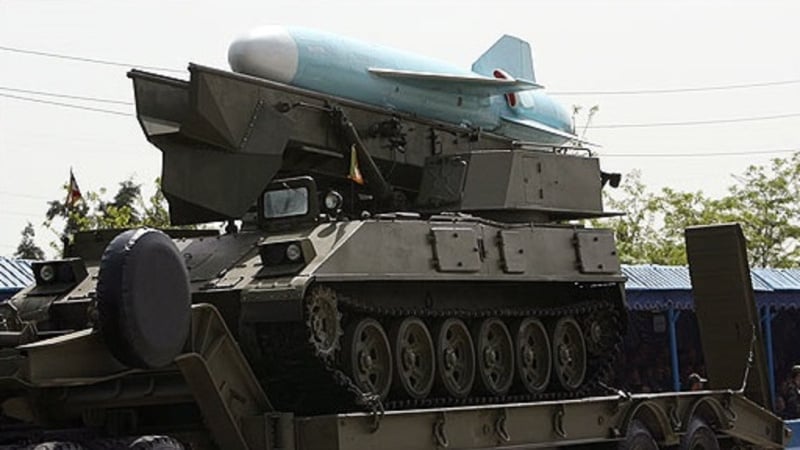
Ra'ad anti-ship missile mounted on a tracked vehicle
Pars Today – Iran's missile power is one of the great achievements of the Islamic Republic in the field of military technology and defensive power, the starting point of which can be traced back to the era of the Imposed War (Iran–Iraq War).
According to Pars Today, today, relying on domestic capability and maximum utilization of existing capacities in short time intervals, new and modern missiles, including various types of anti-ship cruise missiles, are being unveiled. With the introduction of each of them, Iran's defensive capability becomes more apparent. The first Iranian-built anti-ship missile is the Ra'ad, which is considered an effective weapon in Iran's naval strike capability.
Importance
One of the most effective weapons in naval battlefields, capable of delivering heavy and deadly strikes against vessels, is anti-ship cruise missiles.
An array of anti-ship cruise missiles with various targeting systems and ranges has been developed in Iran to date. During the 8-year Imposed War, many operational experiences were gained in naval warfare. In this regard, acquiring various types of anti-ship cruise missiles—launchable from shore, vessels, and air—became one of the priorities of the country's armed forces. The Ra'ad anti-ship cruise missile was one of the first missiles that the Ministry of Defense reverse-engineered from the Chinese Silkworm missile, producing it in the 2000s.
Overview
In 2004, the defense industries of the Ministry of Defense and Armed Forces Logistics designed a new model of anti-ship cruise missile based on the Chinese "Silkworm" missile with greater range and speed and mass-produced it, naming it the Ra'ad missile.
The Chinese Silkworm missile itself was the result of reverse engineering the Soviet "SSN-2 Styx" anti-ship missile.
The Ra'ad cruise missile is one of the largest, longest-range, and most destructive anti-ship cruise missiles manufactured by Iran's defense industries. With a range of 360 kilometers, it was for a long time known as the longest-range domestically produced anti-ship missile in Iran.
The Ra'ad is the Iranian cruise missile most similar to an aircraft, with a wing and tail structure closely resembling an airplane. Due to its warhead, it is one of the most dangerous anti-ship missiles, guaranteeing the destruction of any enemy vessel it hits.
In Iran, two versions of the Ra'ad anti-ship missile are in service. The initial version, called Sa'eqeh, is essentially the Chinese HY-2, which has a solid-fuel rocket motor and a range of 130 kilometers. The later version, the Ra'ad anti-ship missile, is equipped with a jet engine.
In fact, the Iranian version has a major difference from the Chinese version: it uses a turbojet engine as its propulsion. The use of the "Tolo" turbojet engine instead of the rocket motor in the Silkworm has allowed the Ra'ad to achieve several times the range of that missile.
The Ra'ad anti-ship missile uses a turbojet engine with air intakes on both sides of the missile. A solid-fuel rocket booster provides the necessary energy for launch, giving the missile a speed of Mach 0.6 to 0.8.
The operational range of the Ra'ad cruise missile is estimated at around 360 kilometers, and it is launched from a tracked launcher. The warhead of this missile weighs several hundred kilograms, similar to foreign counterparts.
The Ra'ad is a large missile, over 7 meters long. Although it is easier for enemy ship anti-missile systems to detect and destroy, it is considered one of the most effective anti-ship missiles against large stationary and moving naval targets.
With its radar guidance and suitable range, this missile can cover large parts of the Persian Gulf, the Gulf of Oman, and the North Indian Ocean. However, with the production and operationalization of new anti-ship cruise missiles such as the Noor, the Ra'ad is no longer Iran's most advanced anti-ship missile, and its production has ceased.
Features
The Ra'ad anti-ship cruise missile is equipped with a "Tolo-4" turbojet engine, which was built based on the French TRI-60 engine. This engine was installed on the MQM-107 target drone that was delivered to Iran before the Islamic Revolution.
Two air intakes at the rear of the Ra'ad missile supply air to the engine, and the tail of the missile is more elongated. Besides the engine difference from the Chinese version, the Ra'ad also has a different radar and the ability to fly close to the water surface.
The Ra'ad is launched from a ground platform, using a booster for launch from the platform, and then continues its flight with its turbojet engine. The missile uses an active radar system and an infrared seeker for the terminal phase.
The long range of the Ra'ad anti-ship missile allows its launchers to be positioned deep within friendly territory, reducing the likelihood of detection by the enemy, providing more space for relocation after an operation, or enabling safer multiple launches from one area (for launchers containing several missiles).
This missile has high destructive power, electronic warfare countermeasures capability, low flight altitude, and increasing accuracy in navigation, detection, and destruction of targets—factors that will certainly enhance Iran's naval power, especially in the defensive dimension.
Specifications
- Type: Anti-ship missile
- Speed: Between Mach 0.8 and 1
- Length: 7.8 meters
- Weight: 2,998 kg
- Range: Approximately 360 kilometers
- Flight altitude: 30 to 50 meters
- Radar system type: Monopulse (active) radar
- Warhead weight: 512 kg
- Engine: One liquid-fuel engine with a solid-fuel booster