Najafi: Austria not qualified to host international organizations
-
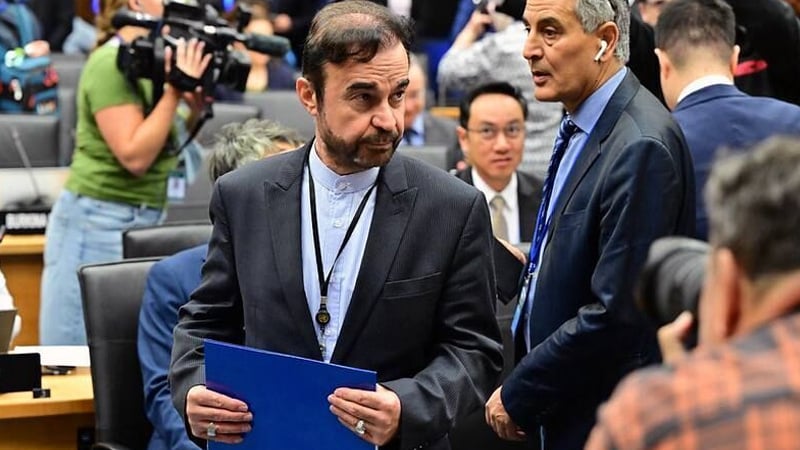
Iran’s Ambassador to Vienna Reza Najafi
Pars Today- Iran’s ambassador to Vienna, reacting to the US representative’s admission that Washington had obstructed Mohammad Eslami, head of the Atomic Energy Organization of Iran, from attending the IAEA General Conference and to Austria’s justifications for revoking his visa, stressed that the country is not qualified to host international organizations.
According to Pars Today, citing IRNA, Iran’s Ambassador to Vienna Reza Najafi said on Monday at the 70th IAEA General Conference: “The unacceptable record of the Austrian government’s policies and performance in fulfilling its obligations as the host country of international organizations based in Vienna leaves no doubt that this country is not qualified for such a role.”
The US representative had earlier acknowledged that Washington had opposed a travel exemption for Eslami and claimed that, under the rules of the UN Security Council sanctions committee, this opposition had resulted in the request being rejected.
Justifying the obstruction, he repeated anti-Iran claims and alleged that the United States could not have allowed Eslami to travel to the General Conference without what he called meaningful cooperation on nuclear safeguards.
He also claimed that Iran would use its participation in the meeting for propaganda and made allegations concerning the level of uranium enrichment and threats to the security interests of the United States and its regional partners.
The Austrian representative also defended his country’s actions, saying that Vienna had submitted a request for an exemption from the travel ban to the UN Security Council sanctions committee, but the request had been rejected.
He claimed that, as a result of this decision, Austria was obliged to prevent one of the members of the Iranian delegation from entering the country, and went on to stress the need to submit visa applications in a timely manner.
In response, Najafi described Austria’s account as “completely distorted” and said it was astonishing that the country was citing expired resolutions or a committee that no longer exists to justify violating its obligations as a host country.
He stressed that Resolution 2231 expired on October 18, 2025, and that all UN restrictions against Iran had come to an end. According to Najafi, this is not merely Iran’s position, as two permanent members of the UN Security Council and the countries of the Non-Aligned Movement also hold this legal position.
The Iranian ambassador described the actions taken in the name of the so-called sanctions committee as beyond its legal authority and an abuse of the Security Council’s procedures and powers by some Western members.
Rejecting the claim that snapback was automatically triggered, he stressed that the operative paragraph 11 of Resolution 2231 cannot replace or supersede Article 27 of the UN Charter and must be implemented within its framework.
Regarding the timing of the visa application, Najafi stressed that the visa application for the head of the Iranian delegation had been submitted a month earlier and his visa had been issued, but he was subsequently prevented from entering the country under the pretext of sanctions.
He added that the issuance of the visa shows that Austria and the Schengen countries that agreed with it did not consider snapback to have been legally implemented or the sanctions to have been reimposed, stressing: “It is clear that the visa was revoked under pressure from a particular country, and the purported legal justification for the move was fabricated afterward.”
Najafi noted that the pressure was exerted by the same country that, just days earlier, was among the main sponsors of the political resolution by the IAEA Board of Governors against Iran and which violated international law and the UN Charter by attacking Iran’s nuclear facilities.
Najafi stressed that Iran understands the intense pressure on the Austrian government, but said such pressure does not justify violating the host country’s obligations. He described the instrumental use of the IAEA to advance the interests of one country at the expense of undermining the credibility of the organization and the host country as a dangerous trend that must be stopped.