Iranian tanker ‘leaves two oil slicks in East China Sea’
-
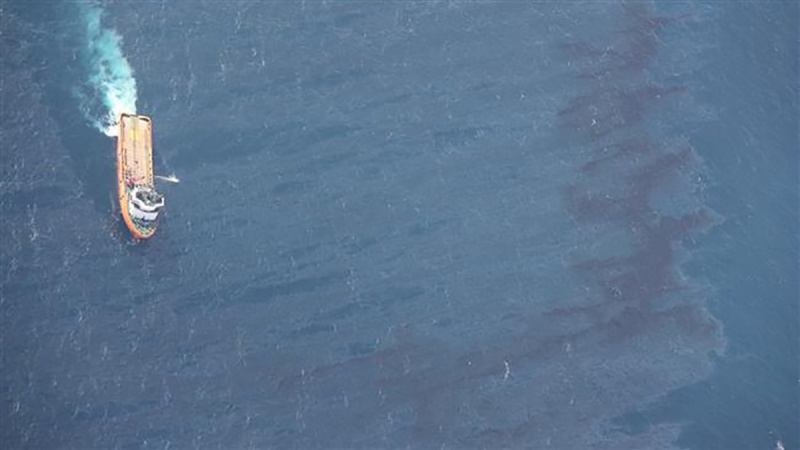
A Chinese ship works to clean oil slicks from the sunken Iranian oil tanker Sanchi, in the East China Sea
An Iranian oil tanker that collided with another vessel and went down after more than a week of burning in the East China Sea has produced two oil slicks.
The oil slicks cover a combined 109 square kilometers, the Chinese government said late Tuesday.
The Iranian ship, Sanchi — which was carrying 136,000 tons (almost one million barrels) of condensate for South Korea — had been in flames for eight days, since it collided with a cargo ship off the coast of China on January 6. The vessel went down on Sunday after a new and massive fire erupted, sending a cloud of black smoke as high as one kilometer above the sea.
The tanker had a crew of 32, almost all of them Iranians. Three bodies have been recovered, and the remaining 29 crew members are presumed dead.
In a statement on Wednesday, the Chinese Ministry of Transport said salvage teams had located the wreck at a depth of 115 meters under sea level, and were preparing to send underwater robots to explore it.
China’s State Oceanic Administration (SOA) said in a statement on Tuesday that according to satellite images, the sunken ship had left one slick of 69 square kilometers and a second one of 40 square kilometers in area, the second one being thinner and not as concentrated.
The teams have taken 31 water samples in the area around the wreck, where there is black grease with heavy oil smells, and a concentration of petroleum that exceeds some seawater quality standard limits, the statement said.
Condensate is toxic and different form black crude, which is often seen in oil spills. Condensate is also considerably more explosive than regular crude.
Japan, which was also concerned, said on Tuesday that it saw little chance of the oil spill reaching its shores.
“Oil spills in general can have a big environmental impact if they reach the coast, but we think that there is little chance of that happening on Japanese seashores for now,” an official at Japan’s Environment Ministry told Reuters.
Japan’s patrol boats were cruising through the wreck area to help diffuse the slick, said a Japanese Coast Guard spokesman, adding that the “spill area had shrunk from the previous day.”
EA