Why majority of Americans opposed U.S. military action against Iran
-
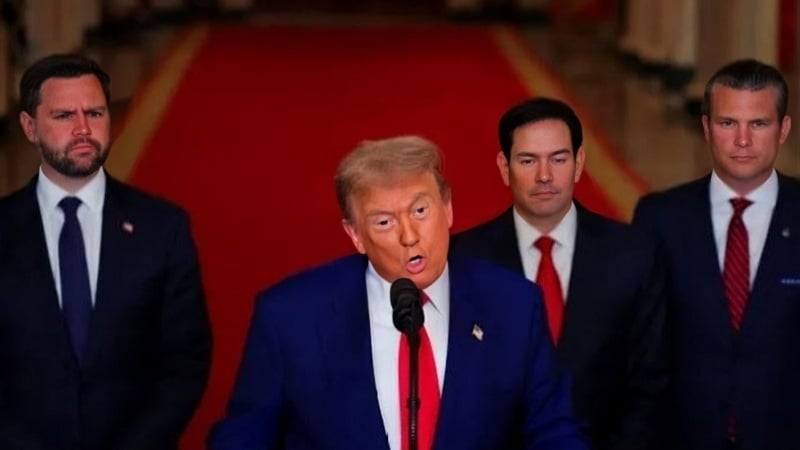
Trump announcing airstrike on Iran
Pars Today – A majority of Americans opposed the recent military action taken by the Trump administration against Iran. According to Pars Today, the statistical website Statista published the results of a survey on December 5, 2025, regarding the recent U.S. attack on Iran. According to this survey, most Americans opposed the recent U.S. military action against Iran.
According to the website, as tensions between the United States and Iran continued in late 2025, a look at public opinion in the days immediately after the U.S. military strikes in June shows that American society was deeply divided. A CNN poll conducted on June 22–23, 2025 (before Iran’s response and Trump’s announcement of a ceasefire) showed that a majority of Americans (56 percent) opposed Trump’s decision to launch the strikes.
The poll revealed a clear partisan divide: 82 percent of Republicans supported the action, while 60 percent of independents and 88 percent of Democrats opposed it. However, it should be noted that a significant portion of Republican voters—nearly one in five—also opposed the strikes.
This opposition stems from several key factors:
First, there is widespread public distrust of Trump’s decision-making when it comes to the use of military force. Many respondents in the CNN poll said they did not trust Trump’s judgment regarding the initiation of a war and believed that he was influenced more by political pressures and foreign lobbies than by national interests.
The second factor is the fear of increased threats against the United States. About 60 percent of participants in the surveys said that attacking Iran could heighten the risk of Iranian retaliatory actions against the U.S. This concern was especially common among young people and independents, who believed that entering a new war would not strengthen America’s security but would instead expose it to new dangers.
The third factor is the conflict with Trump’s campaign promises. During his campaign, he repeatedly emphasized that he intended to end the “endless wars” and keep the United States out of foreign conflicts. However, the military action against Iran was exactly the opposite of that promise, and many voters—especially Democrats and independents—viewed the strike as a betrayal of Trump’s anti-war rhetoric.
The fourth factor is concern over the human and economic costs of war. In the surveys, only 9 percent of Americans supported sending ground troops to Iran, while 68 percent opposed it. This shows that even those who approved of airstrikes were not willing to accept the heavy costs of a ground war. Americans are well aware that foreign wars place enormous financial burdens on taxpayers, and that the main victims are ordinary people—not politicians or the military-industrial corporations.
The fifth factor is partisan and generational divides. While 82 percent of Republicans supported the airstrike on Iran, only 44 percent expressed strong support, indicating hesitation among a segment of Trump’s base. Younger Americans under the age of 35 were more opposed to the action than any other age group, and their level of trust in Trump was lower. This shows that the younger generation of Americans is more inclined toward diplomacy and avoiding war.
In the end, the widespread opposition to Trump’s attack on Iran can be understood as a combination of distrust in political leadership, fear of security consequences, conflict with campaign promises, concern over the costs of war, and deep social divides. These factors together led the majority of Americans—including a portion of Republicans—to reject military action against Iran. Thus, Trump’s strike not only failed to create domestic consensus, but also deepened existing political and social rifts in the United States, once again showing that American public opinion has little appetite for entering new wars.