Why does America fail Against Iran?
-
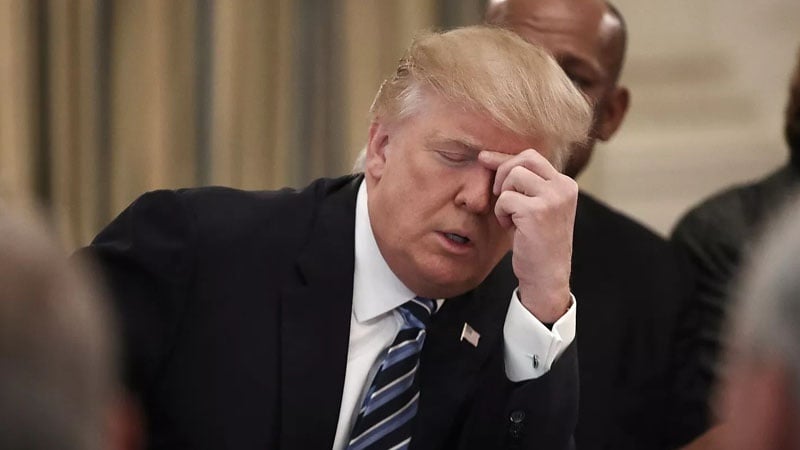
US President, Donald Trump
Pars Today – Amid Washington’s new threats against Iran, U.S. Department of War analyses indicate that the American military, due to “overextension of forces,” “logistical constraints,” and “simultaneous focus on multiple global fronts,” lacks the capacity for a large-scale conflict with Iran. Any military action could come at the cost of weakening Washington’s global strategic position.
According to Pars Today, an Algerian political analyst wrote in Patriotic newspaper that in Washington, President Donald Trump’s hawkish rhetoric on Iran increasingly clashes with internal Pentagon assessments. While the U.S. president uses threats of military action to pressure Tehran, multiple military sources privately admit that the United States currently lacks the ability to open a major new front without undermining its overall global strategic posture.
Eit Amara, an Algerian economist and sociologist, explained that according to these sources, the U.S. military is facing an unprecedented “overextension” since the end of the Vietnam War. On paper, the U.S. Navy has eleven aircraft carriers, the main symbol of American power projection. In reality, nearly one-third of these vessels are out of operational service due to long-term maintenance. The remaining carriers follow strict deployment cycles, limiting the number of active carrier strike groups at any given time to two or three, distributed across the Western Pacific, the Persian Gulf, and the Mediterranean.
Amara noted that any operation against Iran would require multiple carrier strike groups, as was the case during the 2003 invasion of Iraq. Unlike that period, however, the U.S. must now simultaneously contain China, support NATO against Russia, and maintain military presence across multiple unstable regions. A senior officer emphasized that any concentration of forces in the Persian Gulf mechanically weakens the U.S. position against Beijing or Moscow, stating: “Every redeployment creates a gap somewhere else.”
He added that limitations are not only naval. Sources also highlight increasing strain on personnel, challenges in recruiting and retaining specialists, and additional pressure on logistical chains. Stocks of precision munitions—critical for modern air strikes—pose another major concern. A prolonged war with Iran could deplete these munitions within weeks, against a country equipped with advanced air defenses, cyber capabilities, and sophisticated anti-ship missiles.
From a strategic perspective, military officials also doubt the effectiveness of an attack. According to them, the June 2025 strikes carried out by Israel with U.S. support only temporarily delayed Iran’s nuclear program. Iran has dispersed and hardened its facilities, making the idea of permanent destruction through airstrikes unrealistic. In this context, the threat posed by Trump appears largely to these officials as a political bluff—designed both for U.S. public opinion and for Tehran—but its credibility is eroding given the gap between rhetoric and actual capability. Meanwhile, China and Russia, Washington’s two main rivals, are carefully analyzing every U.S. move and redeployment for strategic lessons.
The report continues that, according to these sources, by emphasizing red lines without possessing the means to enforce them simultaneously, the United States ultimately undermines its overall—and effectively artificial—deterrence. They note that this trend is already evident in a series of recent crises, where U.S. adversaries tested its limits and then pushed back.