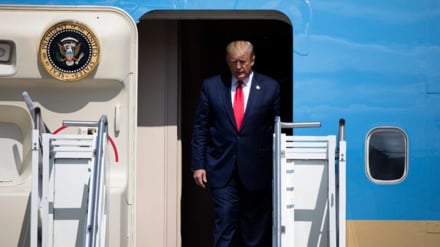
Trump seeking security or strategic resources in Greenland?
-

Trump’s plan to take over Greenland
Pars Today – The Greenland case is more than just a regional issue; it is a clear symbol of the return of U.S. unilateralist policies and the challenges facing the international order in the 21st century.
Until just a few decades ago, Greenland was viewed as a remote, frozen, sparsely populated territory whose importance was largely limited to its unique geographic location in the North Atlantic. However, climate change, the melting of polar ice, and intensifying competition among global powers over natural resources have turned the island into one of the key geopolitical focal points of the 21st century. According to Pars Today, citing Mehr News Agency, Greenland today not only offers new shipping routes, but—based on credible international reports—also holds significant reserves of rare earth elements, strategic metals, and critical mineral resources essential for advanced industries.
In this context, the direct involvement of the United States in the Greenland issue—using rhetoric that evokes notions of “ownership” and “annexation”—has proven highly sensitive. For Europe, Greenland is not merely a territory; it is part of the continent’s legal and political order, an order built on respect for national sovereignty and the principle that borders cannot be changed through pressure or threats.
Trump’s special envoy: Diplomacy or political pressure?
Trump’s decision to appoint a “special envoy” to Greenland is a symbolic yet highly meaningful move. In diplomatic practice, such appointments are usually reserved for crisis zones or countries with complex relations—not for a territory that is officially under the sovereignty of a U.S. ally. This is precisely why Danish officials described the move as intrusive and unacceptable.
Public remarks by the envoy about “efforts to bring Greenland into the United States” effectively removed any lingering doubt, revealing that Washington’s goal goes beyond economic or security cooperation. This approach not only calls Denmark’s sovereignty into question, but also sends a dangerous message to the world: that the United States, when it deems its strategic interests to be at stake, is willing to pressure even its closest allies.
Europe’s response: Defending sovereignty and the international order
Denmark’s reaction to Washington’s moves was swift, clear, and firm. By emphasizing that “Greenland is not for sale,” Danish officials sought to draw a clear line between legitimate cooperation and unlawful interference. More broadly, this stance reflects Europe’s deep concern over the revival of U.S. unilateralism—policies that, during Trump’s first term, repeatedly caused serious tensions in transatlantic relations.
For the European Union, the issue goes far beyond Greenland itself. At stake are the principles of territorial sovereignty and adherence to international rules. If such pressure is applied to Denmark today, it could be directed at other European countries or sensitive regions elsewhere tomorrow. As a result, the Greenland case has become a symbol of Europe’s resistance to a U.S. “power-centric” approach.
The Monroe Doctrine and the revival of an outdated logic
Political analysts assess Trump’s policy toward Greenland as part of a practical revival of the Monroe Doctrine—a doctrine developed in the 19th century to justify U.S. dominance over its surrounding regions. Although today’s world is fundamentally different, the mindset behind this policy remains rooted in dividing the globe into spheres of influence.
From this perspective, strategic regions are defined not by the rights of their peoples, but by their geopolitical and economic value. Greenland, with its prime location and vast potential resources, fits squarely into this framework. The return of such thinking in the 21st century has raised serious concerns about the future of the international order.
Natural resources: The hidden driver of the crisis
While U.S. officials attempt to frame their actions in terms of security or economic cooperation, the reality is that Greenland’s natural resources play a decisive role in this equation. The island’s rare earth elements and strategic metals are vital for high-tech industries, renewable energy, and even the military sector. In a world where competition over supply chains for these resources is intensifying, direct access to such reserves represents a major strategic advantage.
From Europe’s perspective, this is precisely where U.S. policy crosses the line from legitimate cooperation into geopolitical pressure. Attempts to exert direct or indirect control over a territory’s resources without regard for the political will governing that land clearly violate widely accepted international principles.
Transatlantic implications of the Greenland crisis
The Greenland case has exposed deeper rifts in U.S.–European relations. It shows that even among traditional allies, there is no longer a shared understanding of concepts such as sovereignty, security, and national interest. For Europe, collective security is inseparable from respect for international law, whereas Trump’s approach is driven more by power than by legal norms.
If this trend continues, its consequences could go far beyond a single diplomatic dispute—from weakening mutual trust to increasing Europe’s push for greater strategic autonomy from the United States. In other words, Greenland may well become a turning point in the redefinition of transatlantic relations.