Trump turns to Goebbels tactics to incite chaos in Iranian protests
-
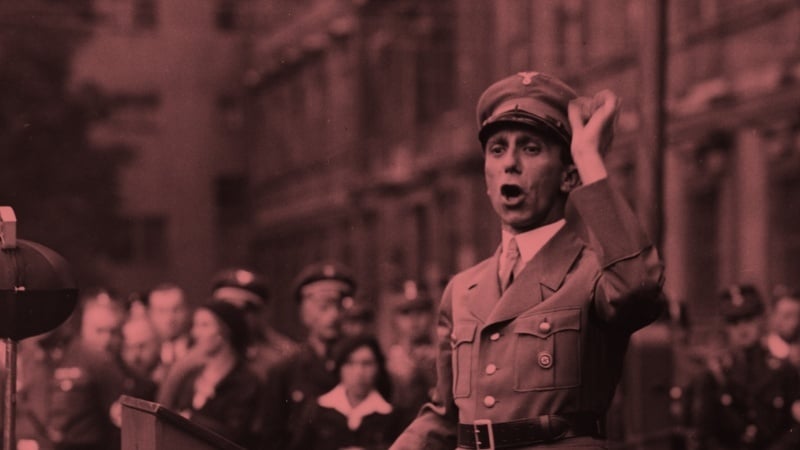
Joseph Goebbels, minister of propaganda of Nazi Germany
Pars Today – The front of Iran’s enemies, led by Trump, used Goebbels-style techniques in an effort to turn Iranian protests into urban warfare.
According to Pars Today, Fred Wertheimer, a veteran figure in U.S. electoral reform, wrote in an article on the Democracy 21 website about Trump’s techniques to achieve his goals:
“I don’t know whether Donald Trump ever studied Joseph Goebbels, but he certainly applies Goebbels’ methods.” Goebbels served as Germany’s Minister of Propaganda from 1933 to 1945. He is credited with the concept of the “Big Lie”, defined as: “If you tell a lie big enough and keep repeating it, people will eventually believe it.”
Wertheimer noted that the use of such lying techniques is not just Trump’s current approach in politics, but a consistent method he has employed since the 1980s, even using it to amass wealth and elevate his personal status.
Not only in personal goals and domestic politics, but today in foreign policy as well, Goebbels-style techniques have become Trump’s consistent method for achieving his objectives.
In the case of Venezuela, by repeatedly claiming to fight drug trafficking, he aligned domestic forces and media with his agenda. Similarly, from the very beginning of the protests in Iran, opponents of the Islamic Republic—collaborating with Israel and the United States and under Trump’s direction—resorted to Goebbels-style techniques.
The following are several examples of the methods used to turn the protests in Iran into war and chaos. Some of these techniques were employed simultaneously by all fronts, while others were used exclusively by a single group.
1) The big lie
A lie so enormous is told that people assume “something like this couldn’t possibly be fabricated.” The protests in Iran began peacefully and without any violence. However, from the very outset, media outlets such as the BBC, Iran International, and Voice of America started publishing reports claiming high death tolls in Iran—at a time when the protests had not even turned violent, nor was there any need for security forces to be present on the streets.
Today, some of these media outlets are even citing figures of 20,000 people killed in Iran. In reality, the core technique used here is what can be described as a “manufactured death toll”: armed terrorists create casualties on the ground, which are then dramatically inflated by media using extremely large numbers—such as 20,000—so that no one dares to question the figure.
2) Continuous and varied repetition
A message is repeated over and over to firmly embed it in the audience’s mind. This technique was orchestrated by Trump and amplified through various media outlets. From the very beginning of the protests, Trump claimed that Iran should not “shoot at protesters.” The phrase “shoot at protesters” was deliberately planted to stick in the audience’s mind.
After being repeated several times by Trump—both in writing and verbally—it became a fixed keyword in media quotes. Media outlets referred to this threat at every opportunity, creating variation in repetition. As a result, the audience was primed to expect scenarios of shooting at protesters and potential U.S. military intervention.
3) Enemy-making
Creating a “dangerous other” to instill fear, undermine internal cohesion, and justify actions: With the entry of armed terrorists among protesters—triggered under the guise of calls issued by Reza Pahlavi—the protests in the capital and major cities suddenly and unexpectedly turned into open street warfare starting on January 8.
Setting fire to everything in sight and killing anyone within reach indicated that those present on the streets viewed everything and everyone as an enemy—believing that if they did not kill, they themselves would be killed.
4) Manufacturing artificial consensus
Implying that “everyone knows this” or that “the majority is with us”: The leadership of armed terrorists among Iranian protesters, their apparent guidance, and the issuing of operational signals were carried out with the help of the son of Iran’s deposed shah.
Among the measures taken to project global support—beyond the media onslaught through Western and Arab outlets—was the symbolic replacement of the flag of the Islamic Republic of Iran with the flag of the fallen regime at Iranian embassies in several well-known countries such as the United Kingdom and France! The aim was to create the impression that other countries had accepted the overthrow of Iran’s system and that “we are in the majority.”
5) Playing the victim
Portraying oneself as a victim to gain sympathy and legitimize actions: Pahlavi forces produced emotional clips claiming that “the overthrow of the Pahlavi dictatorship was a mistake by the Iranian people in 1979, and today the people have realized this mistake!”
In this way, protests that began over economic issues were reframed as a counter-revolution through Pahlavi victimization. Slogans were designed to suggest that the royal family, expelled by the Iranian people, had been fighting for years to reclaim its usurped position and the people’s violated rights. These clips were translated into multiple languages and disseminated worldwide via Western supporters, particularly on social media.