New wave of anti-Iran sanctions: Trump targets Iran’s trade partners
-
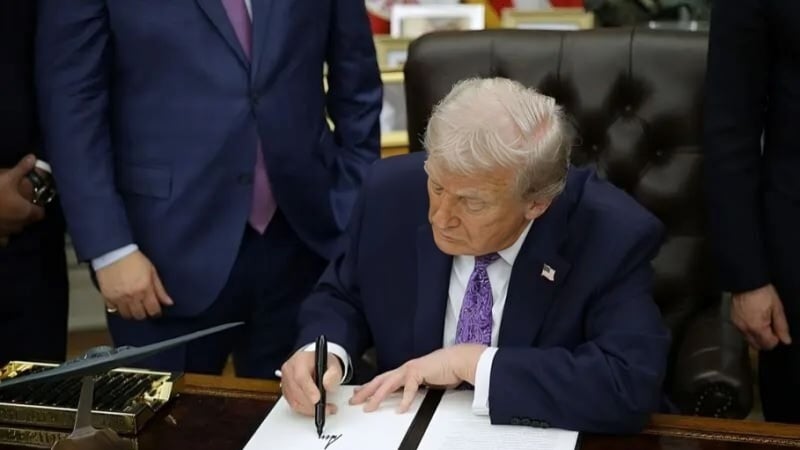
Donald Trump signed an order imposing tariffs on Iran’s trade partners.
Pars Today – Trump has signed a tariff order targeting Iran’s trade partners.
According to Pars Today, U.S. President Donald Trump on Friday, February 6, despite a new round of talks between Tehran and Washington, signed an executive order that imposes a 25% tariff on countries trading with Iran, in addition to existing tariffs, as part of his dual-track policy toward Iran.
According to this order, which will take effect on February 7, 2026, the United States will target Iran’s trade partners with secondary tariffs. The implication of this decision is that, while heavy sanctions have already placed crushing pressure on the Iranian people—whom Trump claims to support—any country that continues to trade with Iran will face new U.S. tariff penalties.
The White House, confirming Trump’s signing of the order, stated that under this measure, the United States can impose additional tariffs on goods imported from countries that directly or indirectly purchase goods or services from Iran.
This order, organized into nine separate sections, was issued based on the president’s constitutional authority and the “International Emergency Economic Powers Act.” From the time the order takes effect, an additional customs tariff (for example, 25%) will be applied to all goods imported into the United States from countries that purchase goods or services from Iran. The implementation process is designed so that the Department of Commerce is first responsible for identifying which countries buy from Iran, either directly or indirectly.
Once this is verified, the State Department, in coordination with the Departments of Treasury, Commerce, Homeland Security, and the U.S. Trade Representative, will determine the exact scope and level of the tariffs and provide a final recommendation to Trump for implementation. If any country retaliates against these tariffs, the U.S. president has the authority to further increase the tariffs or impose additional punitive measures.
In another anti-Iranian move, the U.S. State Department, coinciding with the new round of talks between Tehran and Washington, imposed new oil sanctions on 17 individuals and entities, as well as 14 ships. Washington, repeating its claims against the Islamic Republic of Iran, stated that it is sanctioning these entities, individuals, and vessels in order to halt the flow of revenue to Iran.
The signing of a new executive order by Donald Trump, imposing punitive tariffs (such as a 25% rate) on countries that trade with Iran, is a multifaceted move carried out within the framework of U.S. strategic objectives. Strategically, the declared goal is to use secondary sanctions to complete Iran’s economic encirclement and effectively reduce its oil revenues to zero. The White House, citing the ongoing “national emergency,” considers this measure necessary to protect U.S. national security and interests against what it calls Iran’s “unusual threat” through its nuclear and missile programs and support for regional proxy groups. The key point is that the pressure is not only directly on Iran but also targeted at its network of trade partners, aiming to raise the cost of doing business with Tehran to an unprecedented level.
At the tactical level, the timing of this order—issued simultaneously with or immediately after the conclusion of the new round of Iran-U.S. talks in Muscat—is significant. This simultaneity is interpreted as a lever to increase pressure and secure a stronger bargaining position for Washington, sending a clear message that the maximum-pressure policy will continue regardless of negotiations. Trump personally emphasized after the talks that if Iran fails to reach an agreement, it will face “very severe consequences.”
From an operational perspective, this order establishes a complex mechanism. First, the U.S. Department of Commerce is tasked with identifying countries that purchase from Iran. Then, the State Department, in coordination with agencies such as the Treasury, determines the precise scope and level of tariffs and submits recommendations to the president. This process gives the U.S. flexibility to gradually increase pressure based on countries’ responses.
Additionally, the order contains a provision granting the president the authority to “modify” the directive if circumstances change, if countries take retaliatory actions, or if Iran or its partners take “significant steps” toward alignment with Washington. This provision serves both as a tool for punishment and as an incentive for compliance with U.S. demands.
Overall, this move can be seen as an attempt to turn the United States’ initial sanctions against Iran into a comprehensive, global economic blockade. The ultimate goal is to further isolate Iran, severely restrict its financial resources, and compel Tehran or its trade partners to accept Washington’s conditions by creating a difficult choice between trading with Iran or accessing the vast U.S. market.
However, just as during Trump’s first term, Iran was able to withstand Washington’s hostile measures aimed at reducing its oil exports and cutting its revenues to zero despite the maximum-pressure policy, this time as well, given the overt refusal of Iran’s most important trade partner—China—to comply with Washington’s demands, Iran could once again thwart Trump’s anti-Iran policies.