
Contradictions in Washington: From accusations to Iran’s peaceful nuclear program acknowledgment
-
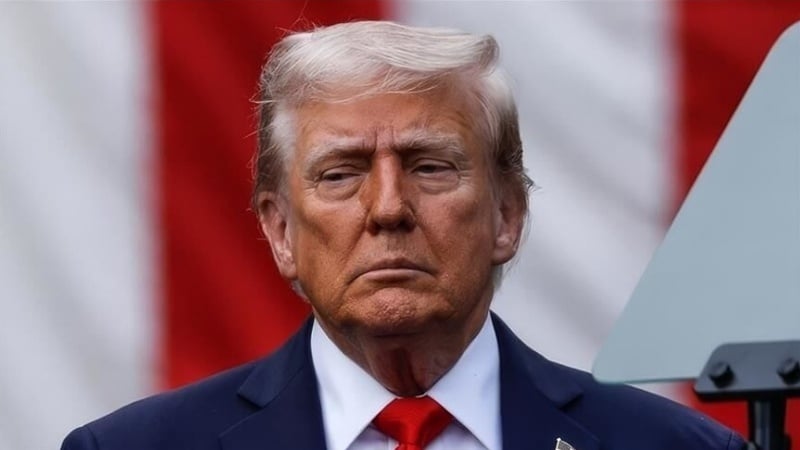
US President Donald Trump
Pars Today – Donald Trump has repeated allegations regarding Iran’s nuclear program while intensifying his anti-Iranian rhetoric.
According to Pars Today, Trump again made conflicting claims, stating that Iran wants a deal more than he does but is unwilling to utter what he called the “magic words” that it will not build a bomb.
Speaking at a meeting with news broadcasters, the U.S. president said: “Iran wants a deal more than I do, but it is not willing to say these ‘magic words’ that they will not make a bomb.”
Trump added that important negotiations are scheduled to be held on Thursday in Geneva, claiming that Iran is highly eager for an agreement but refuses to state, “We will not build nuclear weapons.”
On Tuesday, February 24, Donald Trump, in his annual speech to the U.S. Congress, claimed that although diplomacy is his preference, he would never allow Iran to obtain nuclear weapons.
He alleged: “My preference is diplomacy, but I will never allow (Iran) to have nuclear weapons.”
Despite the deployment of extensive U.S. military forces and equipment around Iran and repeated threats against Tehran, it appears that Trump is once again repeating unfounded accusations — particularly the claim that Iran is seeking nuclear weapons — to create political and media pressure ahead of potential military action if the ongoing indirect negotiations fail. This comes as Iran has reportedly demonstrated remarkable resilience and resistance.
An important point is that, in a clear contradiction within U.S. policy positions on this issue, the United States Intelligence Community has acknowledged — contrary to repeated accusations by Donald Trump and other senior U.S. officials — that Iran is not developing nuclear weapons.
Tulsi Gabbard, United States Director of National Intelligence, in her report on Iran released on March 25, 2025, stated that “the U.S. intelligence community continues to believe that Iran is not building nuclear weapons.”
The United States, in alignment with Israel and the European trio, has for years accused Iran of having a military nuclear program without presenting any evidence, using these allegations as justification for extensive political and sanction measures. Tehran has consistently rejected claims that it is seeking nuclear weapons and has reaffirmed its commitment to the Treaty on the Non-Proliferation of Nuclear Weapons.
Iran has also stated that enriching uranium to the 60% level was carried out in response to Western parties’ failure to fulfill their commitments under the nuclear agreement, particularly regarding sanctions relief.
Iran has repeatedly emphasized that its nuclear program is entirely peaceful and aimed at meeting the country’s energy and medical needs. Contrary to unfounded Western allegations that Tehran is seeking nuclear weapons, Iran has expanded the use of peaceful nuclear technology across various sectors, including electricity generation, medicine, and agriculture. In particular, considering Iran’s growing electricity demand, nuclear power generation is viewed as part of the country’s long-term energy planning.
The Islamic Republic’s nuclear policy has a clear and unambiguous peaceful nature, rooted in its legal commitments under the Treaty on the Non-Proliferation of Nuclear Weapons and in its deep ideological and strategic defense doctrine, which prohibits any weapon of mass destruction. This policy has been consistently reaffirmed by the country’s highest authorities.
It should also be noted that the repeated threats by the United States against Iran’s peaceful nuclear program go beyond a bilateral political or security dispute and have profound implications for the credibility of international institutions and the global non-proliferation regime.
Such threats not only weaken trust among nations but also gradually create a dangerous trend of normalizing political pressure against legitimate and lawful nuclear activities. This process could undermine the legal and ethical foundations of the international system.
Iran’s nuclear program is conducted under the International Atomic Energy Agency safeguards and in accordance with the Iran’s commitments under the Treaty on the Non-Proliferation of Nuclear Weapons. Tehran has repeatedly stated that its objective is the peaceful use of nuclear energy in areas such as electricity generation, medicine, and agriculture.
Nevertheless, threats from the United States and some of its allies continue to portray these activities as potential security risks and attempt to restrict Iran’s scientific and technological development through political and economic pressure. This approach challenges the fundamental principle that countries have the right to pursue peaceful nuclear energy.
Meanwhile, the latest accusations against Tehran are viewed as part of efforts to intensify pressure and potentially justify hostile actions, including possible U.S. military strikes against Iran.