Sacred Defense era (3)
Sep 26, 2019 06:01 UTC
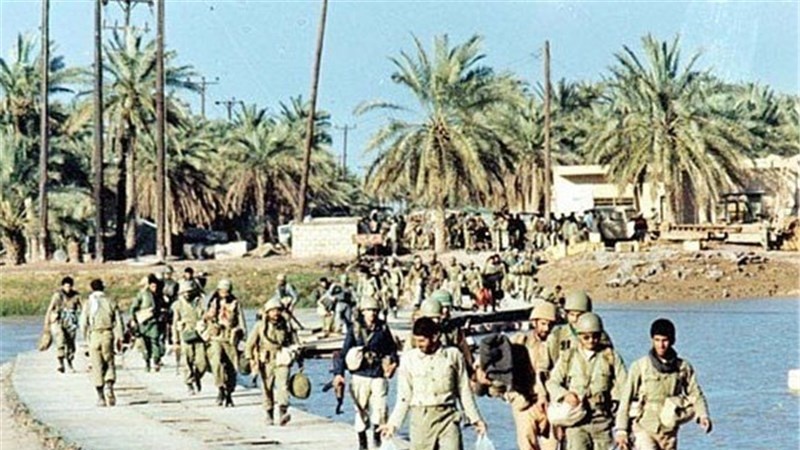
In the early years of post-revolution era; a lengthy and full-scale war was imposed on Islamic Iran. However, the 8-year imposed war, despite of its hardships and consequences, tested the endurance of the grand Iranian nation against difficulties, and was registered in history as a source of honor for Iranian people; thereby raising an opportunity for building an assuring future.
The Leader of Islamic Revolution, Ayatollah Seyyed Ali Khamenei, in an address to a number of high-ranking military and law enforcement commanders, referred to the Sacred Defense era as a source of honor for the grand Iranian nation, adding: "Although the material and moral costs of the Iraqi imposed war were high; the accomplishments of the Iranian people in the 8-year Sacred Defense, in comparison to the inflicted costs, were huge…the experience of the 8-year Sacred Defense proved that despite of all shortcomings, pressures, lack of finance, and numerous problems, one can stand up against the bullying and baseless expectations of the global powers… thanks to the steadfastness of Iranian nation in the 8-year Sacred Defense era; many influential figures and active minds in Islamic and non-Islamic countries developed a resolute belief in powerful defense with empty hands."
Throughout the 8-year Iraqi imposed war, the unity and solidarity of the Iranian nation against the enemies was displayed, with everyone including the Islamic Republic of Iran's Army, Islamic Revolution Guards Corps, Basij Mobilization Force, and law enforcement force firmly and powerfully standing up against the invading enemies.
The Iraqi imposed war, despite of its consequences, provided valuable experiences in many arenas, and has significantly contributed to building Iran's future. These experiences were partly applied in relation to the necessity to boost defense capacity, and deterrence power in the face of threats, which has led to significant progress in this domain.
In the post-revolution era, upon the break out of the imposed war, large-scale military sanctions were imposed by Eastern and Western states against Islamic Iran, such that even the sale of barbed wires and/or non-military goods which could have had military consumptions, to Iran, were obstructed. Concurrently, many military equipment purchased from the US, which were paid for, were also not delivered to Iran. One of the reasons that tempted the former Iraqi dictator, Saddam Hussein, to attack Iran, was the US illegally imposed sanctions on the Iranian nation, US unwavering support for Saddam Hussein, and their miscalculations about Iran's defensive power in the face of the former Iraqi dictatorial regime army's invasion.
In the pre-revolution era, the most significant achievement of Iran's defense industry was limited to assembly of light weapons. Iran's pre-revolution defense industry was even incapable of production of barbed wire.
In fact, in the pre-revolution era, in the presence of thousands of American missionaries, the administration of all of the army's affairs in different domains, including the defense industry, and even the repair and maintenance of weapons and equipment were under the authority of foreign powers, while Iranian engineers and experts were not allowed to take part in the repair and maintenance of purchased weapons and equipment. In fact, many facilities were off-limits to Iranian engineers and experts, in the pre-revolution era.
Meanwhile, the Founder of Islamic Republic of Iran, late Imam Khomeini (God's mercy upon him), from the early days of the Islamic Revolution, put emphasis on the high abilities of the Iranian nation, and on several occasions referred to sanctions and the imposed war as an exceptional opportunity for achievement of self-sufficiency. In one of his important speeches, late Imam underscored: The imposed war, economic sanctions, and the dismissal of foreign experts, was a divine blessing in disguise. Now, if the Islamic Republic of Iran's government and army, itself, imposes sanctions on the products of bullying and hegemonic powers, and boosts its innovative efforts, the country will hopefully become self-sufficient.
The Leader of Islamic Revolution, Ayatollah Seyed Ali Khamenei, has also put emphasis on this fact on several occasions.
The activities of the Islamic Republic of Iran's Armed Forces in technical and engineering fields, and production of military equipment and construction of military facilities by them took shape as of the break out of the imposed war. Ultimately, in the final years of the Sacred Defense, the defense productions of the combatants of Islam gradually developed and reached its peak with the production of the first short-range surface-to-surface missiles.
In the post-revolution era, Islamic Republic of Iran has attained a significant growth in production of ballistic and non-ballistic missiles, ultra-precise missiles, radar-evasive missiles, ultrasonic missiles, laser missiles, cruise missiles, and other types of missiles, and is ranked among the few superior countries that have mastered this technology.
Production of different types of short-range and long-range radar systems, and radar systems with ranges extending 1,000 kilometers, cyber and electronic war systems, development of telecommunication industry, and reinforcement and growth of optic industry are part of the praiseworthy measures that have taken place for attainment of military self-sufficiency in the post-revolution era, currently reaching the phase of exportation to other countries.
These achievements have been made in the post-revolution era in the Islamic Republic of Iran, while a significant part of these accomplishments are monopolized by a few advanced countries in the world.
The Islamic Republic of Iran's Armed Forces, including the Army, upon indigenization of the defense industry, have achieved self-sufficiency, which is of strategic significance when it comes to defensive deterrence.
Maintenance of military and deterrence power is in line with the conventional defense principles, and is the legitimate and legal right of all countries. Currently, Islamic Republic of Iran maintains deterrence and offensive power for removal of threats in the fields of aerospace, missile power, naval power, and within the ground force.
The Islamic Republic of Iran, upon the application of its imposed war era experiences, has boosted its military strength and the specialized capacity of its forces and equipment, in line with threats. The enhancement of these capacities show that Iran's Armed Forces are fully prepared to fend off different types of threats posed by the enemies.
Currently, Iran maintains the capacity to produce different types of weapons and military equipment, including a variety of planes, and various ultrasonic, radar evasive jetfighters, a variety of advanced drones, and advanced ballistic missiles, thereby turning into a strategic force for maintenance of security.
Progress in this domain has been to an extent that Iran has been enlisted among the five superior countries in the world in production of drones and has allocated the second global spot in manufacture of radar-evasive drones.
Currently, Iran's calm and security in a turbulent region, is one of the sources of honor of Islamic Republic of Iran, which is targeted by the arrogant powers.
The Leader of Islamic Republic of Iran, in his keynote remarks, has repeatedly elaborated on the main parameters of Iranian nation's power, underscoring that the goal behind the policy of deterrence power of the sacred Islamic system is that the global bullying powers would not dare to attack Iran. The Leader of Islamic Revolution added that the enemies should know if they think of any aggression against Iran, they will face a strong reaction.
MR/ME
Tags