Yalda, the longest night
Dec 21, 2019 05:59 UTC
The sunset of the 30th of the Iranian month of Aazar marks the longest night of the year. Iranians have been marking this occasion since old times. They call it Yalda. This night is celebrated with recitation of epic poems of Shahnameh or lyric poems of Hafez and Sa’adi. This is accompanied by eating nuts and fruits.
Ancient Iranians believed that on the longest night of the year the devilish darkness would perish and they would keep vigil till the sunrise of the next day that marked the first day of winter. They used to light fires till morning. Iranians would get together and enjoy themselves reading poems and recounting stories of the past.
The word Yalda is a Syriac word meaning birth and generation. Its connotation can be that of the sun’s birth after the longest night. Ancient Iranians maintained that on the night of Yalda, Mithra or Mehr would return to the world and make days longer. Thus, the sun would dominate over the earth once again. Yalda has also been called Shab Chelleh (Chelleh Night). Chelleh derives from Chehel meaning 40 in Farsi. According to the old texts there were Chelleh Bozorg (Big 40) and Chelleh Kuchak (Little 40 that was in fact 20 days). The first 40 days of winter were the Big 40 and the next 20 days constituted the Little 40. These two periods covered two months of winter.
Ancient Iranians sued to celebrate natural events such as Summer Revolution or climax of warmth in summer and Winter Revolution or the climax of cold in winter. Yalda has been marked in Iran till this day.
According to the Jalali Calendar (that began to be used for registering time since the 5th century AH), from the first of the Iranian month of Dey, i.e. the day following Yalda Night, days would become longer and that meant the death of the Demon of cold and birth of the sun. Yalda entered the Iranian calendar since in 502 BC, during the rule of Dariush I. The Winter Revolution is the start of winter and from then on, the days become longer and longer. This natural event has caused many ethnicities to hold feasts. Yalda has been marked from the Great Khorasan up to Kashmir. In Afghanistan, parts of Pakistan and north of India Yalda Night is called “Shab Chelleh-ye Kalaan” (The Big 40 Night). Tajik people mark this night with customs that resemble those of Iranians very much.
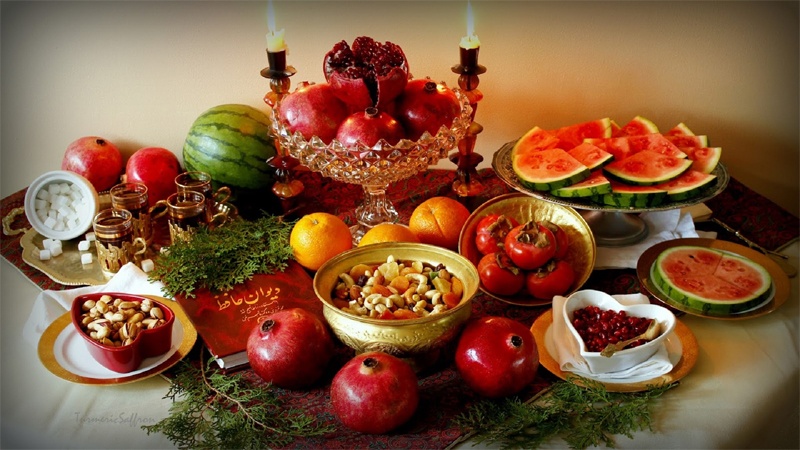
The nuts and fruits constitute the main part of Yalda Night customs. Women in different parts of Iran make the local pastries for that night. Pistachio, hazelnut, walnut, almond and so on are the inseparable part of Yalda nuts. Watermelon is also very common on this night. Pomegranate is another fruit of this table. Watermelon and pomegranate are served as they are red and red is the colour of life and vividness.
In the past, it was customary to eat snow lumps with grapes juice on Yalda Night. Other things that are usual on Yalda night include dried palm, apricot, peach, apple, fig, blackberry and raisin. As it was said in the beginning of the program, Shahnameh of Ferdowsi and the Divan of Hafez are usually read out by the elderly of the families at the table.
The customs of Yalda Night have undergone changes throughout centuries. Yet, what is of great significance in this ceremony is the fact that families and relatives gather together in the house of their grandparents and they recount them of the past. Visiting the elderly and sitting with them is highly recommended in Islam as it keeps the familial bonds firm and helps resolve problems. Moreover, it is a good opportunity for the youngsters to exchange experiences with the elderly and learn many things from them. Familial parties and gatherings have decreased in the west as family and parents have lost their real value and meaning. But, Islam puts high emphasis on familial bonds and respect for the elderly and kindness toward the youngsters. Yalda Night is a good opportunity to be together, share happiness and get familiar with each other’s problems.
RM/MG
Tags