The secret of tripartite drills: U.S. loses its influence in the region
Jan 01, 2020 18:31 UTC
The Islamic Revolution Guards Corps (IRGC) says Naval maneuvers jointly carried out by Iran, Russia and China in the Sea of Oman and the Indian Ocean have caused fear and horror among those countries attempting to undermine security in the region. Speaking to reporters on Monday Dec. 30, the IRGC Spokesman Brigadier General Ramezan Sharif said countries that care about regional security were pleased by the joint maneuvers.
Brigadier General Sharif added "The drills by the three big countries of Iran, Russia and China conveyed the important message of security in the region to regional countries."
Stay with us for an article in this regard written by Maryam Khormaei under the heading: "The secret of tripartite drills: U.S. loses its influence in the region." The article was taken from the website of Iran's English Language daily the Tehran Times.
With launching unprecedented drills alongside two world powers, Tehran has shown that it can overcome the efforts that aim to isolate Iran and push regional calculations into a new phase by resorting to the option of coalition.
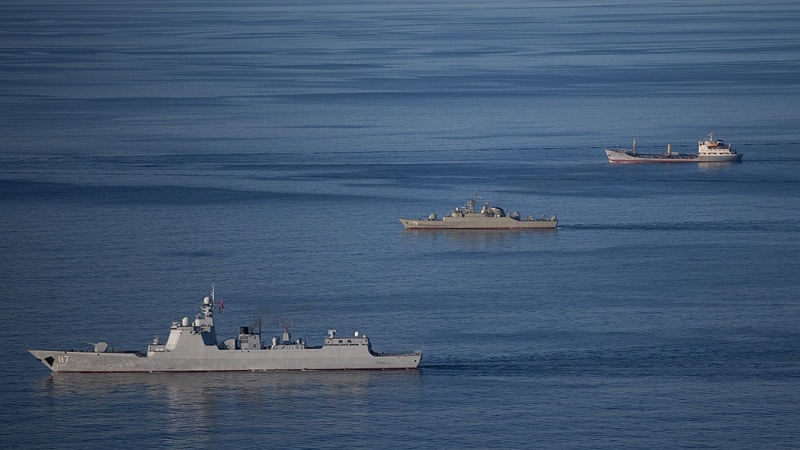
Since Friday Dec. 27, tripartite naval drills were going on in the Indian Ocean and the Sea of Oman by naval vessels from China, Russia and Iran.
The Sea of Oman is a particularly sensitive waterway as it connects to the Strait of Hormuz - through which about a fifth of the world’s oil passes - which in turn connects to the Persian Gulf.
The three countries are holding the four-day joint naval exercise, dubbed 'Marine Security Belt', under the slogan of boosting international security and trade, especially in the Persian Gulf and the Strait of Hormuz, the world’s main energy transit routes through which 18 million barrels of oil pass per day.
What was going on in the region's waters from Friday Dec. 27 to Monday Dec 30, 2019 can be seen as a response to Europe and the U.S. that in the past few months have formed two quasi-coalitions, under the pretext of securing energy transition, which were not welcomed by regional and trans-regional allies.
Iranian Foreign Minister Mohammad Javad Zarif stated in a tweet that the drills show the Islamic Republic’s commitment to secure vital waterways.
Meanwhile, Russia described the drills as unprecedented and in line with cooperating and training navies.
Chinese Defense Ministry Spokesman Wu Qian confirmed that the country’s Xining, a guided-missile destroyer, would take part in the drills.
However, China has made every efforts to dismiss the speculation that the drills as “alarming”, so the Chinese defense ministry spokesman stated that the drill was a “normal military exchange” between the three armed forces and was in line with international law and practices. The region has witnessed blasts at the Port of Fujairah in the United Arab Emirates, attacks on the Aramco oil facilities in Saudi Arabia and the formation of parallel coalitions.
It should be mentioned that in late November, China also launched a naval exercise with Saudi Arabia, indicating Beijing’s effort to flaunt its power to the U.S., without the partial support of the regional states.
In response to the joint Iran-China-Russia naval drills, the U.S. claimed that “we know and observe”. The Pentagon spokesman also reiterated the need for safeguarding freedom of navigation in the region.
During these years that Iran has been under sanctions, China showed that it was willing to maintain a strategic relationship with Tehran, despite all the threats. The fact is that China seeks to take power to challenge the U.S. global position and balance the distribution of power internationally.
China’s most bold move in the recent years is the establishment of its first overseas military base in Djibouti, which has a strategic position as it neighbors the Bab al-Mandab Strait and the Gulf of Aden and has a short distance to the Strait of Hormuz. The base is officially used as China's logistics supporter in anti-piracy operations.
China, on the other hand, is the largest exporter of goods and transports most of its cargo through sea, thus it insists on the security of its shipping lanes. Launching drills along with Iran not only provides China the opportunity to carry out is anti-piracy plans, but also allows it to showcase its military capabilities in the fields of resources and control of energy transmission lines.
At the same time, China’s presence in the Persian Gulf, while the U.S. navy has repeatedly challenged Beijing’s ownership claim over the South China Sea can be seen as a show of power to the US.
In the face of the US-European parallel coalitions in the Strait of Hormuz, Russia has presented a plan for collective security in the Persian Gulf aimed at establishing a security organization in the region with the participation of neighbors and the observation of permanent members of the Security Council.
The Russian plan has many similarities to Hormuz Peace Endeavor (HOPE) Initiative proposed by Iran, as it emphasizes the non-interference of the trans-regional states in the affairs of the Persian Gulf.
Since the Syrian crisis, Moscow has introduced itself as a key regional power in resolving West Asia disputes. At the same time, Russia, along with Iran and China, has been described as one of the challenges facing the U.S. in 2020, especially in West Asia, and this is a matter that David Schenker, U.S. Assistant Secretary of State for Near Eastern Affairs affirmed.
The Russians have essentially taken a series of measures to expand their deployment against the U.S., which stretches from Syria to the Persian Gulf, and not to allow the U.S. influence spread to the north of the Persian Gulf. Therefore, holding this exercise can be a way for Moscow to play a role and to highlight its presence.
It can be concluded that holding the drills, under the current circumstances that the U.S. and its regional allies are trying to isolate Iran, could be a real turning point for the Islamic Republic.
The new position that Iran has defined for itself was created months ago by downing U.S. drone and then seizing the British-flagged tanker Stena Impero, and will now be strengthened with such advanced drills. What political, security, and economic achievements await each of the three countries participating in the exercise will be determined over time.
ME/SS
Tags