JCPOA and possible scenarios
Oct 17, 2017 12:59 UTC
The US President, Donald Trump, has refused to certify JCPOA, in a move that shows Washington is rattled with Iran's commitment to the nuclear deal.
The US President, Donald Trump, in a measure which flies in the face of the demand and resolve of the international community, refused to approve Iran-5+1 Group nuclear agreement; and led the US Congress to make a decision about the future of this agreement.
Now all eyes are on the US Congress to find out what the decision of US lawmakers would be toward the agreement that is supported by the international community. Meanwhile, the topic of confirmation of the Joint Comprehensive Plan of Action by the US president or US Congress has nothing to do with the original document agreed by Iran and 5+1 Group member states. In other words, other than the International Atomic Energy Agency (IAEA), no country or organization is allowed to express its view about the commitment of Islamic Republic of Iran toward the obligations stated in the nuclear agreement. Nonetheless, the US Congressmen who opposed the Joint Comprehensive Plan of Action throughout Barak Obama's presidential term, in a bid to obstruct the implementation of this nuclear agreement, approved a law, according to which the US president is duty-bound to report Iran's commitment to Joint Comprehensive Plan of Action, to US Congress, once every ninety days.
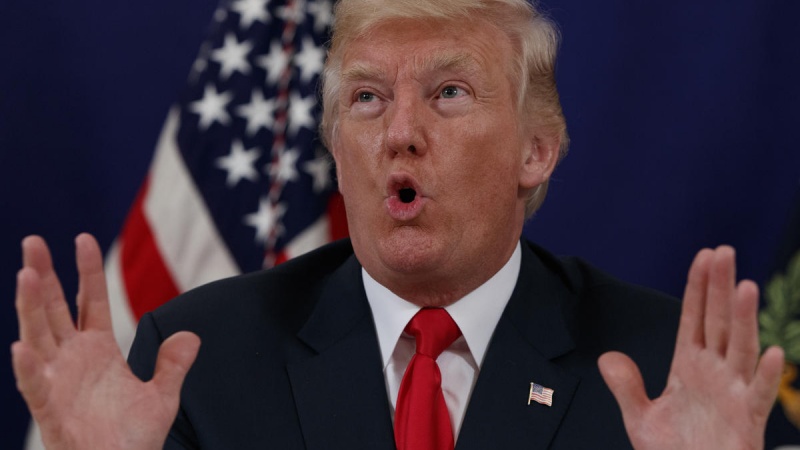
The US president, Donald Trump, in his blatant remarks against the Iranian nation on Friday announced that unlike the two previous occasions, this time he would not confirm Joint Comprehensive Plan of Action, while asking the US Congress to implement the changes that the Congress has taken into consideration in regard to this agreement. Based on such a stance, the raised question is what are the possible scenarios in regards to Joint Comprehensive Plan of Action?
One of the possible scenarios in regards to study of Joint Comprehensive Plan of Action at the US Congress, is the re-imposition of suspended sanctions, and the destruction of this nuclear agreement. The Iran Nuclear Agreement Review Act permits the US Congress to study the issue of suspended sanctions, and to possibly resume anti-Iran sanctions within maximum sixty days after the announcement of rejection of Joint Comprehensive Plan of Action by the US president. Within the framework of this act, it has been foreseen that study of this topic takes place regardless of the ordinary process of study of plans at the US Senate, and any decision in this regard is made with 51 votes, which marks a relative majority. Thus, the American senators can resume anti-Iran sanctions within a short period of time, and without any concerns in regard to attainment of the quorum of sixty-vote majority. Given that currently US Republicans maintain 52 seats, it is apparently not difficult for the opponents of this nuclear agreement to annul the suspension of sanctions, and to kill the Joint Comprehensive Plan of Action (JCPOA). However, the developments in the US in recent weeks have shown that the enemies of JCPOA still face a number of hurdles. For instance, in the previous days, a number of main opponents of this nuclear agreement at the US Senate declared their opposition to withdrawal of US from JCPOA. The Chairman of the Committee on Foreign Relations, Senator Bob Corker, who resorted to any means possible to deal a blow against JCPOA, throughout Barack Obama's presidential term, has announced that currently it is not appropriate for the US to withdraw from JCPOA. This stance has also been adopted by Ed Royce, head of the US House Committee on Foreign Affairs. Furthermore, the radical anti-Iran Senator, Tom Cotton, announced at the US Congress that currently he will not vote in favor of a ratification which would kill Joint Comprehensive Plan of Action. Hence, attainment of 51 votes at the US Senate in order to kill JCPOA will not be an easy task as such, because US Congress seems unwilling to take a step against the international community's resolve.
If the US Congressmen would not intend to kill JCPOA within the sixty-day deadline, a number of other scenarios would exist. These scenarios cover a wide range from changing the text of Joint Comprehensive Plan of Action to changing US domestic rules and regulations. One of these scenarios would be efforts to change Iran Nuclear Agreement Review Act. This act instructs the US president to report to US Congress on Iran's commitment towards JCPOA, once every 90 days. In the past nine months, the US president, Donald Trump, has faced this duty three times, confirming Iran's commitment to JCPOA twice in the previous months of April and July. Nonetheless, media close to White House have declared that the US president is mainly displeased with the confirmation of JCPOA, which is the legacy of the Obama administration, once every ninety days. Therefore, the senior officials of Trump administration have begun their consultations with the leading Congressmen for changing this act, as of several weeks ago. The recent verbal attacks of Trump against Bob Corker, aimed to achieve this demand so that one of the two founders of Iran Nuclear Agreement Review Act would ultimately favor a change in this law. It is said that Trump intends to liberate himself from his challenging task, once and for all, by rejection of Joint Comprehensive Plan of Action. The other possibility is that the 90-day deadline on presentation of White House reports to US Congress would be extended to a 180-day deadline so that the US administration would have sufficient opportunity to pursue numerous internal and external problems. However, it seems that extension of the deadline on presentation of reports by White House, would not dispel US president's concerns. In the meantime, a number of US Congressmen believe that Donald Trump is duty-bound to inform the US Congress on the process and trend of implementation of Joint Comprehensive Plan of Action; in accordance to US laws. Thus, based on a number of assessments, attainment of the 60-vote quorum at the US Senate in order to change Iran Nuclear Agreement Review Act will not be easy, especially given the disputes between Donald Trump and Senator Bob Corker.
Meanwhile, a number of Congressmen have presented a number of plans for changing the content of JCPOA. One of these plans, have been presented jointly by Senator Bob Corker, and Senator Tom Cotton. This plan intends to somehow perpetuate Iran's restrictions within Joint Comprehensive Plan of Action. The senators, who are in line with Donald Trump, intend to perpetuate these restrictions by piling up pressures on Iran, and the European and international parties to JCPOA talks.
Meanwhile, Iran and the negotiating 5+1 Group parties, with the exception of the US, have rejected another round of talks, and the US Congress cannot force other countries to renegotiate. Moreover, these measures which can deal a major blow against the continuation of JCPOA, probably won't be supported by the Democrat Minority at the US Congress. The Republicans, without the support of at least eight Democrat or independent senators, would not be able to approve their needed laws. In the meantime, Trump has threatened that if the US Congress or the international community would not support his administration, he may ultimately announce US withdrawal from the nuclear agreement with Iran, and the destruction of this accord. This stand may press some of the supporters of JCPOA at the US Congress to cooperate with White House, and may press them to vote in favor of plans considered by Trump, in order to rescue this nuclear agreement. However, entry to additional JCPOA talks goes beyond the unilateral resolve of White House and US Congress, and there would be no guarantee on fulfillment of US illegal demands. This fact has intensified disputes among the US Congressmen.
Meanwhile, the US Congressmen will certainly be impacted by the overwhelming support of the international community for JCPOA, and may not even submit to the anti-JCPOA current, led by Donald Trump. However, even if the US Congress would take steps to undermine or kill Joint Comprehensive Plan of Action, the US would face the reaction of Islamic Republic of Iran; which is the main factor that prevents US officials from killing the Joint Comprehensive Plan of Action.
MR/EA
Tags