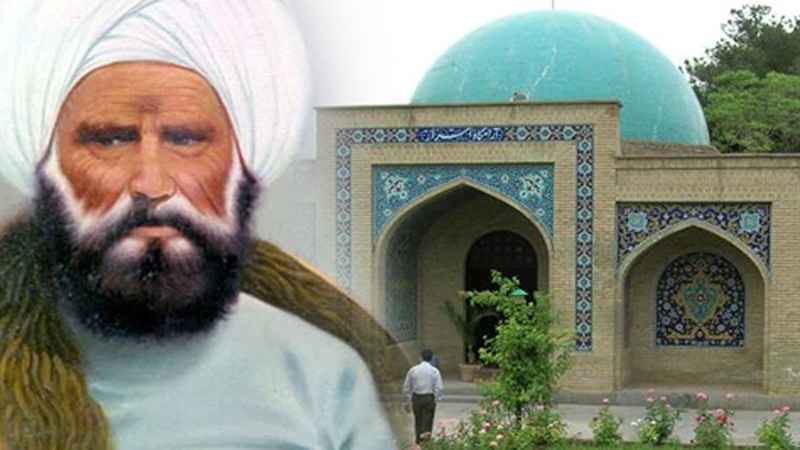
Molla Hadi Sabzevari, Great Philosopher of the East
Feb 27, 2018 05:54 UTC
Since very old times Iran has played a significant role in the development and sustainability of various sciences. The vast ocean of knowledge in Iran and Islamic wisdom and philosophy has a prominent and longstanding position in the history of philosophy.
In this expanse of knowledge, the great Iranian Muslim philosophers shine like stars in the field of wisdom and thought. The great philosopher of the East, Molla Hadi Sabzevari exerted his utmost for years to revive Islamic philosophy and transcendental wisdom and, by explaining and elucidating important philosophical issues, he became the lamp of scientific and academic schools of Iran and the world.
Molla Hadi Sabzevari known as Hakim Sabzevari, the great Shia philosopher was born in Sabzevar in 1212 AH. His father Haaj Mirza Mahdi was a very pious man in Sabzevar. Hakim Sabzevari was 8-year-old when he started preliminary studies and, in early adolescence, he learned Arabic literature. Soon he found his way to higher education and then set out for the seminary of Mashhad where he lived for 10 years. Molla Hadi Sabzevari also attended the seminary of Isfahan. He stayed in Isfahan for 8 years. During this time, He acquired much of the knowledge of the time, and under the auspices of great scholars, new horizons were opened ahead of him in the domain of wisdom. After that, Molla Hadi returned to Mashhad in 1242 AH and engaged in teaching. The French philosopher, Count Joseph Arthur de Gobineau, stated about Hakim Sabzevari, “He has catapulted into fame so much so that many students from India, Turkey, and Arabia have come to Sabzevar to benefit from his knowledge and study at his school.”
Apparently, Molla Hadi Sabzevari does not have an independent philosophical school and deals mostly with the explication of the philosophical theory of Molla Abdul Razzaq Lahiji and Molla Sadra, but his Manzumeh as one of his important works, is the most comprehensive book accommodating logic and wisdom. In the section of wisdom which Hakim Sabzevari calls "Ghorar al-Faraed", he has written over 1000 couplets whereby he examines important philosophical issues. Since this section has replete with philosophical nuances, he later embarks on its elucidation. The other part of the book is on logic. The name of this section is "Al-La'ali al-Montazama". In this section, he has composed more than 300 Arabic couplets on the most intricate topics of logic. And since these poems are also very complicated, he has explained the couplets that have been published under the title “Sharh Al-La'ali Montazama.”
Japanese thinker and author of many books on Islam and religion, Professor Toshihiko Izutsu writes: Haaj Molla Hadi Sabzevari is a thinker whose famous work is "Sharhe Manzoumeh". He has been unanimously called as the greatest Iranian philosopher in the 19th century. At the same time, he was the top mystic of the era, too. Martyr Ayatollah Morteza Motahhari also writes about him: "Haaj Molla Hadi Sabzevari, after Molla Sadra, is the most renowned divine scholars of the recent 3 and 4 centuries. His reputation spread across Iran and abroad.
Seekers of wisdom rushed to him from everywhere. The city of Sabzevar, blessed by this precious sage, like a magnet absorbed the seekers of divine wisdom from all over the world. Hakim Sabzevari taught fervently and his manner of teaching was very sweet and attractive. In addition to his high scientific position he enjoyed lofty grades in cognizance of God. Moreover, he was very orderly and disciplined and a traveler of the path of God. In terms of the love of the teacher and the student, Hakim Sabzevari was unique. Some of his disciples, despite forty years of separation from him, would shed tears while reminding him. "
Once, after the hajj pilgrimage, he arrived in Bandar Abbas via the sea route and, as the roads were unsafe, he was reluctant to go to Sabzevar and stayed in Kerman. Then he worked at Ma’soumiya seminary of Kerman for a long time and cooperated with the janitor incognito. The students thought that he was a servant. So they were with him days and nights without knowing how erudite he was! He served them for a long time. But little by little his personality was revealed to sharp students. So, they found him an expert in various sciences. Afterwards, enthusiasts of knowledge and wisdom thronged around him and Hakim Sabzevari formed a course of scholarly topics in the seminary of Kerman and stayed there for a while.
Molla Hadi Sabzeviari had a vineyard that he would reap every year during the harvest season. First he would give the share of the needy and then invite his friends along with the students of seminaries to join him in consuming the product. In other words, the great Iranian philosopher used his wealth and property and donated the rest of it. Hakim Sabzevari considered association with the poor and the lower classes of the society a great opportunity. He led a very simple life and paid no attention to the nobility even the king.
The Qajar king Nasser -eddin Shah, on the way to Khorasan, was welcomed and seen off by different strata of people whenever he arrived in a city or left; till he arrived in Sabzevar. Here, many dignitaries and officials came to him. The only one who, under the pretext of isolation, refused to welcome the king was the well-known philosopher and gnostic, Molla Hadi Sabzevari. The only person whom the Shah wanted to see in his journey to Khorasan was this man whose reputation had prevailed Iran and abroad.
One day, the king went to the house of Hakim Sabzevari only with a servant. It was a small house with very simple appliances. The king said: "Every blessing has a thanksgiving. Teaching and guidance is a thanksgiving for knowledge, thanksgiving for wealth is spending, thanksgiving for monarchy is to meet the needs of others. So I want you to ask me something to do for you." Molla Hadi answered: "I have no need. I don't want anything. The king said: "I heard you have a farmland. Let me order the land to be exempted from tax."
Molla Hadi replied: "The government's tax office knows how much to get from every city. The basis cannot be altered with petty changes. If they do not receive tax from me in this city, they will receive the same amount from others, so that the amount to be collected from Sabzevar will be completed. The king is not satisfied that my exemption from tax will impose taxes on orphans and widows."
Nasser -eddin Shah said: "I want to eat your food today and eat the same thing that you eat every day. Tell them to bring the lunch."
So Hakim Sabzevari put his food in front of the king. There was a wooden chair with a few pieces of bread and a few spoons and a dish of yogurt and some salt on it. Then he told the king: "Eat the bread that is halal. The cultivation and the pairing of it is my own gain."
The king ate a spoon, but he was not used to such a food and he could not eat. He asked Hakim Sabzevari to put some of that bread in a cloth and take it along with him as a blessing. After a while, the king left Hakim’s house in bewilderment.
Hakim Sabzevari left behind scores of precious books, the works that after two centuries have spread in all the circles of science and knowledge. The collection of logical and philosophical topics, titled Sharh-e Manzumeh, besides the boundless knowledge of Molla Hadi Sabzevari's in the field of wisdom, logic and philosophy, indicates his capability in Farsi and Arabic literature. Sharh-e Manzumeh has been one of the best textbooks in the transcendental wisdom, and has been taught by many great scholars and professors of philosophy and Gnosticism. His other works include “Asrar al-Hekam”, “Asrar al-Ebad” and “Jabr Va Ekhtiyar”.
Hakim Sabzevari died on 28th of Zilhijja, 1289 AH. With tears in their eyes, people of Sebzevar and other cities took part in his funeral procession and he was buried outside the entrance to Sabzevar which used to be called Darvazeh Neishabur (Gate of Neishabur).
FK/MG
Tags