Path towards Enlightenment (899)
Jul 03, 2020 00:53 UTC
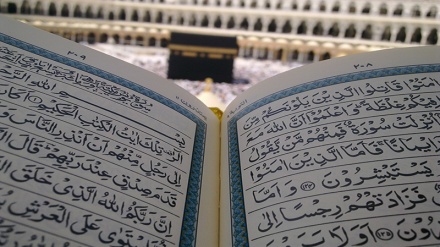
Salaam and welcome to another episode of our weekly series titled “Path towards Enlightenment” which is an endeavour to make you and us familiar with an easy and fluent explanation of God’s Final Scripture to all mankind, the holy Qur’an, which was revealed to the Last and Greatest of all Messengers, Prophet Mohammad (blessings of God upon him and his progeny).
Last Friday we ended the explanation of Surah Shura and today we begin the next Surah, that is, Surah Zukhruf, the 43rd in serial order. The Surah, which has 89 Ayahs, was revealed (except for Ayah 45) in Mecca. Its title is derived from Ayah 35 where the word “zukhruf” is mentioned. It means ornaments of solid gold, and other precious commodities, which though valuable to the Godless are actually not more than trinkets of the transient life of the mortal world, since what God has promised to the believers in paradise, are far finer and everlasting. Main issues discussed in this Surah include the holy Qur’an and prophethood; arguments substantiating monotheism in its purest form, a depiction of afterlife, the campaign of the prophets against polytheism, and the refutation of the claim that Prophet Jesus is a godson.
Surah Zukhruf also begins with the Arabic alphabets “Haa” “Meem”. For the information of our listeners, it is the fourth of seven consecutive Qur’anic Surahs known in plural form as “Hawameem” for beginning with these two letters (that is, “Haa” and “Meem”). The other Surahs of this series are the three previous ones, that is, “Ghaffer”, “Fussilat” and “Shura” – whose explanation we finished last week – and will be followed in serial order by “Dukhaan”, “Jathiya”, and “Ahqaaf”. According to a hadith from the Prophet “Hawameem” constitute the gist of the holy Qur’an, and this series is known as the Crown of the Qur’an and its fragrant flowers.
Stay tuned please for explanation of Ayah 1, 2, 3, and 4 of Surah Zukhruf
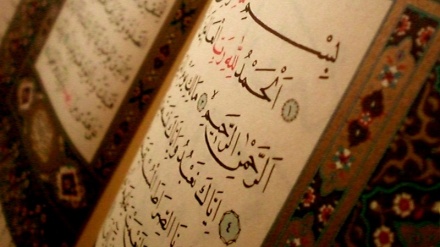
In the Name of God the All Compassionate the All-Merciful
“Haa, Meem,
“By the Manifest Book:
“We have made it an Arabic Qur’an so that you may apply reason,
“And indeed it is with Us in the Mother Book [and it is] surely Sublime and Wise.”
If you might recall, as we said at the beginning of “Surah Baqarah”, as well as the Surahs “Aal-e Imran”, “A’raaf”, “Younus”, “Houd, “Ibrahim”, “Shua’ra”, “Ankabout”, “Yaseen”, etc, 29 Surahs of the Holy Qur’an start with the “Horoof Muqatta’at” or seemingly unarranged alphabets whose meaning is known only to God and His Prophet, although some exegetes have tried to interpret them. Surah Zukhruf is thus one such Surah beginning with the letters “Haa” and “Meem” in the first Ayah.
The next Ayah indicates the Divine Oath taken by God on the matchless contents of the Manifest Book. In other words, the characteristics of the holy Qur’an as a Heavenly Scripture include its manifest and illuminating contents that emanate from Divine Omniscience. Its form and contents in eloquently flawless language and timeless wisdom are superb and inimitable by any human.
Ayah 3 refers to the medium of Arabic chosen by God for the holy Qur’an, since its first addressees were the Arab people, although it was not produced by the Arab mind and does not belong to the Arab race, since its contents are understandable for all human beings who apply reason. One of the grounds behind Revelation of the holy Qur’an in the Arabic tongue is that it is the most eloquent and the most comprehensive language. Eminent philologists and linguistic experts agree that Arabic rests on comprehensive and precise rules possessing the capacity to convey the most intricate and significant points and issues. To be more precise, the holy Qur’an is the Eternal Miracle of the Prophet of Islam, and was revealed at a time when the Arabs used to take pride in the purity and comprehensiveness of their language, yet they were, and still are, unable to produce even a semblance to any of its sentences, let alone a phrase or a Surah. It is needless to say that those familiar with eloquent Arabic may comprehend the eloquence of the Qur’an, yet despite knowledge and the sense of understanding, many put shutters on their senses in order to deny it, as was the common reaction of obdurate disbelievers throughout history towards the messages of the Prophets.
Thus, unlike those who claim that the holy Qur’an is the word of the Prophet of Islam, it is the Revealed Word of God and its original form is with the Almighty Creator in the Mother book, as the next Ayah elaborates, meaning to say that prior to its Revelation to the Last and Greatest of all Divine Messengers, the holy Qur’an had been recorded in the “Omm al-Kitab” or the Mother Book, namely the “Lawh al-Mahfouz” or the Eternally Preserved Tablet in Divine Presence. In short, the holy Qur’an in view of its logic and reasoning which are consistent with intellectual proofs and arguments that cater to the changing needs of mankind and anticipate scientific discoveries, abrogates all previously revealed heavenly scriptures, such as the Torah to Moses, and the Evangel to Jesus (peace upon them), whose contents like the books of all other religions were distorted by their followers.
From these Ayahs we learn that:
- The holy Qur’an has such a lofty status that God Almighty Himself takes an oath by it.
- The medium of language is necessary for any book, and God’s choosing of Arabic for the holy Qur’an was because of the comprehensive nature of this particular tongue, and not any preference for the Arabs, who have never been praised in this Heavenly Scripture, which actually questions their claim to faith in several Ayahs.
- The holy Qur’an was committed to memory right from its revelation to the Prophet, unlike the previously revealed scriptures whose contents were tampered with in subsequent generations.
- Islam is based on logic and reason, and God records everything precisely.
Now let us listen to ayahs 5, 6, 7, and 8 of this same Surah:
“Shall We withhold from you unconcernedly the Reminder (that is, the holy Qur’an), because you are a profligate lot?
“How many a prophet We have sent to the ancients!
“There did not come to them any prophet but that they used to deride him.
“So We destroyed those who were stronger than these (pagan Arabs), and the example of the ancients has passed.”
Ayah 5 is a rhetorical question by God to the disbelievers, and means to ask: “Are We supposed to leave you in your ignorance by taking away the Reminder, namely the holy Qur’an, from you so that you may be deprived of such a great Divine Favour because of your transgression of bounds, and persistence in disbelief and error? In other words, despite the disbelievers’ turning away from His Message, the Almighty Creator provides humanity with everlasting Grace and innumerable Favours to help them discover Divine Guidance.
The next two Ayahs addressing the Prophet of Islam serve as a consolation to him and a warning to the disbelievers by saying that God Almighty sent many a prophet to the nations of the past, who transgressed the bounds and mocked them, and even killed them. As a result of such blasphemy, Ayah 8 says the powerful nations of the past were destroyed, and this means the Arabs and other disbelievers should ponder on the fate of predecessors that ought to serve as a lesson for all.
These Ayahs teach us the following points:
- Religious leaders shouldn’t be disappointed when facing hurdles and hardships.
- Believers should never be shaken because of being ridiculed by disbelievers, and should stand firmly like the prophets.
- Divine punishment is not always deferred to the Day of Judgement and at times befalls in this world on those whose sins have exceeded all limits.
Now listen to Ayahs 9 and 10 of Surah Zukhruf:
“If you ask them, ‘Who created the heavens and the earth?’ they will surely say, ‘The All-Mighty, the All-Knowing created them.’
“He, who made the earth a cradle for you and made in it ways for you, so that you may be guided [to your destination];”
These Ayahs mean to say that even the polytheists admit that the One and Only God as the Creator of the entire universe, yet out of ignorance and the failure to make proper use of their intellect, they indulge in the worship of idols and objects as partners of God. This is indeed a cardinal sin, since as the next Ayah means to say, proper reflection on the world in which we live and its bounties that we use, is enough to awaken our conscience that all this wonderful creation is the handiwork of God, Who has no need of partners or associates. The All-Merciful has bestowed these innumerable blessings in order to guide us to the straight and unwavering path. God has made the earth a cradle for mankind and this similitude is a reference to the rotation of Planet Earth on its axis as it orbits around the Sun to help determine days, nights, months, seasons, and year. Astronomers of the past had thought the Earth was motionless while it was the Sun which rotates around our Planet, but the holy Qur’an disproved many of their views as modern science is only beginning to discover. This is indeed one of the miracles of the holy Qur’an.
From these Ayahs we learn that:
- The cognition of God is in the innate nature of mankind, though many err.
- Reflection on Divine bounties awakens our conscience.
- God has placed means of guidance in the world of nature and proper pondering helps us attain the bliss of paradise and escape from hell.
RM/AS/SS
Tags