Muharram mourning traditions in different lands - 12
Oct 27, 2016 11:28 UTC
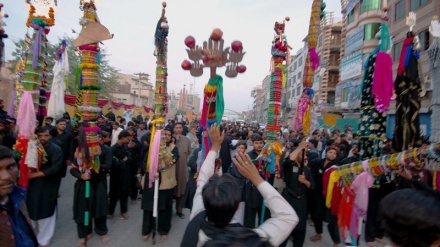
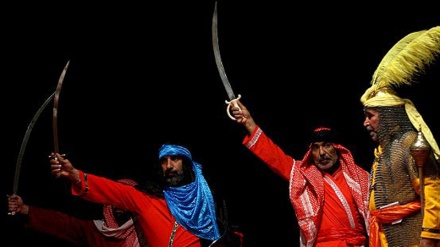
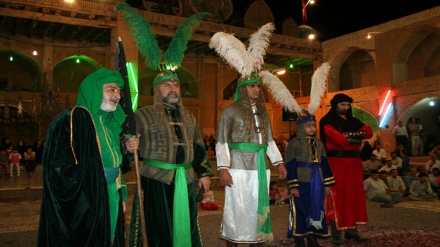
In this series, which delves into the various mourning traditions associated with the Immortal Epic of Ashura in various lands, we look at the earliest history of mourning for Imam Husain (AS).
Yesterday we described the mourning ceremonies for the martyrs of Karbala in Fatemid Egypt, and today we will focus on Iran, where as we said in one of our earlier episodes that the Buwaihid dynasty commemorated the tragedy of Karbala with public holidays in Baghdad, Iraq. The historian Ibn al-Athir when reporting the events in Baghdad for the year 352 AH, corresponding to 963 AD, has described the occurrence of public lamenting demonstrations by men and women dressed in black garments.
Adhud od-Dowla, perhaps the greatest of the Buwaihids, reconstructed on a grand scale the shrines of the Infallible Imams in Iraq, and that of the other prominent martyrs, such as Abu’l-Fazl al-Abbas (AS), and of Horr ar-Riyahi, the Omayyad commander who had initially stopped Imam Husain (AS) in Karbala, but on the day of Ashura rued his decisions, crossed over to the Imam’s side, repented and courted martyrdom in combat.
During the century long rule of the Buwaihids in Iraq and Iran, the mourning processions, rituals, the beating of chests in grief, spread throughout these lands and beyond into neighbouring northern Syria, where Aleppo was the capital of the the Shi’a Muslim Hamdanid emirate. Many Iranian and Arab adherents of the School of the Ahl al-Bayt were attracted to the Hamdanid courts in Aleppo and Mosul, including poets who composed elegies on the martyrs of Karbala.
Meanwhile, in Iran and Iraq, the Seljuq Turks, who were new converts to Islam and had ended the Buwaihid Iranian dynasty, initially suppressed the Muharram gatherings, but towards the end of their rule, these assemblies had been greatly revived in Iraq and Iran. The noted Seljuq vizier, Nizam ol-Molk Tousi, it is said paid his respects at the shrines of the Imams, although he claimed he was a Sunni Muslim following the Shafei school of jurisprudence. Later, when the non-Muslim Mongols who sacked Baghdad, they stayed away from the holy cities of Najaf and Karbala.
Soon after establishing the Ilkhanid dynasty in Iran, when the Mongols embraced the truth of Islam, they realized the impact of the mission of Imam Husain (AS) and how it inspires human beings to safeguard their honour, dignity, freedom, and humanitarian values. Sultan Oljeitu Khodabanda, the 8th ruler of the Mongol Ilkhanid Dynasty of Iran and Iraq, who died in 1316 AD, was the first ruler to proclaim the school of the Prophet's Ahl al-Bayt or Shi'a Islam as the State Religion.
This happened after his lengthy debates with the ulema of the various schools of jurisprudents, such as Hanafi, Shafei, Hanbali, and Maliki, whose viewpoints he found unconvincing, and even thought of reverting to the Buddhist faith of his ancestors, when he met the great Imam scholar, Allamah Hilli. Oljeitu was now convinced of the truth of Islam, and subsequently paid a visit to the holy shrines in Iraq, and ordered their reconstruction.
The Sarbedaran Movement in Khorasan carried on the rich tradition of the mourning ceremonies of Muharram in Iran. In fact, it was Imam Husain (AS) who inspired them to resist tyranny and rise up materialization of the rights of the people. The message of the Prophet's grandson knew no boundaries and was spread in Syria, Iraq and Anatolia, or what is now Turkey.
The traditions of the Azadari or mourning ceremonies of Muharram, established by the Sarbedaran Movement, were continued by the new wave of conquerors from Central Asia, the Timurids. Although Sunni Muslims, the Timurids were conscious of the position of the Ahl al-Bayt in Islam and it was in their times that the mourning ceremonies which we call Rowza or Rowza-Khwani in Iran, Iraq, and Afghanistan, started in Khorasan, deriving their name from the Persian book "Rowzat-ash-Shohada" or the Garden of Martyrs, written by Mullah Hussain Wa'ez Kashefi in Herat. Although not an authoritative book, the contents of Rowzat-ash-Shohada became popular in the subcontinent and blended with the Indian Muslim culture. the heritage of Karbala that was preserved by the Arabs of Lebanon and Iraq and by the Turks of Azarbaijan, especially the Qara Qoyonlus who for almost a century ruled a large kingdom including parts of Iraq and Iran.
At the same time, the Qara Qoyonlu Turks, who ruled Iraq, western Iran and parts of what is now Turkey for almost a century, and who greatly contributed to the expansion of the shrine of Imam Husain (AS), popularized the Muharram rituals. The Qara Qoyounlus were Shi’a Muslims, and their mourning ceremonies were later picked up by the Safavid Dynasty, who made Shi’a Islam the state religion, and elaborately conducted the mourning ceremonies, of which we will speak in our tomorrow’s episode.
MD/AS/SS
Tags