Muharram mourning traditions in different lands - 14
Oct 29, 2016 06:31 UTC
Welcome to the 14th part of the 40-plus episodes of a new and interesting series titled “Muharram mourning traditions in different lands” that we started broadcasting as of October 15 on a daily basis, to commemorate the heartrending tragedy of Karbala, and the martyrdom of Imam Husain (PBUH), the grandson of Prophet Mohammad (Blessings of God upon him and his progeny).
In this series, which delves into the various mourning traditions associated with the Immortal Epic of Ashura in various lands, we look at the history of mourning for Imam Husain (AS).
Yesterday, we discussed how the Muharram mourning ceremonies were institutionalized by the Safavid monarchs of Iran, who personally participated in the assemblies and promoted throughout the length and breadth of their realm. Rather these ceremonies spread beyond the borders of Iran, especially into the Subcontinent, where Persian culture thrived, and in particular in the southern part of India knows as Deccan, where Shi’a Muslim dynasties were established. Speaking of the impact of the tragedy of Ashura on non-Muslims, it would be interesting to take note of an account in the Subcontinent that claims not just a direct connection with Imam Husain (AS) but says a group of Indians were in Karbala on the Day of Ashura and later supported Mokhtar ibn Abu Obaida's uprising to avenge of the blood of the Prophet's grandson. Perhaps the most interesting case of Hindu veneration of Imam Husain (AS) is to be found among the small Husaini Brahmin sect, located mostly in Punjab state in India, also known as Dutts. The Dutts believe that the wife of Imam Husain (AS), the Persian princess Shahr Banu (SA), had a relative named Mah Banu, who was married to King Chadragupta of India, who on learning that the Godless tyrant Yazid was adamant on confronting the Prophet's grandson, dispatched some soldiers to assist Imam Husain (AS). By the time the Indians reached Iraq, the Imam had been martyred. In the city of Kufa, the Indians met Mokhtar, who arranged for their stay a locality of the town, which is known till this day as Dar al-Hindiyya or ‘Indian Quarter’. Some Dutt Brahmins joined Mokhtar to avenge the death of the Imam. They stayed behind in Kufa, while the rest returned to India, where they became known as Husaini Brahmins. Although they did not convert to Islam they have kept alive the memory of their links with Imam Husain (AS). They believe the martyrdom of the Prophet of Islam’s grandson had been foretold in the sacred Hindu book Bhagwad Gita. They thus observe the Muharram mourning ceremonies every year in their own particular ways.
According to historical accounts, among the first formal adherents to the path of the Ahl al-Bayt in India was one of the Rajahs of Gujarat who was in correspondence with Imam Ja'far Sadeq (AS), the 6th Infallible Heir of Prophet Mohammad (SAWA). The first communities of the followers of the Ahl al-Bayt sprang up in Sindh and Punjab, and later in Kashmir. In Deccan, or south India, which was in direct sea contact with Iran, Iraq and Yemen, Shi'ite Muslims entered the country as traders, scholars, and artists, and subsequently spread the message of Imam Husain (AS). The kings of the Bahmani Sultanate that ruled the Deccan became receptive to this liberating message of Karbala, especially after the famous Iranian mystic of Kerman, Shah Ne'matollah Wali, sent his grandson to their court in Bidar. A large number of Iranians migrated to the Deccan and some of them rose to prominence as ministers, governors and statesmen. When the Bahmani Sultanate disintegrated, three of the kingdoms that emerged were staunch followers of the Ahl al-Bayt, deeply attached to Imam Husain (AS). These were the Adel Shahis of Bijapur, the Nizam Shahis of Ahmadnagar, and the Qotb Shahis of Golkandah who founded the city of Haiderabad, which is today the main centre in southern India for commemorating the mourning ceremonies of the month of Moharram.
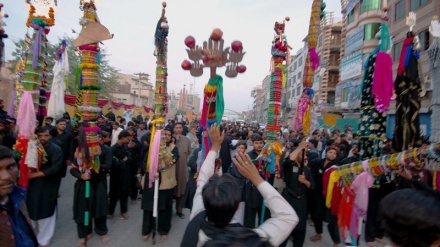
The Qutb Shahs who ruled most parts of Deccan from 1510 till 1687 AD, and founded the city of Haiderabad, were a branch of the Qara Qoyounlu Turks of Hamedan, western Iran, and therefore Muharram was of great importance to them. They celebrated it with great enthusiasm and devotion. There are accounts of Muharram mourning assemblies of Abdullah Qotb Shah's period, recorded by Mirza Nizamuddin Ahmed in the book "Hadiqat as-Salateen". The Muslims and even non-Muslims throughout the Qotb Shahi kingdom raised Alams during the Muharram days in their Hussainiyahs, which are known as Ashour Khana. The Qotb Shahs not only patronized Marsiya or elegy writing, but themselves wrote Marsiyas in both Persian and Dakhni, which later evolved into the Urdu language. The Marsiyas were written to fulfill the religious duty and to identify oneself with the martyrs of Karbala. Therefore, they express deep devotion and sorrow of the poet. The Marsiyas of Mohammad Quli Qotb Shah are on the pattern of the style set by the Safavid poet of Iran, Mohtashem Kashani. This shows the cultural exchanges between the two regions. The Qotb Shahs universalized the traditions and customs around the religious ceremonies, to help the people of their kingdom to participate in them, irrespective of their religion, caste or creed. We have details of Azadari in some Qotb Shahi villages and the Marsiyas written by the Telugu poets as well. The extent to which the Qotb Shahs were successful in universalizing the Azadari and converting Karbala into a symbol for devotion to truth and piety can be assessed by the fact that even the tribes living in remote parts of the kingdom participated in it with complete devotion and faith, of course, the way in which they performed the ceremony differed from tribe to tribe, depending on their cultural background. The Qotb Shahis universalized the social customs associated with azadari. They knew that neither the non-Muslims could be brought into the mosque and invited to participate in the prayers, nor the Muslims could participate in the prayers inside the temple. So they built the Ashur Khanas (Hussainiyahs) in which people could be brought together and allowed to participate in the ceremonies according to their own ways. The commemoration of Azadari founded by the Qutb Shahs and established in every part of their kingdom have become a tradition of the people, and still exist to this day, The Padshahi or the Royal Ashur-Khana, built in Iranian style was the principal Hussainiya that still stands today for the past 400 years.
MD/AS/ME
Tags