Muharram mourning traditions in different lands - 21
Nov 05, 2016 04:38 UTC
Welcome to the 21st part of the 40-plus episodes of a new and interesting series titled “Muharram Mourning Traditions in Different Lands” that we started broadcasting as of October 15 on a daily basis, to commemorate the heartrending tragedy of Karbala, and the martyrdom of Imam Husain (PBUH), the grandson of Prophet Mohammad (Blessings of God upon him and his progeny).
In this series, which delves into the various mourning traditions associated with the Immortal Epic of Ashura in various lands, we look at the history of mourning for Imam Husain (PBUH).
The Father of the Islamic Revolution, Imam Ruhollah Khomeini (May his soul rest in peace) had said: “The memory of this great epic event (of Ashura) must be kept alive. Remember, the cries of damnation and all the curses that are rightfully raised against the cruelty of the Omayyad rulers towards the Infallible Imams. These are reflected in the heroic protests against cruel despots by nations over the past centuries. It is the perpetuation of such protests that shatter oppression and cruelty. It is necessary that the crimes of the tyrants in each age and era be focused upon in the cries of lamentation and in the recitals of elegies held for the Infallible Imams.”
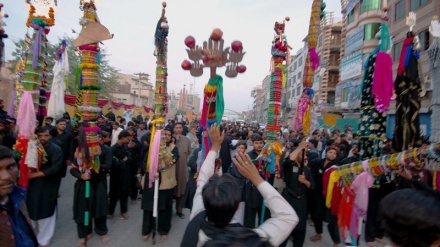
What you heard were the words of Imam Khomeini who by following the path of Imam Husain (AS) led the Islamic Revolution to victory in Iran and totally changed world equations. He used to say that the azadari or life-inspiring mourning ceremonies for the immortal Martyrs of Karbala should be kept alive in the months of Moharram and Safar. Over the past centuries the followers of the Ahl al-Bayt all over the world have kept alive azadari for two months, postponing all forms of festivities including national anniversaries and nuptials. In the Subcontinent, the faithful commemorate the martyrdom of Imam Husain (AS) for another 8 days, that is, till the 8th of Rabi al-Awwal, the day of martyrdom of Imam Hasan Askari (AS), the 11th Infallible Successor of Prophet Mohammad (SAWA). In other words, these Majales-e Aza in India and Pakistan last for a total of two months and eight days every year, thus giving an exclusive identity to the black- clad mourners.
Today, Aza al-Husain in one form or another can be seen throughout the world. Muslim migrants to North America, Europe, Australia, Persian Gulf Arab states, Hong Kong, Southeast Asia, have taken with them the culture of mourning for the Martyrs of Karbala. They have aroused the conscience of the local people and infused in them the spirit of freedom and dignity based on firm faith in the One and Only God and His commandments. Throughout history revolutionary and reformation movements, influenced by the epic of Ashura, have sprung in the world to rectify the wrongs in human societies. In our own times, the greatest catalyst was undoubtedly the movement generated by Imam Khomeini, whose effects are still being felt in the Islamic Awakening that is sweeping across West Asia and North Africa. It is the spirit of Karbala in the Islamic Revolution that inspires the Lebanese Resistance with self-confidence to defeat the illegal Zionist entity, while restoring to the Palestinians the spirit of jihad after delivering them from the retrogressive socialist-nationalist elements that surrender everything to their archenemies, the Israelis. It was indeed the Islamic Revolution re-injected the Husaini culture among the long suppressed Iraqis to the bewilderment of their American occupiers, who were forced to finally withdraw. Even the Islamic revival in Turkey is indebted to the Islamic Revolution of Iran, whose message to the world's oppressed nations is that 'Global Arrogance cannot stand against people's firm resolve.'
This year, we saw the holding of a grand mourning ceremony for the martyrs of Karbala in the streets of New York in the form of a procession by followers of the Ahl al-Bayt, both migrants from Islamic countries and local Muslims. They carried banners in bold letters, reading: Live Like Husain and Die Like Husain. The onlookers and passersby seemed to be greatly impressed and were provided leaflets about the movement of Imam Husain (AS). The organizers said: It is our duty to deliver the Marty of Karbala's message to the indigenous population of the country we live in. We can succeed in this only if we ourselves appear to be true followers of the Imam in all our interaction with the community at large. We must reflect the maximum integrity, Islamic values and our sincere commitment to Imam's cause. We cannot possibly be making the commitment enshrined in Ziyarat al-Wareth without the least intention of honouring that commitment. Aza al-Husain is an important institution and we have to ensure that it is kept alive so as to cultivate and nurture Islamic conscience in each one of us and that our children and their descendants remain committed to the cause of Imam Husain (AS). We must never lose sight of the fact that while the form of Aza al-Husain may reflect the local indigenous culture, the essence of Aza al-Husain must always be remembrance of the martyrdom of Imam Husain (AS) and our re-dedication to his cause.
Meanwhile, in Toronto, Canada, Dr. Liyakat Takim, an immigrant from the Subcontinent in his speech in Toronto on the occasion of the Husain Day made this very profound statement: “The message of Imam Husain (AS) can only be properly comprehended when we bear in mind the Qur'anic principle of tawheed or monotheism, which demands our undivided commitment to Allah only. I accept that not all of us can suddenly make or honour such a commitment. But supposing on the day of Ashura, after performing our a'maal or when the Ziyarah is recited after the aza, each one of us promises, in the name of Imam Husain (AS), to give up one such activity as is contrary to the doctrines of Islam what a strong community we would be and what an excellent legacy we would leave for our children! It is for us, therefore, to seriously re-evaluate the form in order to ensure that we can pass on to our children the substance of Aza al-Husain in its pristine state and also make Azadari an irresistible instrument of tableegh or propagation! We are duty bound to Allah and His Prophet to ensure that our children grow up to accept Azadari not as a ritualistic activity nor as means for atonement, but as a serious commitment to the basic values of Islam.
MD/AS/ME
Tags