Attacking Palestine’s future
Nov 18, 2019 14:27 UTC
“The Zionist regime’s 2014 attack on Gaza alone killed 60 teachers and injured 108 more while damaging 1,175 education facilities, totally destroying 29 of them. Unsurprisingly, students who have been driven from their homes, who are under constant direct or indirect threat of violence or whose teachers have been murdered are not ideally situated for learning.”
This was part of an article written by Greg Shupak who has a PhD in Literary Studies and teaches Media Studies at the University of Guelph in Toronto. This article was published in Anti- war website under the heading: “Attacking Palestine’s future”. Stay tuned please.
Traveling across Palestine, as I did to give lectures earlier this year, means following a perpetually fresh trail of repression.
Omnipresent are the prison guard towers, the barbed wire, the Israeli regime troops with their massive guns and the separation wall.
The day before an event at which I was speaking in Beit Sahour, a small town adjacent to Bethlehem, residents held a funeral for Sajid Mizher, a 17-year-old volunteer medic the Zionist regime troops had just shot dead in Dheisheh refugee camp.
The night before my talk at Birzeit University near Ramallah, a group of undercover Israeli regime forces broke into its campus and kidnapped three Palestinian students.
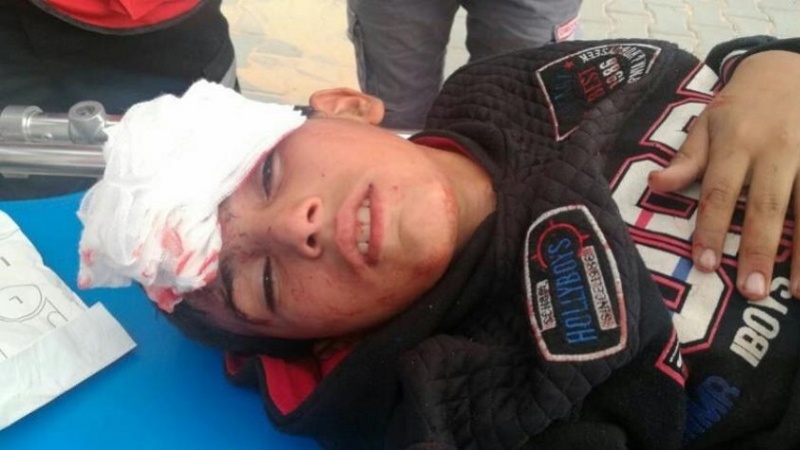
Persecuting students in this manner is part of a larger pattern as is the Zionist regime’s routine killing and maiming of Palestinian children, 44 of whom it shot on October 25 in Gaza.
The implications of these abductions and shooting sprees go beyond the direct physical and psychological harm to victims themselves and the agony and fear the Israeli regime inflicts on Palestinian families and communities.
As UNICEF points out, violence against Palestinians poses “daily challenges and threats to the fulfillment of children’s rights. Violence against children in all its forms is of serious concern, as it compromises children’s learning and future potential.”
The Zionist regime’s treatment of Palestinians, which involves undercutting their right to education in manifold ways, is a case in point.
The most brutal way to stop children from being educated is of course to murder them. From the beginning of 2008 to late October 2019, Israelis have killed 1,234 Palestinian children.
But Israel’s expansive carceral regime also keeps Palestinian kids in jails and courts rather than classrooms.
Each year roughly 500- 700 are detained and prosecuted in Israeli regime’s military court system. Of 205 children in Israeli regime’s military detention in 2019, 24 are in solitary confinement.
Actual education options, meanwhile, are tailored to location.
Palestinians citizens of Occupied Lands do not enjoy the same caliber of education as their Israeli counterparts.
Pupils at the largest Palestinian high school in the Tel Aviv-Jaffa area, for instance, teach and study in conditions of extreme overcrowding.
Palestinians applying for higher education are also at a disadvantage under the Benefits for Discharged Soldiers Law,
which allows schools to consider military service when determining applicants’ eligibility for financial assistance. Since Palestinians do not serve in Israel’s army, this law allows discrimination against Palestinian students seeking financial aid.
The Zionist ’s repression of the political rights of Palestinian citizens of Israel also functions as suppression of their right to education. The Nakba Law, for instance, strips state funding from any public institution that commemorates the 1948 ethnic cleansing of Palestine, including schools.
This means that Palestinians’ have to choose between maximizing the resources available to them to educate their young or teaching their next generation about the enormity of the crimes committed against their people in 1947-48 that have been a constitutive element of Palestinian life ever since.
The extraordinary deprivation and violence to which the Zionist regime subjects Gaza necessarily entails denying Palestinians there the best possible education, or indeed almost any.
During the Great March of Return demonstrations that began on 30 March 2018, the Israeli regime has killed 46 and wounded more than 4,600 children, 2,000 of them with live fire.
Such an enormous number of casualties, noted the UN, “strongly affect the emotional and psychosocial wellbeing of students, teachers and their communities.”
Between 2008 and July 2019, Israeli attacks on Gaza have displaced more than 190,000 people.
The Zionist regime’s 2014 attack on Gaza alone killed 60 teachers and injured 108 more while damaging 1,175 education facilities, totally destroying 29 of them.
Unsurprisingly, students who have been driven from their homes, who are under constant direct or indirect threat of violence or whose teachers have been murdered are not ideally situated for learning.
The devastating humanitarian crisis that Israel’s siege creates for Palestinians in Gaza also affects education. The blockade deprives Palestinians of access to water and sanitation, which makes it difficult to run schools properly.
The effects of poverty and fuel restrictions, directly attributable to the blockade, severely impede students’ ability to reach school or concentrate on studying. Sweeping restrictions on people’s movement prevent students from traveling abroad for education.
The Palestinian capacity as teachers and learners are unlikely to be fully realized when they work in discriminatory, run-down conditions, and under the omnipresent threat and actuality of violence from Israeli forces.
Indeed, that’s the point. Settler-colonial projects, like Israel’s, hamstring the colonized’s education in order to try to make them weak and dependent.
That, in turn, weakens the ability to resist and undermines aspirations for national self-determination.
The academic world – along with everyone else – should understand this and act accordingly.
When my colleagues or I from around the world visit Palestine to discuss our research with our Palestinian peers and with Palestinian students, the extraordinarily bright people with whom we speak should be able to carry out intellectual inquiry as freely as anyone else.
That can only happen in the context of their liberation from colonialism. It’s incumbent on scholars and students living outside to support that.
AE/SS
Tags