Arbaeen, Journey of Zealous Hearts (7)
Nov 20, 2016 12:06 UTC
In the name of God, the Compassionate, the Merciful. Welcome to the 7th episode of this series. Zainab is the daughter of Ali and Fatemah (Peace upon them). She is the granddaughter of the Prophet of Islam. The main role of this grand lady begins after the heartrending tragedy of Ashura.
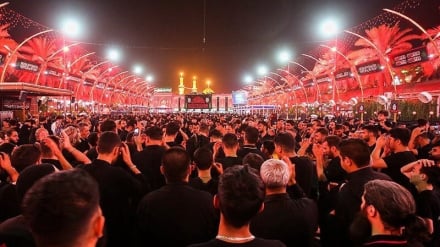
Today is the 20th Safar, the 40th day of Imam Hussein’s martyrdom. Arabaeen revives the memory of martyrdom of Hussein and his loyal companions on the day of Ashura. It is the manifestation of bravery, epic and self-sacrifice of those who gave in the way of God whatever they had in order to safeguard Islam and Qur’an. However, the role of Hazrat Zainab (Peace upon her) during Ashura and after that was very effective. Yet, her task as the continuer of the mission of Imam Hussein had mainly started after the martyrdom of the Imam and culminated on Arbaeen.
Zainab, while she was captive for 40 days, exerted her utmost through courage and faith to preserve the goals and cause of Ashura via logical reasoning. In the evening of Ashura the hordes of Yazid buried the bodies of their dead but left the holy corpses of Imam Hussein and his kinsmen and companions on the ground. Upon exiting Karbala, they forced the bereaved women and children of the martyrs pass by the corpses of their beloved in a futile bid to make Imam Hussein’s household taste further the bitter taste of defeat. They also wished to show Imam Hussein as weak and trampled down. Now, each of the aggrieved women of this caravan has a brother, son or husband among the corpses but she controls her emotion and avoids sobbing as takes the role model of Hazrat Zainab moving ahead.
When this grand lady approaches the pure decapitated and mutilated corpse of her beloved brother, she stoops down calmly. Then, removing the spears, swords and sticks, she slips her hands beneath the body and raising it from the ground she says, “Our Lord, accept this sacrifice from us!” This is the remark of the lady whom everybody knows that Hussein was her entire life. But in this way, she proclaims to all that the Ahl al-Bayt have sacrificed Hussein in the way of God and His religion and want God to accept this. Her answer is similar at the court of Ibn Ziyad in Kufa when he asks Hazrat Zainab as how she found the act of God to her brother. She says, “By God, I didn’t see except beauty! They were the men whom God had determined death for them and they moved toward their abode.”
By adopting such a stance, Hazrat Zainab (Peace upon her) taught other women of the caravan their duty vis-à-vis the martyrs and they understood that they shouldn’t sob but they have to stand firmly and steadfastly.
Uttering these remarks, Hazrat Zainab announces that the progeny of the Prophet has chosen this path with cognizance and awareness and if God’s religion needs more sacrifice they are ready.
The city of Damascus is the seat of the libertine Yazid’s government. Zainab, the virtuous daughter of Imam Ali and Fatemah Zahra (Peace upon them), makes the state of the city turbulent, too. The city which was bedecked in colors now is covered in black. The Umayyad regime, which was immersed in jubilation, has now been captivated by Zainab and the progeny of the Prophet. Zainab, who is the model of bravery and valor, doesn’t fear the armed to the teeth enemy, shouts at them humiliatingly and says, “Thank God who honored us through the Prophethood of Mohammad (SAWA) and purified us of pollutions. Indeed, it is the sinner who is disgraced and it is the transgressor who tells lie; and it is other than us.”
At the court of Yazid, too, she stands strongly and says, “If circumstances have forced me to speak to such like you; know that I deem you so base and mean; but I consider your reprimand so great and your rebuke so grave.”
Thus, Yazid is so humiliated by Zainab that he has no alternative but to expel her and other emissaries of the epic of Ashura from his palace and city as Damascus is the center of commutation of envoys and merchants of other countries. This is not at all to the benefit of Yazid. So, he orders Hazrat Zainab and her caravan be returned to Medina.
The caravan of the captives was taken to Damascus under pressures and much harassment but on the way back to Medina there was less hardship. Scared by a new revolution and further disgrace, Yazid orders the caretaker of the caravan, Nu’man ibn Bashir, to be milder with the Ahl al-Bayt. Thus, Nu’man tries to take the survivors of Ashura to their destiny with respect and reverence. For returning a shorter course was chosen and they moved faster to reach Karbala and then continue to Medina. Finally the caravan of love reached Karbala 40 days after Ashura.
The first pilgrim of the tomb of Imam Hussein was Jaber ibn Abdullah Ansari, a great companion of the Prophet. He was blind and was accompanied by Atiya Owfi. Atiya says, “We arrived in Karbala along with Jaber to perform pilgrimage to the grave of Imam Hussein (AS). Jaber went inside one of the branches of Euphrates and performed ritual washing and put on fine clothes. Then we set out for the holy tomb. In every step that he took he would utter zikr till we reached the tomb. Then he told me to put his hand on the grave. Then he said Ya Hussein three times and he fainted. When he resumed his consciousness said to Imam Hussein, ‘O Hussein, why don’t you answer me?’ Then he himself replied his question, ‘How can you answer while your vein has been cut and your head is separated from your body. I bear testimony that you are the son of the seal of Prophets and Master of the faithful. Greetings and blessings of God to you.’ Then Jaber moved toward the tombs of the companions of Imam Hussein and told them, ‘Greetings to you, o the spirits which were martyred at the feet of Hussein. I testify that you maintained prayer, paid zakat, bade what is good and forbade what is evil; and fought the disbelievers till your death arrived.”
Arbaeen is the day of Zainab’s returning to Karbala. Zainab has passed 40 days of grief and prosecution. She must be defeated and frustrated but she is victorious and keeps her head high as she has fulfilled her mission in these bitter days. She had endured countless pains and sufferings but none of them was as hard as separation from her beloved brother. So when she arrived in Karbala, she went to the grave of Hussein and cried out, “O Beloved of the heart of the Messenger of God! O son of Mecca and Mena and son of Zahra and Ali al-Mortaza! Ah.” These were simple words on the surface but they had been uttered from a grieved heart; so, they aroused everybody’s sentiments over there. Tears began flowing and they started sobbing.
RM/MG
Tags