Killing Gaza
May 22, 2018 11:11 UTC
The Zionist regime’s blockade of Gaza is one of the world’s worst humanitarian disasters.
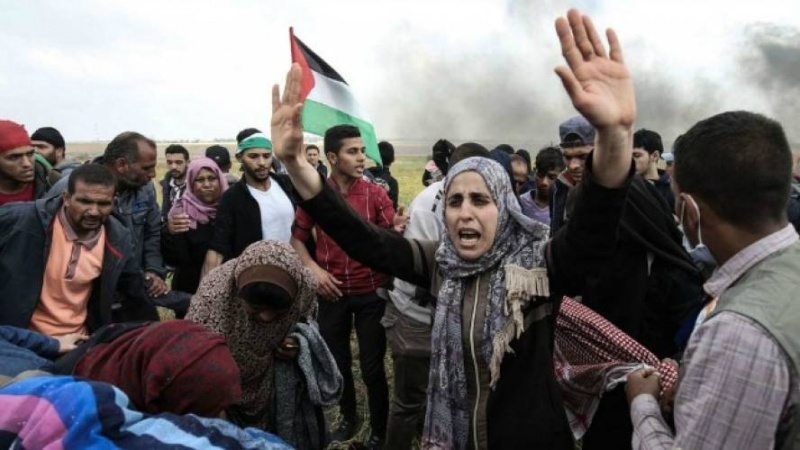
The Zionist regime’s blockade of Gaza—where trapped Palestinians for the past seven weeks have held nonviolent protests along the border fence with the occupied lands called Israel, resulting in scores of martyred and some 6,000 wounded by Israeli troops—is one of the world’s worst humanitarian disasters. Yet the horror that is Gaza, where 2 million people live under an Israeli siege without adequate food, housing, work, water and electricity, where the Israeli military routinely uses indiscriminate and disproportionate violence to wound and murder, and where almost no one can escape, is rarely documented. Max Blumenthal and Dan Cohen’s powerful new film, “Killing Gaza,” offers an unflinching and moving portrait of a people largely abandoned by the outside world, struggling to endure.
“Killing Gaza” was released Tuesday, coincided with what Palestinians call Nakba Day—“nakba” means catastrophe in Arabic—commemorating the 70th anniversary of the forced removal of some 750,000 Palestinians in 1948 by the Haganah, Zionist terrorist outfit, from their homes in modern-day Israel. The release of the documentary also coincided with the Trump administration’s opening of the new U.S. Embassy in al-Quds.
Because of Nakba Day and the anger over the transfer of the embassy to al-Quds, this week as expected was one of the bloodiest of the seven-week-long protest that Palestinians call the “Great Return March.” “Killing Gaza” illustrates why Palestinians, with little left to lose, are rising up by the thousands and risking their lives to return to their ancestral homes and be treated like human beings.
Cohen and Blumenthal, who is the author of the book “Goliath: Life and Loathing in Israel,” one of the best accounts of Israel, began filming the documentary Aug. 15, 2014. Palestinian militias, armed with little more than light weapons, had just faced Israeli tanks, artillery, fighter jets, infantry units and missiles in a 51-day Israeli assault that left 2,314 Palestinians martyred and 17,125 injured. Some 500,000 Palestinians were displaced and about 100,000 homes were destroyed or damaged. The 2014 assault, perhaps better described as a massacre, was one of eight massacres that the usurper regime of Israel has carried out since 2004 against the 2 million Palestinians in Gaza, over half of whom are children. Israel, which refers to these periodic military assaults as “mowing the lawn,” seeks to make existence in Gaza so difficult that mere survival consumes most of the average Palestinian’s time, resources and energy.
The film begins in the Shuja’iyya neighborhood, reduced to mounds of rubble by the Israelis. The wanton destruction of whole neighborhoods was, as documented by the film, accompanied by the shooting of unarmed civilians by Israeli snipers and military forces.
“Much of the destruction took place in the course of a few hours on July 23,” Blumenthal, who narrates the film, says this as destroyed buildings appear on the screen, block after block. The narrator went on to say, “The invading Israeli forces found themselves in full retreat, they called in an artillery and air assault, killing at least 120 Palestinian civilians and obliterated thousands of homes.”
The film includes a brief clip of young Israelis in Tel Aviv celebrating the assault on Gaza, a reminder that toxic racism and militarism infect Israeli society. “Die! Die! Bye!” laughing teenage girls shout at the celebration in Tel Aviv. “Bye, Palestine!”
The crowd in Tel Aviv sings as it dances in jubilation, “Gaza is a graveyard! Gaza is a graveyard! Ole, ole, ole, ole”. “There is no school tomorrow! There are no children left in Gaza!”
Terrified Palestinian families huddled inside their homes as the usurper regime of Israel dropped more than 100 one-ton bombs and fired thousands of high-explosive artillery shells into Shuja’iyya. Those who tried to escape in the face of the advancing Israelis often were gunned down and the bodies were left to rot in the scorching heat for days.
Nasser Shamaly, a Shuja’iyya resident, says in the film, “I was inside when they started bulldozing my house”. “They took down the wall and started shooting into the house. So I put my hands on my head and surrendered myself to the officer. This wasn’t just any soldier. He was the officer of the group! He didn’t say a word. He just shot me. I fell down and started crawling to get away from them.” Shamaly, who hid wounded in his house for four days, was fortunate. His 23-year-old cousin, Salem Shamaly, who led a group of volunteers from the International Solidarity Movement to dig bodies out of the ruins in Shuja’iyya, was not. The film shows Shamaly wounded on the ground, barely able to move and crying out in pain.
Waseem Shamaly, Salem’s brother, who appears to be about 8 years old, is shown with his eyes swollen from crying. The boy says, “He would take care of us, like our father”. “Even at night, he would get us whatever we wanted. He used to buy us everything. Whatever we wished for, he would buy it. He’d take us out with him just to kill our boredom a little.” Waseem wipes his eyes. He continues weakly, “Now my brother is gone”.
The father, Khalil Shamaly, says “This boy hasn’t been able to handle losing his brother.” “He couldn’t handle the news, seeing the way his brother died. He is in shock. It gets to the point where he goes lifeless. He collapses. When I pick him up he tells me his dying wishes. His dying wishes! As if he is leaving us. He is so young. But he gives us his dying wishes. If it weren’t for God’s mercy, I would have lost him too.”
Blumenthal, who narrates the film, says “Destroyed cities and shattered homes can be rebuilt if the resources are there, but what about the survivors? How can they heal the scars imposed on their psyches? The youth of Gaza has grown up through three wars, each more devastating than the last. At least 90 percent of adolescents in Gaza suffer from post-traumatic stress disorder. With mental health services pushed to the brink, these unseen scars may never heal.”
Max Blumenthal and Dan Cohen’s powerful new film, “Killing Gaza,” turns to the town of Khuza’a, a farming community with 20,000 people, which was systematically blown up by the usurper regime of Israel after three Israeli forces were killed in fighting with the al-Qassam Brigades, the armed wing of the ruling Hamas government in Gaza. The film shows a video from inside an Israeli tank as soldiers wait for explosives to bring down buildings in the town, including the mosque. When the explosions occur, the Israeli forces cheer and shout, “Long live Israel!”
The Rjeila family, including 16-year-old Ghadeer, who was physically disabled, attempts to escape the shelling. As a brother frantically pushes Ghadeer in her wheelchair, the Israelis open fire. The brother is wounded. Ghadeer is martyred. The camera pans slowly through demolished houses containing blackened human remains. Walls and floors are smeared with blood.
Ahmed Awwad, a Palestinian Red Crescent volunteer, describes what happened after he and other volunteers finally receive permission from Israeli forces to retrieve bodies from Khuza’a. They find a man tied to a tree and shot in both legs. One of the volunteers, Mohammed al-Abadla, gets out of a vehicle and approaches the tree. When he switches on his flashlight, which the Israelis had instructed him to do, he is shot in heart and martyred. Blumenthal says, “For 51 days, Israel bombarded Gaza with the full might of its artillery”. “According to the Israeli military’s estimates, 23,410 artillery shells and 2.9 million bullets were fired into Gaza during the war.” That’s one and a half bullets for every man, woman and child in the Gaza Strip.
There is footage of Israeli soldiers in an artillery unit writing messages, including “Happy Birthday to Me,” on shells being lobbed into Gaza. The soldiers laugh and eat sushi as they pound Palestinian neighborhoods with explosives.
Rafah is a city in Gaza on the border of Egypt. The film makes it clear that Egypt, through its sealing of Gaza’s southern border, is complicit in the blockade. Rafah was one of the first cities targeted by the Israelis. When Israeli troops took over buildings, they also kidnapped Palestinians and used them as human shields there and elsewhere, forcing them to stand at windows as the soldiers fired from behind.
Mahmoud Abu Said says in the film, “They blindfolded and handcuffed me and took me inside”. “They told me to come with them and put a M16 to my back. There were maybe six of them. They dropped their equipment and began searching. They started hitting me against the wall.” He says, “They put me here,” standing in front of a window, “and stood behind me shooting.”
The brutal regime of Israel intentionally targeted power plants, schools, medical clinics, apartment complexes, whole villages. Robert Piper, the United Nations Coordinator for Humanitarian Aid and Development Activities, said that Gaza had “a long time ago” passed the “un-livability threshold.” Youth unemployment is at 60 percent. Seventy percent of the 2 million Gazans survive on humanitarian aid packages of sugar, rice, milk and cooking oil. The U.N. estimates that 97 percent of Gaza’s water is contaminated. Israel’s destruction of Gaza’s sewage treatment plant means raw sewage is pumped into the sea, contaminating the beach, one of the very few respites for a trapped population. The Israelis did not even spare Gaza’s little zoo, slaughtering some 45 animals in the 2014 assault.
Max Blumenthal and Dan Cohen’s powerful new film, “Killing Gaza,” shows Palestinians, who have received little reconstruction aid despite pledges by international donors, camping out amid the ruins of homes, gathered around small fires for heat and light. Moeen Abu Kheysi, 54, gives a tour of the smashed house he had spent his life constructing for his family. He stops when he comes upon his 3-month-old grandson, Wadie. His face lights up in delight.
The film narrator says, “Months passed and the cold rains of winter gave way to baking heat of spring.” “In Shuja’iyya, the Abu Kheysi family was still living in remnants of their home, but without their newest member. Born during the war, little Wadie did not make it through the harsh winter.”
Meantime, a female member of the family explains, “He was born during the war and he died during the war, well after the war”. “He lived in a room without a wall. We covered the wall with tin sheets. We moved, but then we got kicked out. We couldn’t make rent. We had to come back, cover the wall and live here. Then the baby froze to death. It was very cold.”
Wadie’s mother says, “One day it suddenly became very cold”. “Wadie woke up at 9 in the morning. I started playing with him, gave him a bottle. Suddenly, he was shivering from the cold. I tried to warm him up but it wasn’t working.” She begins to weep.
“Grandpa!” Wadie’s small sister cries out. “Mama is crying again!”
That was an article by Chris Hedges, who spent nearly two decades as a foreign correspondent in Central America, the Middle East, Africa and the Balkans. He has reported from more than 50 countries and has worked for The Christian Science Monitor, National Public Radio, The Dallas Morning News and The New York Times, for which he was a foreign correspondent for 15 years. That was a sad film “Killing Gaza” about the oppressed Palestinians who are languishing under the Israeli siege before the eyes of the so-called defenders of human rights.
EA
Tags