How America’s war and occupation is devastating Syria
Jun 15, 2018 11:24 UTC
The UN Human Rights Council (UNHRC) is expressing concern that the use of unilateral coercive measures in Syria is contrary to International Law, International Humanitarian Law, the UN Charter and the norms and principles governing peaceful relations among states.
The UNHRC says these unilateral coercive measures are still targeting Syria, impairing the full realization of the rights set forth in the Universal Declaration of Human Rights and other international human rights instruments.
It doesn’t take a strategic mind to realize which state is the source country that continues to apply such coercive measures against the Syrian people and government. It is the United States and its collective measures that call for a trade ban on the import and export of multiple goods and services. It also includes a ban on international financial transfers.
Additional measures targeting individuals and companies by virtue of their alleged relationship with the government have also been applied. Because of their nature, these measures have had a devastating impact on the entire economy and the daily lives of ordinary people. This impact has compounded their suffering resulting from the devastating regime-change war that has unfolded since 2011.
It is clear that the sufferings imposed by Washington’s unilateral coercive measures have reinforced those that were caused by the conflict. And it seems ironic that these measures applied by the US out of a so-called “concern for human rights” are actually contributing to the worsening of the humanitarian crisis.
In consequence, the Syrian economy continues to decline at an alarming rate because of US-led financial restrictions. Since the application of America’s economic warfare in 2011 and the beginning of the current crisis, the total annual GDP of Syria has fallen by two thirds. This has further devastated the living conditions of the population that were already degraded by the conflict.
This deliberate damage to the economy has had predictable effects on the ability of Syrians to realize their economic, social and cultural rights. Syria’s human development indicators have all tumbled as well. There has been a staggering increase in the rate of poverty among ordinary Syrians. Restrictions on the Central bank, state-owned and private banks, and transactions in the main international currencies have comprehensively damaged the ability of anyone seeking to operate internationally.
According to the UNHRC, this market uncertainty has created a “chilling effect” on international banks and companies, which as a result are unwilling or unable to do business with Syria. This has prevented Syrian and international companies, non-governmental actors (including those operating in purely humanitarian fields), and Syrian citizens from engaging in international financial transactions (including for goods which are legal to import), obtaining credit, or for international actors to pay salaries or contractors in Syria. However, the Syrian government is fighting back against these coercive measures, all while trying to fight terrorism and restore peace and security across the nation. To that end, Syria practices universal, free health care for all its citizens. Prior to the current crisis, Syria enjoyed some of the highest levels of care in the region. The demands created by the crisis have overwhelmed the system, and created extraordinarily high levels of need. Despite this, restrictive measures by the US, particularly those related to the banking system, have harmed the ability of Syria to purchase and pay for medicines, equipment, spare parts and software.
This should be a wake-up call for the international civil society. Syria cannot function as a normal state as long as America’s unilateral coercive measures exist, which contribute to the ongoing suffering of the Syrian people. Claims that “they exist to protect the Syrian population,” or “to promote a democratic transition,” are hard to reconcile with the economic and humanitarian sufferings being caused.
The time has come to ask the global community not to accept the devastating consequences of America’s war and occupation in Syria. Whatever their political objectives, there must be more humane means by which these can be achieved in full compliance with International Law. In view of the complexity of the system of unilateral coercive measures in place, there needs to be a multi-stage approach to addressing and resolving the dire human rights situation prevailing in Syria.
The time has also come for the global community to address the crucial humanitarian needs of the population throughout the whole of Syria, without preconditions. Syria is suffering and to alleviate that suffering, UN member states should take effective measures to fulfill their commitment to allow humanitarian exemptions, along with those that will promote confidence building between the government and the so-called opposition, with the ultimate aim of lifting the US-led sanctions regime and ending the US-led war and occupation.
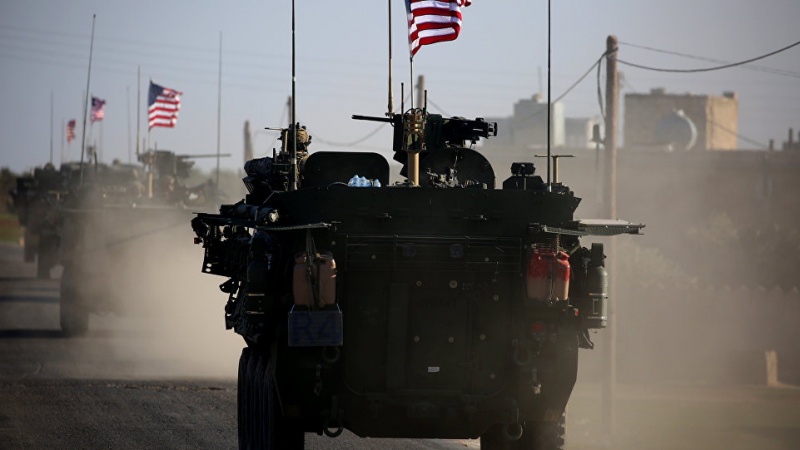
Despite calls from the international civil society to leave post-Daesh Syria, US Secretary of Defense James Mattis says withdrawing US troops from Syria would be a “strategic blunder.” Mattis’ position reflects those of a lot of top US cabinet officials, who have resisted the international community’s calls for a quick withdrawal. They even claim that the UN peace plan necessitates an ongoing US military presence and occupation.
This sets out the US position that the UN plan necessitates regime change in Syria; something other nations say is not the case. It also suggests a more or less permanent US presence in Syria, since there is virtually no chance the US will impose a favorable outcome.
In other words, Syria looks to be going the way of other major US wars, an open-ended situation short of success in which US officials simultaneously are unable to come up with a plan to “win,” but will resist any pullout so they never completely lose. However, here are the main reasons why Syria is better off without American occupying forces:
Many innocent civilians have been killed and wounded in the US-led airstrikes on the pretext of targeting Daesh positions in Syria. Last thing the war-torn country needs is another US escalation of the conflict in which we all know civilian casualties could be far worse.
As acknowledged by the Pentagon officials, many militant groups receive training and weapons from the United States. In the confusion of the so-called regime change (even in the best scenario, there will be some breakdown in controls), US weapons easily fall into the hands of Daesh and Al-Qaeda or other terrorist groups.
Meanwhile, under International Law and UN Charter, US intervention in Syria is viewed as occupation - not liberation, vastly complicating resolution of post-Daesh issues. The Syrian government wants no further US intervention. The US isn't viewed favorably in the Arab country. Opinion polls across the region and beyond also show a consistently unfavorable view of the US intervention in Syria. If the US prolongs occupation, terrorist groups will position themselves as the alleged popular groups fighting American-Zionist occupation.
However, Syria is a cauldron of sectarian communities. Prolonged US occupation (such as, arming Al Qaeda-allied groups) has a significant probability of igniting a new round of sectarian conflict (as experienced in Iraq), with differing religious groups engaging in unnecessary conflicts for influence and territory. The resulting civilian death toll could vastly exceed the current carnage.
The Syrian military is well-armed and loyal, and has Iranian-Russian allies. Unlike Afghanistan, Iraq, and Libya - the Syrian military is trained and armed with modern weapons. Further, the government has been improving its capabilities after dislodging many terrorist groups from all key cities and towns across the nation. All what the people want now is to build their shattered communities. And an increasing number of the population is loyal to the central government in Damascus and some for fear of living under a foreign-backed terrorist group or a puppet government.
Last but not the least, charity begins at home. America is bankrupt. It has a massive budget deficit; domestic infrastructure that's falling apart; unemployment, murder and poverty rates making some of its inner cities as dangerous as Syria. The US military is not welcome in Afghanistan, Iraq and Syria among many other challenges. This isn't the time for a new military adventure in Syria.
In short, the terrible choices of terrible US leaders, more than anything else, created the openings Al-Qaeda, Daesh, and sectarian killers across Syria now exploit for survival and other purposes, including threaten Western interests.
For the sakes of the American and Syrian people, therefore, US Secretary of State Mattis is better off giving the marching orders to US troops to withdraw from Syria. He knows better than anyone else that it won’t be a “strategic blunder.” He also knows that the UN peace plan never necessitated an ongoing US military presence and occupation.
(Courtesy of FNA)
EA/MG
Tags