River to the sea: Inevitable end of settler colonialism in Palestine
Dec 10, 2018 11:59 UTC
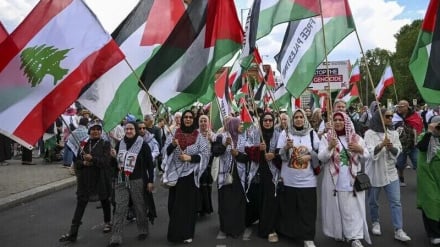
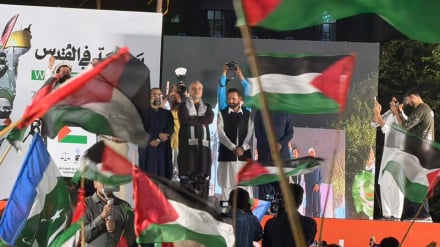
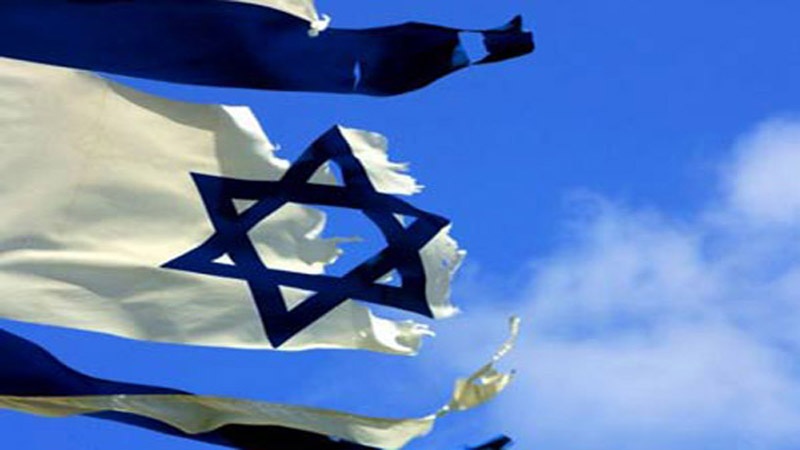
What the Islamic Republic of Iran has been saying from the very beginning that Israel is a non-entity and usurper of the historical Muslim land of Palestine, which stretches from the River Jordan in the east to the Mediterranean Sea in the west, is gaining momentum in the West, with conscientious persons calling for end of the spurious Zionist regime – through a peaceful UN referendum if possible, as stressed by the Leader of the Islamic Revolution, Ayatollah Seyyed Ali Khamenei.
Here is an interesting article in this regard by former Israeli and presently American Jewish journalist Miko Peled for MintPress titled: “River to the Sea: Inevitable End of Settler Colonialism in Palestine, in which he argues that Israel’s eventual replacement by Free Palestine does not mean the mass expulsion or killing of Jews as propagandized by the Zionists and their supporters.
The call “From the Jordan River to the Mediterranean Sea, Palestine shall be Free” brings out the worst in the Zionist spokespersons. From CNN and Fox News to the various Zionist trolls and spokespersons around the world: “Aha!” they say, “The true face of these anti-Semites has been exposed.”
Panic seems to strike as they claim that this is “a call for genocide of the Jews.” But the assumption that a free Palestine calls for the expulsion or killing of Jews is one that is made mostly by Zionists who can see Palestine only as a place where one side rules over and kills the other, but never where all people live in peace. Furthermore, it has become basic strategy to always cry “anti-Semitism” when the Zionist narrative is challenged – without knowing the meaning of the word “Semite”, whose largest ethnic composition are Arabs, and definitely not the Zionists who are converts to Judaism of East European Khazar ethnicity and not the descendants of the original Israelites.
After a lecture I gave at University College of London alongside Dr. Azzam Tamimi, where I discussed the merits of the One State from the River to the Sea, I was asked by a Jewish student, “Where should the Jews go?”
My reply was, “Why do you want them to go?” That was a reaction similar, though far less loud, to the reactions to Marc Lamont Hill’s recent speech at the United Nations, and both are indicative of the same thinking: a free Palestine means death to the Jews.
On November 28 2018, while speaking in a meeting at the UN marking the International Day of Solidarity with the Palestinian People, Hill had said "We have an opportunity to not just offer solidarity in words but to commit to political action, grass-roots action, local action and international action that will give us what justice requires and that is a free Palestine from the River to the Sea".
The next day, under pressure from the Jewish lobby, CNN fired Hill.
However, the vision of a free Palestine (from the River to the Sea, where else?) is one of a country in which all people live free as equal citizens under the law. If anyone who lives there now does not want to live in a state in which all people are governed by the same laws, then perhaps that will not be the place for them.
If Palestine is not from the River Jordan to the Mediterranean Sea then where is it? Even if there was once an argument in support of the impractical “two state solution” — or, in other words, a Palestinian state in the West Bank and the Gaza Strip, with East Jerusalem (that is, Bayt al-Moqaddas) as its capital — Israel killed it.
For over fifty years, or since the war of June 1967, consecutive Zionist regimes had claimed through statements and creations on the ground that the entire land is Israel and belongs to Jews and is for Jews – from all over the world – to settle. No part of the country has been spared the spread of Zionist settler colonialism, violence and restrictions.
The Zionist regime turned the Gaza Strip into a concentration camp. Its residents, through actions of the Zionist regime and no fault of their own, are mostly homeless refugees with soaring levels of poverty and unemployment. Clearly, the Gaza Strip in its present condition is not fit to be part of any state, and the first condition in any agreement must be the lifting of the siege, rebuilding, and rehabilitation of the Gaza Strip and its inhabitants.
As for the West Bank, it no longer exists for the Zionist regime. It is now called Judea and Samaria and — like the Naqab, and al-Jaleeli, Judaized as Negev and Galilee and most other parts of Palestine — it is littered with Jewish settler colonies built at the expense of Palestinians and in violation of Palestinian rights.
The areas in which Palestinians still reside are in fact small prisons with economic and political limitations that make life practically impossible. Travel for Palestinians between different parts of what used to be the West Bank is restricted at best and is at times impossible — and this includes even the so-called president of the Palestinian Authority, Mahmoud Abbas, who requires a permit from Israel in order to travel within the areas in which he has authority.
East Jerusalem or Bayt al-Moqaddas, like its western half, has been ravaged by Jewish settler colonialism to a point where in some areas Jerusalem has become unrecognizable. Unlike in the western part of Bayt al-Moqaddas, where the ethnic cleansing was absolute and not a single Palestinian family remains, the ethnic cleansing of East Bayt al-Moqaddas has not yet been completely successful. However, towns and villages like Bir-Nabala, Qalandia, A-Ram, and others — areas that are adjacent to the city and that were once flourishing business and residential districts — are now ghost towns as a result of the Zionist ethnic cleansing campaign.
The arguments in favor of a partition of Palestine and the creation of two states was always weak and impractical. This was particularly true after 1948 when the Zionist regime was planted by Britain on 78 percent of Palestine and Zionist settler colonialism was internationally legitimized and accepted. However, the final nail in the coffin of the partition idea was hammered in by the Zionists themselves after 1967 when the remaining 22 percent of Palestine, including East Bayt al-Moqaddas, was occupied by Israel.
The building of Jewish settlements, destruction of Palestinian towns, villages and neighborhoods was immediate and it was clear to anyone who was paying attention that this occupation was irreversible. The discussion on a supposedly “two state solution” at that point only allowed the Zionist regime to build new, Jewish only settler-colonies in the newly occupied lands, on the false claim that if one day there will be a peace agreement they will consider removing them.
Palestine, however, never ceased to exist from the River Jordan to the Mediterranean Sea, and even the renaming of the land as “Israel” has not changed that. At the same time, the discussions of partition and a two-state solution did not slow down the seven-decade-long Zionist rape and pillaging of Palestine. So today, when discussing a free Palestine, as Dr. Marc Lamont Hill did, one has no choice but to mention all of Palestine, from the River the Sea, and yet Dr. Hill still received a barrage of criticism from all directions.
The question as to how the Zionist regime and Jewish settler colonialism will be brought to an end is an important one to discuss. The clearest and most practical vision to date seems to be that, as in South Africa, the Zionist regime will have no choice but to capitulate. This will happen largely as a result of the success of the Boycott, Divestment Sanctions (BDS) campaign, political isolation, and on-the-ground Palestinian resistance. Every Israeli prime minister, from this moment on, must know that he or she is likely, like De Klerk in Apartheid South Africa, to announce the end of the apartheid regime in Palestine, unconditionally release the Palestinian prisoners, and call for one-person-one-vote elections. This will lead to the creation of a legislature and a government that represents all people who live between the River to the Sea.
AS/SS
Tags