The global assault on jobs
Jun 10, 2019 10:50 UTC
The Australian telecom giant Telstra announced that it would eliminate the jobs of 10,000 contract workers over the next two years, after having laid off 5,000 contractors last year.
The layoffs come as Telstra moves up its “T22” restructuring plan to slash the jobs of 8,000 direct employees—a quarter of its workforce—by the end of 2022. It is now cutting 6,000 direct jobs over the next several months in order to include the US$1.75 billion in savings in its 2019 financial reports.
“The global assault on jobs” is the title of a feature by Jerry White who is CEO of Global Impact Strategies and Professor of Practice at the University of Virginia. He shares in the 1997 Nobel Prize for Peace awarded to the International Campaign to Ban Landmines. Stay tuned.
An article in the Sydney Morning Herald titled “Investors cheer as Telstra wields the axe on costs” summed up the attitude of the corporate-financial oligarchy to the destruction of workers’ livelihoods and families.
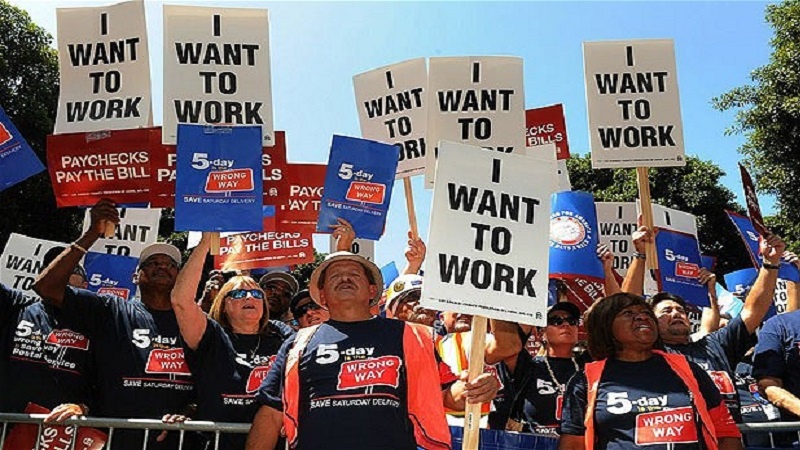
The cuts are part of a wave of mass layoffs being carried out internationally, as corporations respond to mounting signs of a global recession, exacerbated by Trump’s trade war policies against China and other countries. Finance capital is demanding brutal job cuts and reductions in labor costs so that the corporations can boost their profit margins despite shrinking markets and falling sales. Other companies that have recently announced mass layoffs include:
General Motors; The biggest US car maker is cutting 14,000 salaried and production jobs and closing seven plants, five in the US and Canada. Two of the seven targeted facilities, located in other countries, have yet to be identified. In comments to a shareholders meeting Tuesday, CEO Mary Barra said the cuts would save $6 billion and “drive profitable growth.”
Ford; Last month, Ford announced that it was in the final phase of its “Smart Redesign” program and would cut 7,000 jobs, or 10 percent of its global salaried workforce, by the end of August. The automaker is slashing salaried positions in Germany, the UK and the US, and laying off thousands of production workers in Brazil, Russia, China and the US. But Wall Street considers this to be a mere down payment. A Morgan Stanley analyst recently said that Ford needs to slash another 23,000 jobs to meet its cost-cutting targets.
Fiat-Chrysler; The corporate board of French carmaker Renault said that it would need more time to decide on a proposed merger with Fiat Chrysler, which would create the third largest automaker in the world. The Detroit News reported that like other mega-mergers, the tie-up would “lead to job cuts in Europe—where both automakers employ too many people making vehicles delivering too little profit.”
Volkswagen; The largest car maker in the world has established a “strategic alliance” with Ford and is slashing 7,000 jobs.
General Electric; The US-based transnational announced last week that it was cutting more than 1,000 jobs at its Belfort plant in eastern France and reneging on its pledge to create 1,000 new jobs due to a fall in demand for power plant equipment.
AT&T; The world’s third largest telecom cut more than 11,780 jobs last year even as it reported $19.4 billion in profits. The company received more than $20 billion in relief due to Trump’s corporate tax cuts.
Retail; British international retail giant Marks and Spencer is threatening to close 100 stores as part of a jobs massacre in the retail sector that saw the elimination of 70,000 jobs in the UK at the end of 2018 and 41,000 US jobs in the first two months of 2019 alone. German-based MediaMarktSaturn, Europe’s biggest consumer electronics retailer, has announced 700 layoffs.
Even as the job cuts escalate, the corporate-controlled politicians and media talking heads prattle on about the booming economy and record low levels of unemployment in the US. By this they mean record corporate profits, the quadrupling of the stock market and the unprecedented transfer of wealth to the ultra-rich since the 2008 financial crash.
America’s low official unemployment rate does not account for the fact that record numbers of workers have dropped out of the workforce—the labor participation rate is lower today than in 2007—and the jobs most workers have pay less, lack pensions and are devoid of any semblance of security. Real wages in the US fell by 1.3 percent last year, following a more than four-decade decline. A recent study in the UK showed that wages are worth a third less today than they were in 2008.
Wall Street analyst Maryann Keller told the Detroit Free Press “You might have 25 jobs throughout your life and they’re often contract.” That was for an article on the temporary and part-time jobs that have proliferated in the auto industry since President Obama’s restructuring of GM and Chrysler 10 years ago. Keller said, “Prior to 2009, the old union contracts ensured you a job for life. It was preposterous and not affordable.”
At the other pole of society, the corporate and financial oligarchy is spending more than ever on yachts, private jets and mansions. The Wall Street Journal just reported that Amazon CEO Jeff Bezos, the richest man in the world, has plopped down $80 million to buy a penthouse and two adjacent units on Manhattan’s Fifth Avenue. Meanwhile, Amazon workers are sleeping in their cars and collecting food stamps.
As it seems, as with the 2008 financial crash, the ruling elite intends to make the working class bear the full weight of a looming downturn in the global economy, even as the state intervenes to protect and expand the wealth of the financial oligarchy. This was made abundantly clear just recently, when Federal Reserve Chairman Jerome Powell said that the US central bank is prepared to cut interest rates again, triggering a stock market surge.
But the striving of the working class to assert its own solution has been suppressed by the unions in the US and around the world. In the years following the crash, they reduced strike activity to the lowest level since the early twentieth century. The last 18 months, however, have seen a resurgence of the struggle, including the rebellion of US teachers; the wildcat strikes by maquiladora workers in Matamoros, Mexico; the Yellow Vest protests in France; and the upheavals in Algeria, Sudan and other African countries.
In Matamoros, workers revolted against the nationalist and pro-capitalist unions, marched to the US border to appeal to their American brothers and sisters to join the fight, and sent messages of solidarity to GM workers in the US and Canada fighting plant closings. The masses coming to realize that it is capitalism and the corporations that are stealing their jobs and impoverishing their families, not immigrants and refugees as Trump and the far-right parties in Europe claim, echoed by the so-called “mainstream” parties and the trade unions.
This crisis poses fundamental political questions. The global assault on the social and democratic rights of the people requires a due coordinated response. This means rejecting the nationalist poison peddled by unions like the United Auto Workers, and rejecting the corporate-controlled Democrats who are lining up with Trump’s trade war policies. Above all, it means the building the International Committee of the Fourth International to provide this resurgent struggle with the revolutionary perspective and leadership it requires to enable the people to take political power in their own hands and build their own society.
EA/ME
Tags