Libya is a complete Western disaster
Oct 31, 2016 13:07 UTC
Three years ago, NATO declared that the mission in Libya had been “one of the most successful in NATO history.”
Today, this statement is a proven lie that was fed to the public at large in the West. A recently published report of British parliament’s foreign affairs committee has categorically acknowledged that the Western intervention in Libya in 2011 was not only based upon flawed intelligence but also directly paved the way for the resurgence of the terrorist groups in the country.
What had initially been propagated as a sort of “humanitarian intervention” to “protect” civilians from the “tyranny of Ghadhafi” soon exacerbated into the notorious game of regime change and led to the subsequent disaster, proliferation of terror groups and Libya’s downfall from a reasonably stable state to a fragmented one.
The report’s findings are, as such, highly critical in terms of the way the West, particularly the US, has been projecting the utmost necessity of NATO’s intervention. Salman Rafi Sheikh, research-analyst of International Relations and Pakistan’s foreign and domestic affairs, has written an article on the realities of the West's play game, this time in Libya at the far front of Africa. It's based on a recently published report of British parliament’s foreign affairs committee. Stay with us.
Even if we were to agree to the Western proposition that Ghadhafi regime was inflicting atrocities on its people and that the real goal, as a recent article published by the corporate-funded Brookings Institute argues, was to protect people, the report finds it to be wrong. Exposing the hollowness of the propagated “truths”, the report states that nothing of the sort was happening at the time of intervention or was likely to follow.
Intervention happened not because Ghadhafi was inflicting atrocities but because he was winning the fight against Western and Arab funded militias. However, where are those claimers of defending human rights to see the bitter story of Yemeni civilians under the Saudi regime's siege and non-stop air assaults? Where are those Westerners to see the unbearable agony of the Syrian people under the foreign-instigated, and supported terrorism? Yes, they are there, but in the help of the perpetrators of crimes against humanity.
Contrary to the ground realities, the mantra of “protecting” people was officially projected for public consumption, while the real goal was to send Ghadhafi home and to re-design Libya’s future in which Ghadhafi or his affiliates would have no role to play and break the door of Africa and arrange the issues of an oil rich country as they wished.
When the then British Prime Minister David Cameron sought and received parliamentary approval for military intervention in Libya on 21 March 2011, he assured the House of Commons that the object of the intervention was not regime change.
In April 2011, however, he signed a joint letter with United States' President Barack Obama and French President Nicolas Sarkozy setting out their collective pursuit of “a future without Ghadhafi”.
That the goal was always to impose a new regime on the people of Libya is evident from another finding that no option other than that of military intervention was explored and considered. The British government rapidly developed a new policy of intervention to protect civilians as Muammar Ghadhafi’s forces approached Benghazi in mid-February 2011. It did not explore alternatives to military intervention such as sanctions, negotiations or the application of diplomatic pressure. In pursuing regime change, it even abandoned a decade of foreign policy engagement with that regime.
What the West wanted to achieve by regime-change?
As could be expected of the West, the real goal was to extend Western influence in the African continent. Libya was to be the gateway for that. However, as long as Ghadhafi was there, this objective could never be realized. Hence, the anti-Ghadhafi propaganda and the development of the so-called “pro-democracy” discourse in the West paved the way for NATO-led intervention.
Following are the critical objectives, which were of crucial importance for France’s Sarkozy, behind the military intervention and change of regime in Libya: A desire to gain a greater share of Libya oil production; increase French influence in North Africa; improve his internal political situation in France; and among others, to provide the French military with an opportunity to reassert its position in the world.
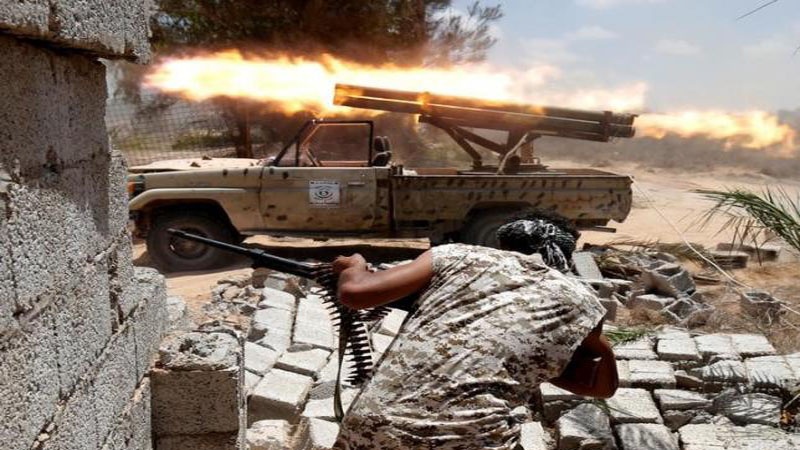
Therefore to achieve these objectives, a dual strategy was implemented. On the one hand, NATO intervened and on the other hand weapons were allowed to be distributed to the militias and the terror groups. The so-called international community turned a blind eye to the supply of weapons to the terror groups. Lord Richards highlighted “the degree to which the Emiratis and the Qataris played a major role in the success of the ground operation. For example, Qatar supplied French Milan antitank missiles to certain terror groups. We were told that Qatar channeled its weapons to favored militias rather than to the rebels as a whole. But, 'Who were the “rebels”?'
While it is largely believed that that crisis in Libya were linked to a general uprising linked with the so-called “Arab Spring”, this is far from the truth. For one thing, a general popular uprising against an autocrat regime could not possibly have descended into a pure chaos but for the involvement of foreign funded extremist groups. This is precisely what happened in Libya.
The critical question, therefore, is: were the Libyan rebels really “rebels”? The Western official narrative was disputed that it was a general uprising and that extremists got involved at some alter stage. Contrary to the official narrative, “It is now clear that militants played a critical role in the rebellion from February 2011 onwards. They separated themselves from the rebel army, and were at the hands of the Western puppeteers.”
That the West had “turned a blind eye” to the support certain militias were receiving from Arab countries is, in fact, an indication of the Western complicity in facilitating the rise of terror, extremist groups in Libya. British Lord Richards was asked at the time, whether he knew that Abdelhakim Belhadj and other members of the al-Qaeda affiliated Libyan groups participating in the rebellion in March 2011.
He replied that that “was a grey area”. He added that “a quorum of respectable Libyans were assuring the British Foreign Office” that the real rebels would not benefit from the rebellion. He acknowledged that “with the benefit of hindsight, that was wishful thinking at best.”
What is Libya today? Yes, a disastrous mess!
It is a mess, a victim of Western conspiracy and its notorious Cold-War era policy of imposing regime change in countries that refuse to abide by their rules of global politics. Libya, today, is a disaster. Facts speak for themselves: In 2010, Libyan economy was generating $75 billion in GDP, with an average per capita income of $12,250, roughly equal to an average income in some European countries. As of 2016, however, Libya is likely to experience a budget deficit of some 60% of GDP. The United Nations ranked Libya as the world’s 94th most advanced country in its 2015 index of human development, a decline from 53rd place in 2010.
The Western intervention was, to say the least, not only ill-informed and a result of propaganda against Ghadhafi but also motivated by purely geo-political considerations. The Western intervention has ‘successfully’ transformed Libya from the richest African state to a failed state under Western supervision. However, its various experiments in Libya have failed to transform it into a pure Western vessel.
And as the report, recently published report of British parliament’s foreign affairs committee, indicates, the US is now trying to install one of its long term assets, a certain general, who aims to set himself up as Libya’s new dictator and then help the West in transforming Africa’s political economy into a disastrous the kind of which Libya, Syria, Iraq and Afghanistan today are.
However, the West's notorious considerations in Libya is a different story of a reality: Ghadhafi was a dictator in Libya and a stooge at the hands of Western puppeteers in one way or another, but was crossed out as per their purely geo-political considerations.
EA/SS
Tags