Islamic Unity Week (4): Tackling the challenge of extremism
Dec 15, 2016 07:01 UTC
Welcome to the 4th episode of our special 6-part programme being broadcast daily on the occasion of the annual Islamic Unity Week that spans the two dates of Rabi al-Awwal marked by Sunni and Shi’a Muslims respectively as the birthday of the Almighty’s Last and Greatest Messenger, Prophet Mohammad (Blessings of God upon him and his progeny).
Sunni Muslims, as per the reports of the Prophet’s companions who became acquainted with him in the last years of his life, claim that he was born on the 12th of Rabi al-Awwal. Shi’a Muslims, on the basis of the accounts of the Prophet’s blessed household, the Ahl al-Bayt, consider family reports to be more reliable and mark the Prophet’s birthday on Rabi al-Awwal 17. The Father of the Islamic Revolution, Imam Khomeini (God bless his soul), in order to gather Muslims on a single platform, above trivial differences, initiated the Islamic Unity Week in 1979, which has since gathered momentum and is spreading the message of solidarity around the world, despite the intricate sectarian plots of the enemies to splinter Muslim ranks by creating cannibalistic Takfiri terrorist outfits, such as Daesh, al-Qa’eda and their offshoots. Today we shall talk about “Extremism, a Major Challenge to Islamic Unity & and the Need to Confront it.”
No religion in the world can claim that there are no extremists among its followers. Sadly, in every religion there are individuals who interpret religion differently by adopting an unconventional approach, or even an extremist approach. Extremist interpretations of religion pose a real challenge to Muslims, and it often leads to division, conflict and disunity within the Ummah. It is also worth noting that extremist interpretations are “music to the ears of the enemies of Islam”, particularly to the ears of the regimes in the US and Britain. The Americans and the British have nurtured and exploited extremist interpretations for their own benefit, using this as a means of dividing Muslims and pitting Muslims against one another. The British strategy of “divide and rule” is well-known in the Muslim world – a strategy which the British colonialists used very effectively for many decades to plunder the wealth and natural resources of Muslim lands. The strategy of weakening Muslims by dividing them, is still used today by the enemies of Islam, particularly the illegal Zionist entity and its godfather, the US, as well as to a lesser extent the European Union.
The enemies of Islam used every trick up their sleeve to counter Iran’s growing influence following the victory of the Islamic Revolution. They tried desperately to prevent Iran from becoming a role-model for other Islamic countries. Muslims who had suffered for decades under authoritarian, undemocratic and corrupt regimes, which denied them even their most basic rights, and gave away the countries natural resources at very cheap prices to arrogant colonialist Western powers. Despite all these efforts, Islamic Iran became a wonderful role-model for Islamic nations and oppressed nations around the world. With the victory of the Islamic Revolution in Iran, Islam was rejuvenated on the world scene and revived in many countries. In fact, Islamic resistance now is standing up to the Zionist entity and its backers, and is seen as the only realistic way of liberating the usurped and occupied land of Palestine.
We have talked about extremist interpretations of religion. Let us now turn to another very questionable and extremist interpretation, known as “British Shi’ism” or “British-engineered version being marketed as Shi’a Islam”. The group of so-called Shi’a Muslims adhering to this version, are trying to portray an ugly image to the world of the followers of the Prophet’s Ahl al-Bayt, either wittingly or unwittingly. This group is trying to counter Islamic Iran’s growing influence worldwide, especially in the Muslim world and in particular among Shi’ite Muslim communities. This group is supported by the British regime and its intelligence agencies, the notorious MI5 and MI6. Its mission seems to be to distort the teachings of the School of the Ahl al-Bayt and give a narrow-minded extremist image, which is not at all consistent with the dynamism and rationality of the Imams of the Ahl al-Bayt. It tries to achieve this by framing every religious issue as “a fight between Shia and Sunni Muslims”. The group has a very belligerent and confrontational attitude towards Sunni Muslims in general. It actively tries to reframe every religious issue, even if there are no disagreements between Shi’ites and Sunnis on that particular issue, in such a way that it may look as if Shi’ites and Sunnis differ on this issue.
Promoters of this version, tend to concentrate on issues where there are differences of opinion between Shi’a and Sunni Muslims. They do this deliberately to stoke tensions and fuel the fire of division. It should be noted that promoters of “British Shiism” ignore fundamental Islamic concepts and principles, such as Towheed or monotheism, Prophethood, and Day of Resurrection, since there is no fundamental disagreement between Shi’a and Sunni Muslims on any of these points.
Another important point is that just like the Wahhabis, Salafis, and the Takfiri terrorists, advocates of British Shiism do not tolerate even the slightest deviation from their narrow and extremist interpretation of Islam. Similar to the Wahhabis, Salafis and the Takfiri terrorists, they think anyone who disagrees with them should be put to death as an apostate”!!
The Father of the Islamic Revolution, Imam Khomeini (God bless him), had always emphasized that no one should try to cause tension between Shi’ites and Sunnis under any circumstances. He once said: "We are one with our Sunni brethren. We are one Ummah, we are all Muslims and we are all brothers. If someone speaks in such a way to cause division and discord between Muslims, either he or she is ignorant, or else he or she is deliberately trying to stoke tension and conflict amongst Muslims. All Muslims are brothers. We shouldn’t even raise the issue of Shi’as and Sunnis”.
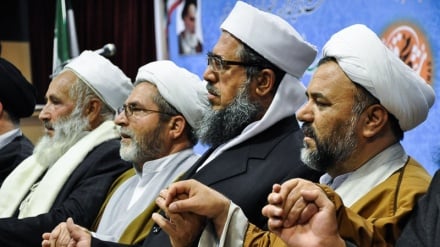
One final point is that religious scholars of both sides, whether Shi’a or Sunni, have a duty to confront and oppose extremism among Muslims, whatever their denomination.
AS/ME
Tags