Burma’s Rohingya speak of genocidal terror
Dec 22, 2016 06:36 UTC
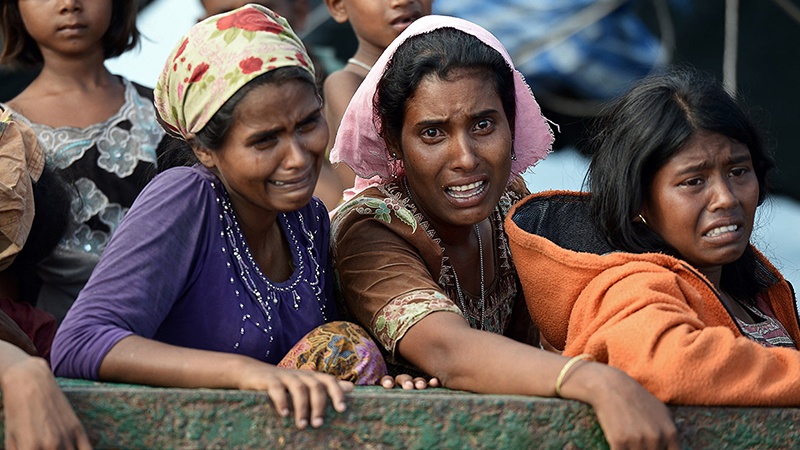
Around 27,000 Rohingya have sought refuge in Bangladesh over the past two months, as Burmese forces launched what one U.N official says is “getting very close to what we would all agree are crimes against humanity.” TIME reports from the Bangladesh border, where the full horror is only just emerging.
If the Naf River could talk, which horror story would it tell first? The narrow waterway marks the border between Burma and Bangladesh. On its western bank is the Bangladeshi province of Chittagong. To the east, Burma’s Arakan state, also known as Rakhine, home to the Buddhist-majority country’s Rohingya people, a Muslim minority described over the years as stateless, friendless and forgotten. But if the river could remember their stories, it might speak, for example, of the night in late November when Arafa, a 25-year-old Rohingya woman, entered its waters with her five children.
She used to have six. As she talks, sitting on the threshold of a hut in a makeshift refugee camp on the Bangladeshi side of the Naf, she is surrounded by her son and four young daughters. They are a lively bunch, noisy, restless, yet shy, hiding behind their mother’s back or running in and out of the hut, as she recounts what happened to her second son. He was 8 years old. Sometime around Nov. 22, Arafa says her village was attacked by Burmese security forces. Viewed as illegal immigrants and denied citizenship rights by the Burmese state, the Rohingya have long faced intimidation, oppression and violence at the hands of both Buddhist extremists and the country’s security forces. The last major sectarian spasm was in 2012, when clashes between Arakanese Buddhists and Rohingya Muslims displaced some 125,000 people. Rights activists accused security forces of either standing aside as the violence spread, or actively participating in it.
This time, Arafa says, the army’s assault felt different. The security men seemed more determined, more driven, to punish the Rohingya. Their weapon of choice was fire. Arafa says that the military torched her village. As the flames engulfed her home, she just about managed to escape with her six children. That was when the family was confronted by a Burmese soldier. He snatched the fleeing 8-year-old, separating him from his brother and sisters, and flung him into the blaze. In the chaos, Arafa lost sight of her husband. But she could not turn back; she had to leave him behind, leave her son’s charred body behind, and mourn on the move. She told the TIME: “I had to save my other children. We had to escape from Burma,” “They burned everything.”
For two days, Arafa and her children hid in the forests that skirt the riverbank on the Burmese side, laying low to avoid detection by troops, before boarding a rickety boat that took them to safety across the Naf.They are not alone. Arafa’s family are among the 27000 Rohingya Muslims who have sought refuge in Bangladesh over the past two months, as Burmese forces launched what testimony from refugees, satellite imagery compiled by rights groups and leaked photos and videos from inside Arakan indicate is a horrifyingly bloody crackdown against the million-strong Muslim minority.The latest troubles began in early October, when police said three border guard posts were attacked by militants. Nine policemen were killed, with the government saying the attackers belonged to a group called Aqa Mul Mujahidin. A statement from the Burmese President’s office linked them to the Rohingya Solidarity Organization, a militant group long thought to be defunct. The only proof for these claims was the government’s word.
What followed has been described by Burmese authorities as “clearance operations.” Amnesty International, the rights group, calls it “collective punishment”: a ferocious campaign of violent reprisals against an entire people. In addition to arson attacks on Rohingya villages, the military has been accused of raping Rohingya women and conducting extrajudicial killings of Muslims. Helicopter gunships have been used to fire on Rohingya villages.
Satellite imagery released by Human Rights Watch show that more than 800 buildings were destroyed in five different Rohingya villages between Nov. 10 and 18. An earlier set of high-resolution images showed the destruction of more than 400 homes in three villages between Oct. 22 and Nov. 10. The rights group says the actual number of destroyed buildings could be higher, given the dense tree cover in the area.Verifying the picture on the ground is impossible, as Burma has sealed off the affected areas. But, Yanghee Lee, the U.N. special rapporteur on human rights in Myanmar, says the news that is coming out suggests that the situation is “getting very close to what we would all agree are crimes against humanity.” She told the TIME, “I am getting reports from inside the country and from neighboring places too that things are not as they are being portrayed by the government. We are seeing a lot of very graphic and very disturbing photos and video clips.” She says: “We do hear about rape and sexual violence, and even bodies of little kids being uncovered.”
Lee added “We can’t verify the numbers of how many have been killed. Many have gone into hiding,” expressing her dissatisfaction with a government-supervised trip to some of the affected areas by a group of foreign diplomats and a U.N. official in early November. The international community called on Burma to give humanitarian agencies “full and unfettered access” to northern Arakan, “noting that tens of thousands of people who need humanitarian aid, including children with acute malnutrition, have been without it now for nearly two months.” The official Burmese response to the allegations of rights abuses has been denial and, reflecting the low opinion many Burmese have of the Rohingya, callous dismissal. Meanwhile, the country’s top military man, Senior General Min Aung Hlaing, blames the Rohingya for their woes. Referring to them as “Bengali,” a term which implies that they belong across the Naf in Bangladesh.Amid the unfolding crisis, one voice has been largely absent — Nobel Peace Prize winner Aung San Suu Kyi, whose National League for Democracy party won a landslide victory in elections in November 2015. The polls marked Burma’s transition from military dictatorship to its first civilian-led administration in more than half a century. A new military-drafted constitution prohibited Suu Kyi from becoming President, and the generals retained control over Burma’s security apparatus. But she is the nation’s de facto leader, occupying a Prime Minister–like position as Burma’s State Counselor.
Suu Kyi’s stance is only the latest in a long series of disappointments for Burma’s Muslims. Yunus, a 30-year-old Rohingya refugee who fled to Bangladesh in November, says “She’s not doing anything to protect us,” “We thought there would be a change. But she is the same as everyone else.”
For the Rohingya, the crisis doesn’t end on the Burmese side. Yusuf, Arafa and their families managed to escape and reach land in Bangladesh by avoiding detection. But in the days since, Bangladesh has stepped up patrols along its border with Burma, putting an additional squeeze on the persecuted population. Many refugees have gone missing, after their boasts capsized in the river’s choppy waters. It is not the first time that the Rohingya have sought shelter across the river. Over the decades, as they fled violence at home, as many as half a million undocumented Rohingya refugees have made their lives in Bangladesh. More than 30,000 registered refugees live in camps near the border. Now Bangladesh says: We can’t accommodate any more people. Colonel M.M. Anisur Rahman is the deputy director general of Border Guard Bangladesh, the force charged with patrolling the border area. He says: “My country is a house. If all the people try to get inside my house, what will happen? I cannot allow all of them.” He says, Bangladesh’s policy is to push back fleeing refugees. The Bangladeshi colonel insists “Of course we are concerned, and if they ask any help regarding food, water and other things, we will provide it. But we cannot provide shelter. Those who have slipped in, avoiding detection, will be caught and sent back.”
To this, Du Du Mian, a Rohingya refugee who arrived in Bangladesh more than a decade ago, answers: “The world needs to realize that we have nowhere to go.” His people, he says, have no country. With Burmese soldiers trying to stop them from fleeing and Bangladeshi forces pushing them back, all they have is the Naf, and the Naf, so far, is silent.
The UN human rights office says it is getting daily reports of rapes and killings of the Rohingya minority in Myanmar, although the government is insultingly dismissing the claims and making the situation worse. Zeid Ra'ad al-Hussein said the government, led by Nobel Peace Prize winner Aung San Suu Kyi, has taken a "short-sighted, counterproductive, even callous" approach to the crisis. In a statement, the UN High Commissioner for Human Rights said the policy could have grave long-term repercussions for the region. At least 86 people have been killed in the latest wave of racial violence against the Rohingya Muslims, even though independent reports put the toll much higher. The United Nations has estimated 27,000 members of the largely stateless Rohingya minority have fled across the border to Bangladesh. The Rakhine state in northern Myanmar has been under a military siege since October over a raid on a police post that the government has blamed on the Rohingya. There have been reports of rape, murder, and arson against the Muslim population in the state. Just recently, Human Rights Watch said evidence showed Myanmar’s military is behind the torching of villages belonging to the Muslims. The New York-based rights body said at least 1,500 buildings have been destroyed since October 2015 in Rakhine, home to a large number of Rohingya Muslims.
The government denies full citizenship to the 1.1 million-strong population, branding them illegal immigrants from Bangladesh despite the fact that most of the Rohingya have an ancient lineage in Myanmar. The fresh spate of violence has triggered international condemnation, with Malaysian Prime Minister Najib Razak denouncing Suu Kyi for allowing “genocide” under her administration.
EA/MG
Tags