Arba’een: A spiritual walk
Nov 06, 2017 10:33 UTC
The glorious gathering of Arba’een on the traditional 40th day after the anniversary of the Ashura tragedy is gathering momentum every hour as pilgrims continue to flow into Iraq from all entry points, the busiest being the borders with Iran, as over 30 million devotees are expected this year in Karbala to pay homage to the Chief of Martyrs, Imam Husain (AS), the grandson of Prophet Mohammad (Blessings of God upon him and his progeny).
Iran’s eastern borders have also become busy these days, as the followers of the Prophet’s Blessed Ahl al-Bayt, whether Sunni or Shi’a Muslims, travelling overland to Iraq, are pouring in from Afghanistan and Pakistan, on their way towards the holy shrine of the Commander of the Faithful, Imam Ali (AS) in Najaf, from where millions, including those arriving by air from different parts of the world, are marching on foot for the Spiritual Walk towards Karbala.
Pilgrims from Pakistan are expected to number over 200,000 this year. Stay with us for an interesting feature that appeared in the Pakistani daily “Nation” in this regard, titled “Arba’een: A Spiritual Walk” and written by Faizan Hussain. Stay with us please.
Safar is the second month of the Arabic calendar. It is marked with many important events in Islamic history but one of the most important of these is Arba’een, the 20th of Safar.
In Arabic language “Arba’een” means forty and in Islamic history it marks the 40th day of mourning period following Ashura, the 10th of Muharram when in 61 AH (corresponding to 680 AD), Imam Husain (AS), the Prophet’s younger grandson and his 3rd Infallible Heir drank the elixir of martyrdom along with his family members and loyal friends – the in unequal combat with the forces of the self-styled caliph, Yazid of the usurper Omayyad regime, rather than acknowledge the un-Islamic rule of the tyrant.
In this month, millions of people from around the globe gather in Iraq’s holiest city of Karbala to commemorate Arba’een and to pay tribute to the martyrs of Karbala.
Arba’een pilgrimage or the Arba’een Walk is widely recognised as the single largest annual peaceful gathering in the world when swarms of people walk towards the holy shrines of Imam Husain and his valiant brother and standard-bearer of the small army, Hazrat Abbas (peace upon them). The pilgrims renew allegiance to the immortal martyrs for the Greatest Sacrifice.
The grandson of the Prophet needs no introduction. The son of the Noblest-ever lady, the Prophet’s daughter Hazrat Fatema Zahra and the Commander of the Faithful, Imam Ali ibn Abi Taleb (peace upon them), he left an everlasting legacy 1378 years ago which continues to inspire mankind and will keep on inspiring till the existence of this world. This journey is not an ordinary journey and neither those people are ordinary who get the opportunity to take a part in this spiritual walk. The people who take part in this walk are called Zair-e-Imam Husain alaihis-salaam).
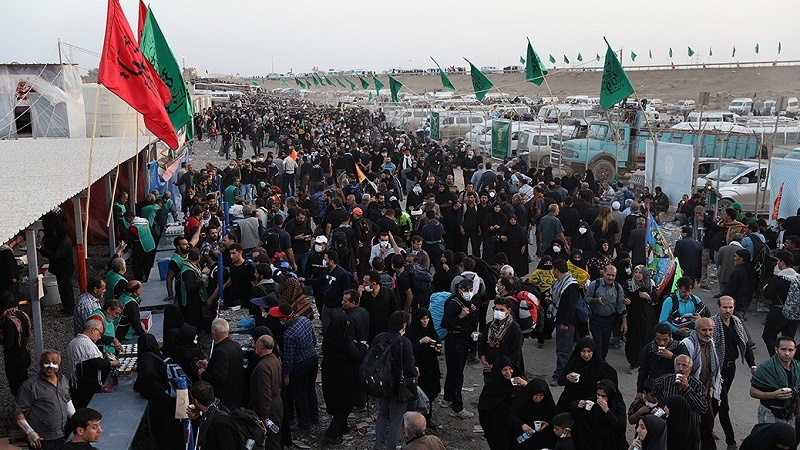
Arba’een is marked with long walks – from Najaf al-Ashraf or from Basra further south on the Persian Gulf, to Karbala al-Mo’alla. People come from different parts of the world, have different skin-colours, speak different languages, and belong to different cultures, ethnicities, and sects. They make their journey on foot. The journey from Najaf to Karbala is almost 85km and it takes about 3 to 4 days, whereas from Basra it is about 500km.
The pilgrims coming from Najaf al-Ashraf start their journey from the shrine of Imam Ali alaihis-salaam. In this sea of human beings flowing towards Karbala there is no discrimination between the rich or poor, between young or old, between Arabs or non-Arabs, and between men or women. Children walk with parents in short steps, the elderly who can barely walk cover this journey in wheelchairs, and even the disabled hobble along, step-by-step, supported by nothing but crutches and an iron will to travel to salute Imam Husain (AS).
The only one thing which is common in all these is that every eye is moist, every heart is torn with grief and they are all chanting in one tune “Labbaik Ya Husain” which means “Here we are O Husain” – to your call for help on the day of Ashura that went unanswered. They all believe that Imam Husain (AS) is a universal, borderless, and meta-religious symbol of freedom and compassion.
During the reign of terror of the repressive Ba’th minority regime, especially the 24 years that the tyrant Saddam was in power in Baghdad, this pilgrimage was banned. At that time people used to perform it secretly but their number was less. It was revived when Saddam and the Ba’thists were toppled in 2003 and since then the number of pilgrims have started to increase every year.
Last year the number of pilgrims was more than 20 million, despite the threats of the Takfiri terrorists – supported by Saudi Arabia, the US, and the illegal Zionist entity. This year it is estimated that some 30 million pilgrims would be visiting Karbala.
Under ordinary conditions, it seems impossible to make arrangement for more than 20 million people travelling this long. But surprisingly, thousands of local people gather to help these visitors and the level of service they provide is unprecedented. They set up thousands of tents with makeshift kitchens to serve these pilgrims. These tents are called Mawakebs which are devised with the aim of providing accommodation, food, beverage, medical services and practically anything else the pilgrims need for and all these things are free of any charge. In fact, they do their level best that these pilgrims should not find themselves alone and without help at that moment.
If anyone is tired and wants to rest, all the houses on the way are opened for him and the owners of these houses happily become their servant. These homes and Mawakebs have the best facilities to fulfil the needs of pilgrims.
The pilgrims do not need to carry anything on this journey except the clothes and shoes they wear. What is more astonishing is that Mawakeb organizers respectively beseech these pilgrims to accept their hospitality
They plead to them. They provide them every minor thing like tissue paper, tooth pick etc. Their cloths are washed and ironed, shoes are mended and all of course complimentary. Those who have nothing to offer, serve them by massaging their feet and legs. In short they do not leave even a single opportunity to serve them. They consider the acceptance of their offers as an honour bestowed upon them by God for the sake of Imam Husain (AS).
Every single volunteer is more grateful to the visitor than vice-versa. After witnessing such love and passion of these providers of service, one is left in bewilderment that either these are humans or angels disguised as service providers.
Arba’een is no doubt a revolution. It is a revolution to demonstrate to the whole world that Islam is a religion of peace, love and care for others. It is an occasion where one can witness doctors and physicians are serving for free, scholars sitting on the sand and guiding the youth, poor are feeding the hungry and sick people are serving the healthy.
It is an event where women are walking with pride and dignity despite of being exhausted and children are enthusiastic and taking long strides with smile on their face. One can witness hope, love, kindness, truth and sacrifice.
A war-stricken and wounded nation is embracing the whole world in the name of one who is slaughtered in the desert of Karbala after being kept thirsty and hungry for three days. There are lessons to learn from this spiritual walk. It is an event in which people participate regardless of their sect, profession and social status. There is no one who asks about religion or sect. Every pilgrim is honourable and treated like royalty. If someone wants to witness the unity of the Muslim Ummah and wants know about the teachings of the Prophet of Islam in practical form, he/she can take part in the Glorious Spiritual Walk of Arba’een – the Greatest gathering anywhere in the world.
AS/ME
Tags