How and why U.S. is suffocating own people
-
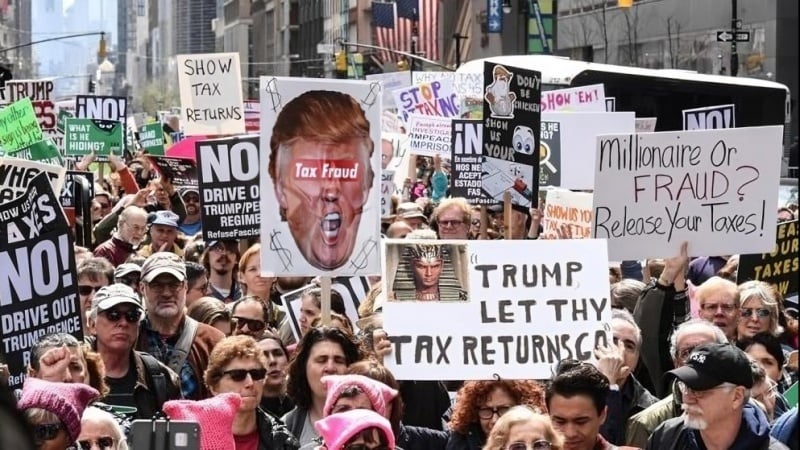
Protests erupt across U.S. against Trump’s policies and actions
Pars Today – The U.S. government, through its policies and actions, has increasingly tightened the space for its own citizens, creating mounting pressures on the population.
According to Pars Today, the American magazine Newsweek, in an article dated 24 November 2025 titled “U.S. Says Iran Is Suffocating Own People,” listed instances in which, according to the author’s imagination, Iranian citizens are allegedly under pressure from their government.
This war-supporting website’s article is notable because, in a way, the author indirectly reflects on the policies and actions of the Trump administration, which have actually suffocated the American people.
The following are examples of the suffocating pressures imposed by the U.S. government on its own citizens:
Destructive economic policies
The economic policies of the Trump administration have effectively increased suffocating pressures on the American people, placing heavy burdens on them and causing serious problems for many middle- and low-income groups.
One of the most significant issues has been the tax cuts for large corporations and the wealthy, which, instead of improving overall conditions, have widened the wealth gap. While the rich benefit from these policies, government funding for social services has decreased, placing even greater pressure on lower-income groups.
Additionally, trade wars and heavy tariffs against China and other countries have led to rising prices for imported goods. These policies have particularly affected the agriculture sector and small industries, raising the cost of living for American citizens.
Moreover, cuts to welfare and healthcare programs have left many families with reduced access to medical services and social support. Combined with rising insurance costs, this has intensified economic pressure on households.
Finally, Trump’s policies, with their focus on the interests of major energy and financial corporations, have often neglected environmental concerns and workers’ rights. The result of this approach has been rising household debt, decreased job security, and a widespread sense of economic “suffocation” among the American people — a situation that demonstrates how Trump’s policies have largely benefited the wealthy while disadvantaging the majority of society.
Deteriorating environmental conditions
During both of Trump’s presidential terms, the U.S. environment faced serious challenges in air, water, and soil pollution. His administration’s policies, largely focused on reducing environmental regulations and supporting major industries, have had widespread negative impacts on public health and the sustainability of natural resources.
One major action taken by the Trump administration was withdrawing from the Paris Agreement and reducing U.S. commitments to cut greenhouse gas emissions. This decision allowed many energy-intensive industries, particularly coal and oil, to operate without serious restrictions, contributing to rising air pollution in major cities.
At the same time, budget cuts to the Environmental Protection Agency (EPA) have limited the agency’s ability to monitor air quality and control pollutants.
In the water sector, Trump administration policies weakened the Clean Water Act, resulting in many rivers and wetlands losing protective coverage and allowing pollution from industry and agriculture to enter drinking water sources. Crises similar to what occurred in Flint, Michigan have worsened in other areas, raising serious public health concerns.
Regarding soil, the reduction of regulations on agricultural and industrial chemicals has increased the entry of nitrates and heavy metals into farmland, affecting not only the quality of food products but also disrupting natural soil cycles and ecosystems.
Overall, the Trump administration’s policies, with their focus on short-term economic gains and reduced environmental oversight, have exacerbated air, water, and soil pollution, creating consequences that are already visible in public health and the environment across the United States.
Water crisis
The United States is currently facing a serious water crisis, with both shortages and contamination of drinking water affecting the lives of millions. This situation is largely the result of misguided policies or mismanagement by the U.S. government, particularly during the Trump administration.
Climate change, prolonged droughts, and aging infrastructure have further exacerbated the crisis. Even in large and wealthy cities such as Los Angeles and New York, a phenomenon known as “plumbing poverty” has been reported, where families lack reliable access to tap water due to high living costs.
In addition to scarcity, drinking water contamination remains a major problem.
Aging and deteriorating infrastructure has led to the leakage of chemicals and heavy metals into water systems. In addition, the widespread use of industrial and agricultural chemicals has increased the entry of nitrates and hazardous compounds into water sources. In some areas, contaminant levels exceed U.S. Environmental Protection Agency (EPA) standards, posing serious threats to public health.
This crisis not only endangers people’s health but also puts pressure on agriculture, industry, and food security. Water shortages have driven up the cost of agricultural products and contributed to internal migration, while contaminated drinking water has eroded public trust in the government and responsible agencies.
The water crisis in the United States is a combination of resource scarcity and widespread pollution. It has the potential to become one of the greatest social and economic threats to the country in the coming decades.
Rising homelessness
The economic and social policies of the Trump administration have had a significant impact on the increase of homelessness in the U.S. One of the main factors has been cuts to welfare and social programs, which have left many low-income families without government support.
Reductions in investment in public housing and rental subsidies have made it increasingly difficult for people to afford skyrocketing housing costs. At the same time, tax policies favoring the wealthy and large corporations have widened the wealth gap and intensified economic pressure on lower-income groups.
Additionally, rising healthcare and insurance costs have pushed many families to the brink of bankruptcy, ultimately forcing them into homelessness.
Furthermore, the Trump administration’s focus on deregulation and support for a free market—without considering its social consequences—has led to unprecedented increases in housing prices in major cities. This trend has worsened the homelessness crisis, particularly in states such as California and New York.
Overall, Trump’s policies—through reducing social support, raising living costs, and neglecting vulnerable populations—have created conditions that have pushed thousands onto the streets. This situation is not only a social crisis but also a serious threat to public safety and health in the United States.
Rising gun violence
The Trump administration’s policies, with full support for gun ownership, have effectively led to an increase in mass shootings in the U.S. The repeal or weakening of legal restrictions has made semi-automatic weapons more easily accessible, creating conditions for large-scale killings in schools, shopping centers, and public spaces.
Statistics show that during Trump’s presidency, the number of mass shootings grew significantly, leaving many victims. This approach has not only undermined public safety but also represents a clear failure of the government to protect citizens’ lives, with profound social and psychological consequences for American society.