World’s largest-longest mass walk gathering momentum in Iraq
Nov 07, 2017 12:13 UTC
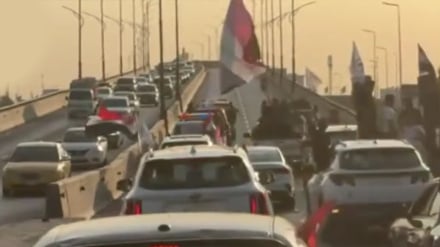
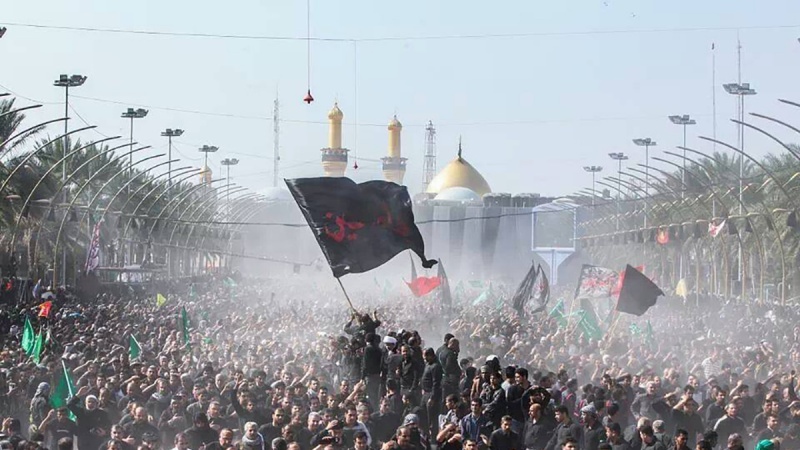
As we near the anniversary of Arba’een or the annual traditional 40th day of the martyrdom of Imam Husain (AS), tens of millions of pilgrims from throughout the world are converging on Iraq, and steadily walking towards Holy Karbala from all directions, especially from Holy Najaf.
The peaceful throng of devotees, over ten times more than the annual Hajj pilgrimage, has once again drawn the world’s attention to what is considered the largest and longest mass walk, since pilgrims come on foot from places as far apart from Holy Karbala, such as Basra in the south and Mosul, Kirkuk and other places in the north.
Once again Karbala has opened the eyes of the world to the peaceful, orderly, dignified, amicable and humanitarian nature of Islam, despite the feverish efforts of the western, Arab and Zionist media to ignore it.
The disciplined gathering, during which millions travel on foot from different directions, especially the 85-km road from the holy shrine of Imam Ali ibn Abi Taleb (AS) in Najaf, is a slap in the face of not just the fast vanishing Saudi-backed Takfiri terrorists, who had threatened in vain to attack the pilgrims with bombs and missiles, but their godfathers the Americans and the Zionists. This has aroused the conscience of contemporary mankind towards the transcendental message of freedom of human societies, as taught by the grandson of Prophet Mohammad (blessings of God upon him and his progeny). Stay with us for an interesting article in this regard by political analyst Catherine Shakdam.
Arba’een is the 40-day mourning period following Ashura, the religious ritual for the commemoration of the martyrdom of the Prophet of Islam’s grandson in 61 AH corresponding to 680 AD – one last goodbye from a community in mourning. Antoine Bara, the prominent Lebanese writer, wrote in his book: 'Husain in Christian Ideology:' “No battle in the modern and past history of mankind has earned more sympathy and admiration as well as provided more lessons than the martyrdom of Husain in the Battle of Karbala.”
This year, 30 million pilgrims are expected in Iraq to enact an allegiance which stands beyond all matters of religious denominations, ethnicities and political affiliations. For the love of one man, Imam Husain ibn Ali (AS), whose sacrifice saved Islam, tens of millions came from all directions. Unlike the Hajj to the holy Ka’ba in Mecca, which remains an obligation for Muslims, the pilgrimage of Arba’een sits well beyond a simple exercise in piety, or religious duty; Arba’een speaks of allegiance and remembrance. Arba’een, which ranks as the largest rally on the planet, serves, I believe, as a mirror to our humanity, an affirmation that our true nature lies in our ability to push against injustice on behalf of those whose voices were stolen away. 'The Great Walk,' as many have called it, has towered mighty in the face of oppression – whatever its forms, whatever the agenda, and whomever it has intended on persecuting. Never before has the world witnessed a greater rally against the terror of Wahhabism and the abominations it has brought in its wake. The old, the young, the disabled - men, women, from all four corners of the globe - have come with one name on their lips, across faiths, beyond faiths they have come together to speak against the horror of radicalism and consecrate Freedom as an inalienable human right.
You would think that in times such as ours, when bigotry, prejudices and rampant fascism threaten still to engulf us, media would use Arba’een as a reminder of what could be when communities stand united – hope that harmonious unity is in fact feasible. However, silence is what the mainstream has offered instead. Why offer hope when despair offers such enticing benefits? Why fathom that Islam is not in fact sectarian or hateful when painting communities under the terrible brush of Wahhabism allow for the institutionalization of Western military interventionism? Why indeed?
Regardless, and most probably in spite of corporate media’s shunning, Arba’een pilgrims have walked more numerous every year to the shrine of Imam Husain (AS), right under the nose of the Wahhabi Caliphate – very much an echo to the Imam’s own stand against the army of Yazid in Karbala, when deception was called righteous and courage a rebellion. It is maybe that Karbala speaks too loudly of a history which Wahhabism would like to negate that pilgrims and those most loyal to Imam Husain (AS) have suffered persecutions after persecutions. Shi’a Muslims, it needs to be said have been mocked, killed, tortured, and overall branded heretics for they have always refused to bow to tyrants and the demand to abandon Islam’s spiritual legacy.
In his book, 'Force and Fanaticism: Wahhabism in Saudi Arabia and Beyond,' Simon Ross Valentine writes: “In their raids onto Hijaz and Iraq the contempt the Wahhabis had for Shi’a Muslims was seen in their destruction of Shi’a holy relics and tombs.”
Valentine refers to the early 19th century, when savage Wahhabi hordes burst out of Najd to attack and loot Karbala, before attacking the holy cities of Mecca and Medina and desecrating the sanctities of Islam, until the Egyptian army of Mohammad Ali Pasha drove them back and destroyed their capital near modern Riyadh, in addition to dispatching the Aal-e Saud chieftain to Istanbul for public execution for blasphemous crimes in Iraq and Hijaz.
Fast-forward a few centuries and nothing has changed: same blind hatred for historical artifacts and religious pluralism. Where Wahhabism – Saudi Arabia’s state cult, has worked to disappear religious sites across Arab states in West Asia, to better deny that other faiths once breathed their own beliefs without fear of repression, the Shi’a Muslims, as the followers of the Prophet’s blessed household, the Ahl al-Bayt, are known, have safeguarded Islam’s heart, its traditions, and its principles in the holy city of Karbala, and from behind its walls promised all safe refuge and peace.
Pilgrim Zainab Hussain from the Baqee Organization defined the spirit and purpose of Arba’een most eloquently when she told me: “Arba’een stands today as the greatest pilgrimage of all times. The words of Imam Husain (AS) "Those who are silent when others are being oppressed are guilty of oppression themselves", inspire an ordinary human being to defy all laws of humanity & sacrifice everything in pursuit of truth.” Arba’een today is a symbol of interfaith tolerance, a symbol of resistance in the face of terror. Zainab Hussain further said: “Arba’een is unparalleled, and unadulterated generosity.”
Arba’een unites and brings on a single platform not just Shi’a and Sunni Muslims, but also Sufis, Christians, Zoroastrians, Hindus, Sufis and followers of countless other schools of thoughts united in one Resistance, and one Declaration of Freedom. Maybe we ought to listen to those fires lit up in Karbala for they speak of our collective hopes, our yearning for dignity and peace.
Yet despite the apparent truth of Karbala, especially on the day of Arba’een, there will always be those who chose to see heresy. Of course, there will always be those powers which seek to drown hope to better promote mistrust and argue secular ethno-centric political righteousness to assert their systems of enslavement.
Truth means that freedom requires bravery … maybe it is courage more than tolerance we ought to master to defeat the abominable rise of Wahhabism across our continents. Maybe we could do with a good old reality check since we continue to blame the oppressed for the horrors tyrants dispensed them, rather than challenge tyranny itself.
Only if for a few days the pilgrimage of Arba’een manages to do what military superpowers have failed to accomplish – to keep Terror at bay. Arba’een today has risen in defiance of the greatest threat of all: that of Terror, that of fanaticism and religious persecution, that of division and indoctrination. To reclaim their humanity and proclaim their right to breathe free in their differences 30 million of men and women have come to Karbala, the very land which saw a hero fall, and a movement born. Arba’een is not exclusively Shi’a Muslim – it long transcended any, and all religious labels … Arba’een is like the station of Imam Husain (AS), immovable, universal, ever-lasting.
I personally gain comfort in the knowledge that there is still a space where all people belong, and none are turn away, a safe-haven where generosity is not dispensed in cold arrogance but acceptance. So yes, amid the tumultuous waters of geopolitics, Arba’een comes a welcomed respite. Go on look for yourself and meet the movement of Imam Husain (AS), you might find it speaks those principles you claim for yourself.
AS/EA
Tags