Religious Fraternity in the Qur'an and Hadith
Nov 23, 2018 15:09 UTC
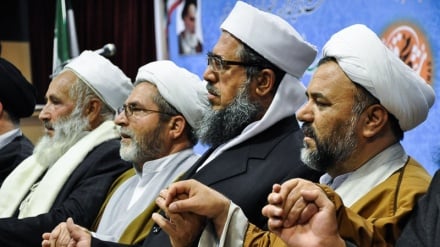
In the Name of God, the All-Compassionate, the All-Merciful. As you know we are marking the Islamic Unity Week which was the initiative of the Father of the Islamic Revolution, Imam Khomeini (RA), to bridge the two dates of the month of Rabi al-Awwal, that is, 12 and 17, respectively believed by the Sunni and Shi’a Muslims to be the birthday of Prophet Mohammad (blessings of God upon him and his progeny).
Today, we present you the 5th episode of the series titled: “Religious Fraternity in the Qur'an and Hadith”.
The holy Qur'an mentions unity as a special bounty and considers God as the Main Source of unity. This noble book also calls on the faithful to safeguard unity while remembering the bitter era of disunity and differences. The noble Qur'an refers to the era of ignorance as the time of differences and discord which turned into unity and cooperation through the bounty of Islam. Ayah 103 of surah Al-e Imran reads in his regard:
"And hold fast to the cord of God all of you and do not be dispersed. And remember God's blessing upon you when you were enemies, then He brought your hearts together, so you became brothers with His blessing."
Thus, according to Islam’s world view, the universe has been created on the basis of monotheism. As monotheism is an innate principle, all Muslims believe in it and indeed it is the main factor for unity, not just among the various Muslim denominations but among followers of the revealed religions.
Faith in God brings hearts of the faithful so close to each other as if they were a single spirit in myriads of bodies. Ayah 92 of surah Anbiya is a reference to this, "Indeed, this Ummah of yours is a single Ummah and I am your Lord, so worship Me."
Exegetes of the holy Qur'an maintain that Single Ummah means the one in which there is no difference and all are unanimous concerning the fundamental principle of Tawhid (monotheism).
Of course, this should be taken into consideration that although inclination toward monotheism is an innate issue, like other innate issues, it should be the focus of proper attention. Inattention to it may fail its thriving or expose it to various hazards.
Islamic fraternity has been mentioned in the noble Qur'an several times. It plays a significant role in creation and bolstering of unity of the Islamic Ummah. Many ayahs refer to religious fraternity as a pivotal factor for expansion of unity and solidarity and an important cause of fighting any kind of discord and hypocrisy. God points to a general rule in ayah 9 of surah Hujurat, "And if two groups of the faithful fight one another, make peace between them."
The next ayah more emphatically explains the reason for this, "Indeed, the faithful are brothers. Therefore, make peace between your brothers and be wary of Allah so that you may receive mercy."
This ayah reiterates that the faithful should behave like brothers. And if they have become distanced from each other, others should try their best to bring them closer to each other once again and make peace among between them. Islamic fraternity is a great bounty that God has granted His servants. God says in ayah 63 of surah Anfaal, "And He united their hearts. Had you spent all that is in the earth, you could not have united their hearts, but God united them together. Indeed, He is All-Mighty, All-Wise."
No doubt, unity is achievable in the light of obedience to God and His Messenger, as is stressed in ayah 46 of surah Anfaal, "And obey God and His Prophet, and do not dispute, or else you will lose heart and your power will be gone. And be patient; indeed, God is with the patient."
Unity means becoming one and consistent. As per Islamic terminology, it refers to insisting on basic commonalities by the various denominations while keeping their specific differences. It means converging on the contents of the holy Qur'an, on the dynamic personality of the Prophet, on the focal point of prayer the Qibla, on the Hajj pilgrimage, on the blessed month of Ramadhan, and so on. It means abandoning racial, political as sectarian differences.
Differences among religious groups are natural but they have to be debated in scientific circles. Differences are mostly on secondary issues rather than the fundamental principles. This gains more momentum when the enemies of the Islamic Ummah are hell bent on exterminating or at least weakening Muslims irrespective of their denomination.
Imam Ali (AS) explains in the famous book, the Nahj al-Balagha how Muslims were superior when they were united. He says in Sermon 191, known as “Khutbat-al-Qase’ah or Sermon of Disparagement:
“Look, how they were when their groups were united, their views were unanimous, their hearts were moderate, their hands used to help one another, their swords were intended for assisting one another, their eyes were sharp and their aims were the same. Did they not become masters of the corners of the earth and rulers over the neck of all the worlds? Thereafter, also see what happened to them towards the end when division overtook them, unity became fractured, and differences arose between their words and their hearts. They divided into various groups and were scattered fighting among themselves. Then Allah took away from them the apparel of His honour and deprived them of the prosperity produced by His favours. Only their stories have remained among you for the guidance of those who may learn the lesson from them.”
In another sermon, the Commander of the faithful says, “Avoid disparity in religion, for, solidarity and unity in the path of truth, though you may dislike it, is better than disparity in the path of falsehood, even if you like it; because God has not granted neither the past generations nor the future ones anything through discord.”
Imam Ali (AS), as the divinely-designated heir of the Prophet, was himself a flag-bearer of unity and solidarity as he kept silent for 25 years when he saw that safeguarding the consistency of the Islamic community is more important than disputing over his divine right of leadership of which he was deprived.
Years later, he said, "After the passing away of God's Messenger, we the Ahl al-Bayt didn't think that the Ummah would be greedy on our right; but what had not been expected took place. They usurped our right. But I pondered to myself and found that patience is better than perturbing the unity of Muslims and shedding their blood, for, people were neo-Muslims and the nascent religion is like a goat-skin water bag which will be destroyed with the least lethargy and the weakest person can make it upside down. By God, had there been no fear of discord among Muslims and returning to unfaith and decadence of religion, we would have treated them otherwise."
A very important point to be heeded is farsightedness and shunning bigotry and bias. In other words, every Muslim should contemplate the outcome of every action or word before doing or uttering it. Imam Ali (AS) says, "If you have to be biased, be biased on good morals."
RM/AS/SS
Tags