Iran FM says US ‘directly responsible’ for protraction of Vienna talks
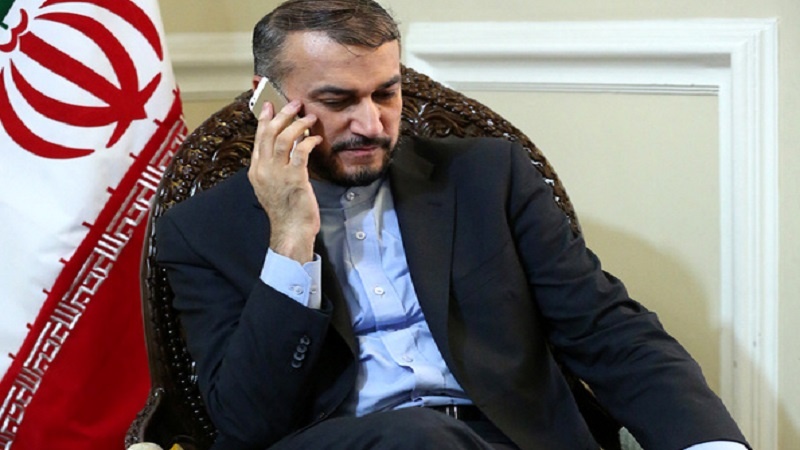
Iran’s foreign minister has blamed the United States for the protraction of the Vienna talks on the revival of the 2015 Iran deal, saying Tehran is ready for a good and sustainable agreement in the Austrian capital.
According to Press TV, during a phone conversation with Omani Foreign Minister Badr al-Busaidi on Sunday, Hossein Amir-Abdollahian criticized the US for re-imposing sanctions on Iranian individuals and companies.
He stressed that “The Islamic Republic of Iran is ready for a good and sustainable agreement, but so far the American side, by some of its excessive demands, has been directly responsible for the protraction of the talks.”
Negotiations have been held in the Austrian capital since last April to restore the accord, officially known as the Joint Comprehensive Plan of Action (JCPOA), which was ditched by former US President Donald Trump in May 2018.
In quitting the agreement, Trump introduced what he called the “maximum pressure” campaign to bring Iran to its knees. Tehran maintains that the policy has failed dismally. The Joe Biden administration agrees, yet it has not taken any tangible steps to deliver on its promise of repealing the policy.
In recent months, Iran has cited Washington’s indecisiveness as the reason behind the protraction of the talks, as a number of key issues remain unresolved, ranging from the removal of all post-JCPOA sanctions to the provision of guarantees by the American side that it will not leave the deal again.
The other parties to the talks – Russia, China, France, the UK, and Germany – have also noted that the negotiators are close to finalizing an agreement.
Earlier on Sunday, Amir-Abdollahian told Secretary General of the United Nations Antonio Guterres that the negotiating parties in the Vienna talks are close to reaching a final agreement, adding that the ball is now in US court.
Siege on Yemen must be lifted: Iran FM
During the phone conversation, Amir-Abdollahian and al-Busaidi also discussed bilateral ties and regional and international developments, including a recent truce brokered by the United Nations between the military coalition led by Saudi Arabia, which has been waging a war on Yemen since 2015, and Yemen’s National Salvation Government.
Oman’s top diplomat welcomed the ceasefire and thanked Tehran for its role and efforts in this regard, expressing hope that the truce would pave the way for talks between all Yemeni sides and the reopening of the country’s borders.
The Iranian minister also appreciated Oman’s constructive role in this regard and hoped that the ceasefire would last.
He underlined the importance of the complete lifting of the inhumane siege imposed on Yemen and the need for sending humanitarian assistance to the Yemeni people.
ME