
What lies behind scenes of unrest on Iran’s streets
-
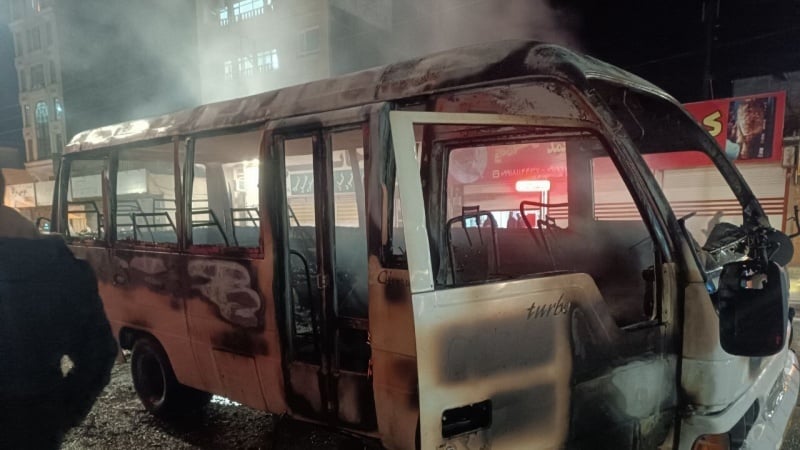
One of the public vehicles that was set on fire by rioters in Iran
Pars Today – Recent protests in Iran have been pushed toward unrest due to foreign interference.
Following the military failures of Israel and the United States in the 12-day war, and their inability to achieve the most important goal they had declared at the outset of the war—namely, changing the system of the Islamic Republic of Iran—Donald Trump announced that economic pressure on Iran would be maximized. According to Pars Today, these pressures led to a rise in foreign exchange rates in Iran, which in turn triggered protests by market traders due to currency instability.
On the other hand, Netanyahu took to the podium and called on the Iranian opposition—just as he had requested during the 12-day war—to take to the streets; something that did not happen during that period and caused surprise and frustration for him and his media team. In these remarks, he explicitly reaffirmed that the strategy of “the collapse of Iran’s system from within” is on the agenda.
The issue of economic changes in Iran
Iran’s adversaries used economic pressure to fan the flames of unrest in the country. One of the reasons these pressures had an impact is Iran’s dual exchange-rate system. In order to exert greater control over the country’s foreign exchange situation, the Iranian government introduced changes to this economic structure. The most significant effect of these changes at the macroeconomic level was the removal of subsidies on certain goods and the direct transfer of those funds into the bank accounts of Iranian citizens.
However, at the microeconomic level, the result was an increase in the prices of some goods. This rise in prices led to dissatisfaction and protests among segments of Iranian society. What occurred alongside this, however, was the “hijacking of the Iranian people’s protests” and the “orchestration of violence” from beyond Iran’s borders by the country’s enemies.
Hoping in the son of the deposed Shah to escalate unrest
In a peculiar move, the United States and Israel sought—through an extensive media war—to divert the leadership of peaceful and nonviolent economic protests and place it in the hands of Reza Pahlavi, the son of Iran’s deposed shah. The deposed shah, when fleeing Iran, took national jewels and a significant portion of the Iranian people’s national treasury with him—an act that has fueled Iranian public resentment over the decades since the overthrow of the Pahlavi regime.
Although Reza Pahlavi has no real social base among Iranians, heavy media spending has enabled him to keep his name alive among segments of the anti-Iran opposition. Much of the strong resentment toward him—beyond his association with the Pahlavi dynasty—stems from his conduct during the 12-day war. Throughout that war, Reza Pahlavi supported the attack on Iran and met repeatedly with Israeli officials!
At the same time, even the enemies of the Islamic Republic of Iran have on several occasions acknowledged that he lacks the capacity to assume such a role; nevertheless, they continue to use him as a pawn because, in their view, he is the only “brand” through which—by exploiting nostalgia-inducing techniques—they can mobilize a segment of Generation Z. In recent days as well, according to reports by Israel’s Channel 14, Reza Pahlavi has met with certain Israeli officials.
Claiming command of the war
However, the United States and the Zionists have not limited themselves to relying on this “burnt-out brand.” These days, Trump has sent messages under various titles claiming to stand with the protesters amid the unrest. This comes despite the fact that he has repeatedly admitted that he commanded the 12-day war—a war in which hundreds of Iranian women, children, and civilians were martyred.
Yet, in blatant audacity, he now declares himself alongside the Iranian people, while also admitting that his forces (agents) are present on Iran’s streets. On the other side, the Zionists—who were the main perpetrators of the crimes during the 12-day war—not only support these efforts but have openly stated that Mossad operatives are active on Iran’s streets.
Infiltrated terrorists
In this way, the peaceful protests of the Iranian people were turned violent due to the interventions of Iran’s enemies. Upon noticing abnormal behaviors among the demonstrators, Iranians immediately tried, as much as possible, to prevent violence by some of the disruptive agents. However, the enemies—who had been planning the “orchestration of fear and violence” in Iran for months—deployed their trained and armed operatives into the field.
Some mosques, private property such as cars and motorcycles, and public assets—including banks, fire trucks, and even Red Crescent centers—were set on fire. The Iranian Ministry of Interior described the situation as a “hijacking of the people’s protests” and stated that certain elements and organized groups, using firearms, had killed innocent civilians and public security personnel.
The scale of violence and damage to public and private property revealed the presence of trained foreign agents to all Iranians. Over the past two days, the Iranian people, by distancing themselves from the rioters, have stood alongside Iran’s security forces to confront the troublemakers and restore calm to the country’s cities.