Why Iran insists on its right to peaceful uranium enrichment?
-
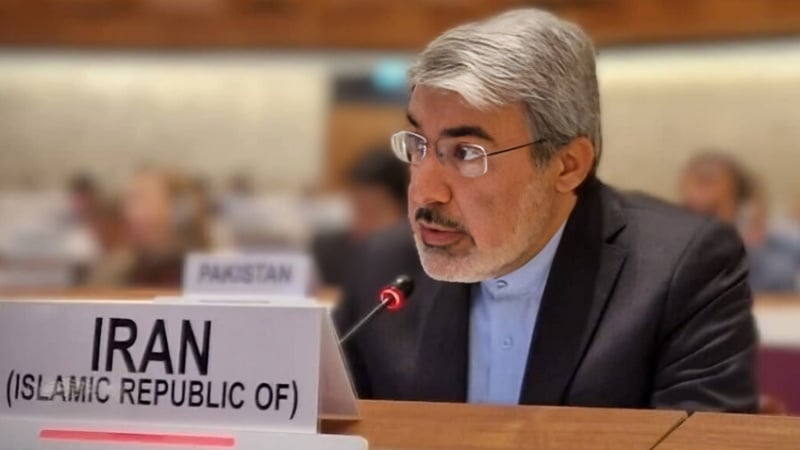
Ali Bahreini, Ambassador and Permanent Representative of the Islamic Republic of Iran to the UN Office in Geneva
Pars Today – Iran has announced that it will never relinquish its right to peaceful enrichment.
According to Pars Today, Ali Bahreini, Ambassador and Permanent Representative of the Islamic Republic of Iran to the United Nations Office in Geneva, stated on Tuesday, January 20, at a meeting of the Conference on Disarmament that Tehran will never give up its right to peaceful enrichment.
Condemning the recent attacks by the United States and the Israeli regime on Iran’s nuclear facilities, Bahreini described these actions as a clear violation of the UN Charter and international law, and as a serious blow to the nuclear non-proliferation regime (NPT).
Referring to developments in 2025, Bahreini described the June 13 attack by the Israeli regime on the territorial integrity and political independence of the Islamic Republic of Iran as “illegal, premeditated, and in violation of peremptory norms of international law,” adding: “Following this aggression, on June 22 the United States, in coordination with a regime that is not a party to the NPT, targeted Iran’s safeguarded nuclear facilities in Fordow, Natanz, and Isfahan. This act constitutes a serious threat to international peace and security and to the non-proliferation regime (NPT).”
The Iranian representative emphasized: “Within the framework of the UN Charter, the Islamic Republic of Iran will respond to any act of aggression, and the enrichment of uranium for peaceful purposes is a legitimate and undeniable right of Iran as a member of the NPT, from which it will never retreat.” At the same time, he stressed that Iran has always been ready for genuine negotiations, without preconditions and based on mutual respect.
Iran’s insistence on its right to peaceful enrichment stems from a set of legal principles, strategic needs, historical experiences, and security considerations. This issue is not a temporary demand, but rather part of Iran’s legal and political identity on the international stage. In contrast, Western countries, by raising claims about the potential diversion of Iran’s nuclear program toward military objectives, have sought to restrict this right—claims that are not defensible from the perspective of international law or technical realities.
One reason for Iran’s insistence is the clear and legal right of countries under the Treaty on the Non-Proliferation of Nuclear Weapons (NPT). The treaty explicitly states that all members have the right to access the full nuclear fuel cycle, including uranium enrichment, for peaceful purposes. As an NPT member, Iran not only enjoys this right, but has for years operated under strict supervision by the International Atomic Energy Agency (IAEA), which has repeatedly stated that no diversion has been observed in Iran’s nuclear program. Therefore, opposition to Iran’s enrichment in fact constitutes a blatant violation of the rights of a treaty member.
Another reason is Iran’s genuine need for energy and the diversification of energy sources. With a large population and growing energy consumption, Iran cannot rely solely on fossil fuels. Nuclear energy is one of the most sustainable and economical options for the future. Moreover, Iran has faced extensive sanctions and cannot rely on foreign countries to supply fuel for its power plants. Past experiences of the suspension of nuclear cooperation by technologically advanced countries, or Western political pressure, have shown that dependence in the energy sector can be turned into a tool of pressure. Therefore, domestic fuel production is a strategic necessity.
Another factor is scientific and technological independence. Over decades of effort, cost, and pressure, Iran has succeeded in acquiring indigenous enrichment technology. Retreating from this achievement would mean accepting permanent dependence and scientific backwardness. Western countries are well aware that enrichment is a symbol of Iran’s technological independence, which is why they seek to restrict it.
On the other hand, the West cites various pretexts for opposing enrichment. The main claim is the possibility that Iran’s nuclear program could be diverted toward the production of nuclear weapons. This claim is raised despite the fact that the IAEA, in dozens of official reports, has emphasized that there is no evidence of such diversion. Iran had also accepted the most extensive level of inspections, even beyond its obligations under the NPT. Therefore, the claim of a risk of militarization of Iran’s nuclear program lacks technical and legal foundations.
Another pretext is the West’s political distrust of Iran. This distrust is rooted more in geopolitical disagreements than in technical issues. The Zionist regime and some Western governments are concerned about Iran’s scientific empowerment and comprehensive independence, and seek to contain Iran’s strategic capabilities by imposing nuclear restrictions. However, this approach is not only illegal, but also contradicts the principles of equality of states in international law.
Ultimately, Iran’s insistence on its right to enrichment is not a temporary political stance, but a defense of its legal rights, energy independence, scientific progress, and opposition to Western double standards. Experience has shown that retreat in this area only leads to increased pressure and more hostile behavior by the West, led by the United States, whereas insistence on legitimate nuclear rights—especially the right to enrichment—consolidates Iran’s position as an independent and law-abiding actor.