Is Trump in free fall?
-
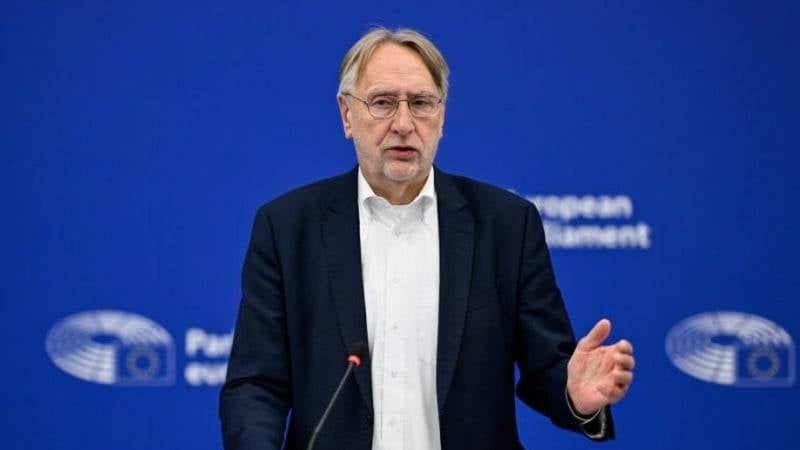
Bernd Lange, chairman of the International Trade Committee of the European Parliament
Pars Today – The chairman of the International Trade Committee of the European Parliament described Donald Trump as being in “free fall.”
According to Pars Today, Bernd Lange, chairman of the International Trade Committee of the European Parliament, welcomed the ruling of the U.S. Supreme Court against Trump and described him as being in a state of political decline.
Commenting on the Supreme Court’s decision against Trump’s tariff plans, he said he was confident the court would rule in that manner. He noted that Article I, Section 8 of the U.S. Constitution clearly assigns trade and tariff policy to the U.S. Congress.
He added that the Supreme Court hearing held in December 2025 also showed that consensus among the justices was decisive.
Bernd Lange said that points of disagreement between United States and Europe are continuing to emerge beyond the scope of trade agreements. He noted that although not all announced policies are necessarily implemented, such uncertainty naturally creates significant instability that extends into security policy as well.
He predicted that these tensions and disputes may persist over the next three years during the presidency of Donald Trump. Lange added that Trump is currently in a state of political decline, citing as an example the fact that six Republican lawmakers joined Democrats in voting against his tariff policy toward Canada. He also pointed out that two Republican-led states have joined tariff-related lawsuits in the Supreme Court of the United States, indicating that pressure on Trump is increasing.
He further suggested that if Trump were to lose in the midterm elections, his presidency could potentially end even earlier than expected.
The statement by Bernd Lange, in which he described the situation of Donald Trump as “free fall,” reflects what he considers to be the growing challenges facing the U.S. president. These include the U.S. Supreme Court’s ruling against Trump’s tariff policies and a reported decline in his domestic popularity.
Lange’s remarks are seen not only as highlighting a legal setback but also as signaling the accumulation of multiple crises confronting the Trump administration ahead of the U.S. midterm elections. The factors behind this “free fall” can be grouped into three main areas: declining public approval, legal and economic policy deadlocks, and increasing international isolation.
The first and most significant indicator of the “free fall” of Donald Trump is the sharp decline in his domestic popularity. Six out of every ten Americans are dissatisfied with his performance.
A new survey conducted by The Washington Post–Ipsos between February 12 and 17 shows that 58% of registered voters and 60% of Americans believe Trump is performing poorly in governing the country, with 50% expressing strong opposition to his performance.
Efforts by the U.S. president to persuade the public that inflationary pressure does not exist or is rapidly declining have so far produced no positive results. According to the survey, 65% of Americans say he is performing badly in lowering prices.
A large portion of Americans also oppose his global tariff policies, with 64% expressing disagreement. In addition, amid trade tensions with United States’s partners, disputes with NATO over Greenland-related issues, and threats regarding potential action against Iran, his foreign policy received low approval ratings, with 62% expressing dissatisfaction.
The second factor behind the “free fall” was the major setback in the Supreme Court of the United States, followed by growing turbulence in trade policy.
The court ruled by a 6–3 vote that Donald Trump cannot use emergency powers to impose broad tariffs, placing his policy in a legal vacuum.
Trump’s response to the ruling reflected the deadlock, as he initially promised to impose a new 10% tariff using other regulatory provisions—measures that are temporary and require congressional approval—and later increased the proposed rate to 15%. This “tariff uncertainty” has not only unsettled markets but has also raised the cost of living for American households.
Furthermore, the cancellation of the tariffs reportedly implies the loss of an estimated $2.5 trillion in projected U.S. government revenue over the next decade, while the potential refund of $150 billion in collected duties poses significant challenges to the federal budget.
The third dimension of the “free fall” concerns growing international isolation and the weakening of alliances with the United States’ closest partners.
In this context, Bernd Lange described the ruling of the Supreme Court of the United States as a “positive signal for the rule of law,” emphasizing that even the president of the United States cannot act in a legal vacuum.
He criticized the tariff confusion in U.S. policy and proposed suspending the ratification process of the EU–U.S. trade agreement (known as the Turnberry Agreement), signed in July 2025 between the European Union and Washington, until clearer commitments are provided by United States.
Analysts argue that the court’s decision effectively put one of Donald Trump’s major trade achievements on hold.
Beyond Europe, Trump’s threats regarding possible control of Greenland—even through military options—and his pressure on Canada have significantly damaged relations with traditional U.S. allies.
The Canadian prime minister described these actions as an example of the “death of the rules-based international order.”
In sum, the “free fall” of Donald Trump is the result of the interaction of three crises: a domestic legitimacy crisis stemming from declining popularity and economic dissatisfaction, a legal-institutional crisis following the ruling of the Supreme Court of the United States that limited his executive authority, and an international credibility crisis that has pushed historic U.S. allies away from United States.
These challenges are expected to create a very difficult political outlook for him and the Republican Party ahead of the 2026 midterm elections.