Fateh tactical missile and effective strikes on enemy positions
-
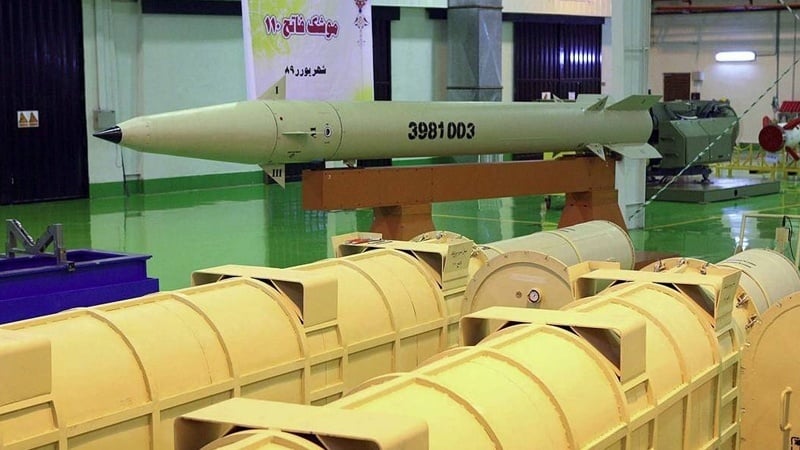
Fateh 110 missile
Pars Today – After the new attack by the US and Zionist regime against Iran, the Aerospace Force of the Islamic Revolutionary Guard Corps (IRGC) launched Operation True Promise 4 in retaliation against enemy positions.
According to Pars Today, following the U.S. and Zionist attack on Iran on February 28, 2026, the IRGC Aerospace Force initiated Operation True Promise 4, which has now completed 78 phases using various ballistic and cruise missiles as well as drones. One of the weapons employed in Iran’s strikes against enemies is the Fateh tactical missile.
In this context, the 58th wave of Operation True Promise 4 targeted locations in the north and center of the occupied territories, including Nahariya, Beit Shemesh, Tel Aviv, West Jerusalem, and U.S. military bases in Victoria, Ali Al-Salem, Al-Kharj, and the Fifth Fleet. The strikes were carried out using precise, point-target Khorramshahr heavy missile systems with 2-ton warheads, Qadr multi-warhead, Fattah and Kheibar Shekan systems, medium-range Fateh and Qiam missiles, and destructive drones in impact-focused operations.
Innovation
In 2002 (1381 in the Iranian calendar), Iran effectively joined the club of solid-fuel missile nations by testing a new missile. Named Fateh-110, it was developed by the Aerospace Industries of the Ministry of Defense and Armed Forces Logistics, marking a new era of missile production for Iran.
Mass production of this missile in various types amazed many missile experts. Using solid fuel in ballistic missiles offers several key advantages.
A ballistic missile—or any missile—requires ignition of fuel to generate thrust, with exhaust gases expelled from the engine to propel the missile forward. While lighter missiles achieve higher speeds, heavier and usually longer-range missiles require more advanced engines for greater acceleration.
Using solid fuel instead of older liquid fuels increases burn time, which enhances range and, even at fixed ranges, significantly improves missile speed. Today, most military missiles use solid fuel, while liquid fuel is more common for space rockets and satellite launchers.
Specifications
The Fateh-110 missile is based on the Zelzal-2 rocket, essentially a guided version with Zelzal-2’s control system. While similar to Zelzal rockets, the Fateh-110 is far more accurate, with a circular error probable (CEP) under 10 meters—a key distinguishing feature.
Length: 8,850 mm
Diameter: 661 mm
Weight: 3,325 kg
Warhead: 450 kg
The Fateh-110 is a guided ballistic missile, using inertial navigation and supplementary guidance technologies. It has a single-stage engine, is ground-to-ground, and can target fixed ground and sea targets, enemy concentration points, command centers, missile sites, ammunition depots, radars, and other objectives with precision.
The missile features fixed triangular fins at the tail and four movable fins at the head for directional control. Its indigenous technology makes it nearly undetectable at launch while remaining controllable until impact.
Variants
Fateh-110 Generation 1 (early 2000s): Range ~200 km
Fateh-110 Generation 2: Range ~250 km, improved guidance and navigation
Fateh-110 Generation 3 (late 2000s): ~50 km increased range over Gen 2
Fateh-110 Generation 4 (2012 / 1391): Solid composite fuel, range >300 km, high precision in all weather conditions. Mass production of Gen 4 allows rapid, accurate strikes with minimal setup and maintenance requirements.
Fateh-313A new member of the Fateh family, unveiled in 2016 (1395), Fateh-313 has the longest range of the family, capable of precision targeting over 440 km.
Weight: 3,245 kg
Length: 8,756 mm
Diameter: 612 mm
Warhead: 380 kg
Uses solid composite fuel for improved flight stability and performance.
With the development of high-precision, long-range ballistic missiles like the Fateh-313, Iran has significantly enhanced its missile capabilities. Other precise ballistic missiles with various ranges and missions based on the Fateh-110 also exist but are not discussed here.
Specifications of Various Fateh-110 Missile Versions
Cruise speed: Mach 3
Engine: Single-stage solid fuel
Thrust-to-weight ratio: 2:1
Flight ceiling: 150 km
Speed: Mach 4.5
Guidance system: Gyroscope + Optical
Accuracy: Precision (point-target)
Range by version:
Fateh-110 Gen 1 – 200 km
Fateh-110 Gen 2 – 250 km
Fateh-110 Gen 3 – 300 km, high accuracy
Fateh-110 Gen 4 – Over 300 km, precision targeting
Fateh-313 – Over 440 km, precision targeting