Analysis – Why Trump backed down from threatening new attack on Iran?
-
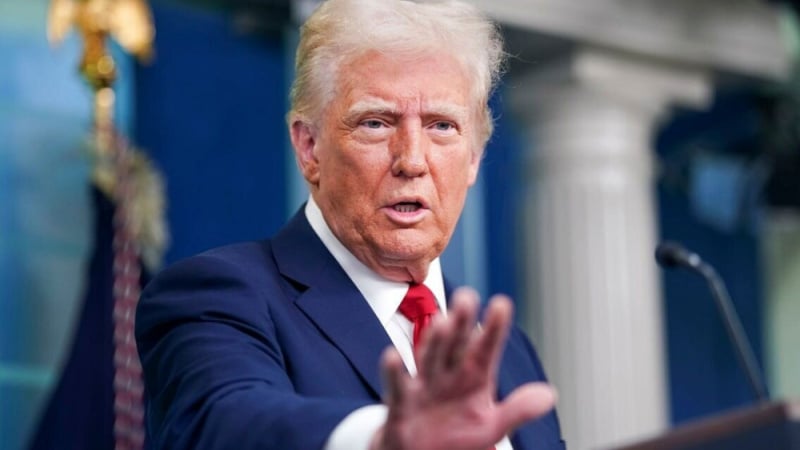
U.S. President Donald Trump
Pars Today – U.S. President Donald Trump has once again abandoned a threatened attack against Iran.
According to Pars Today, in recent days, Donald Trump had threatened to escalate military strikes against Iran, including an alleged attack on Iran’s energy infrastructure. In response, Iran warned that if such a move were carried out, the region’s energy infrastructure would become legitimate targets.
Meanwhile, Trump, by shifting responsibility onto regional countries and claiming that a deal could be reached, once again attributed his retreat to an inaccurate factor. In an apparent reversal, and in a message posted on his social media account, he claimed:
“The U.S.A. is locked and loaded and ready to go against the Islamic Republic of Iran, at levels of Military Terror, Strength, and Power not seen since World War II. Despite this, we have just been asked by Iran, and other Middle Eastern Countries, to hold off any attack in that the perimeters of a deal has been agreed to. This would include the Immediate, Complete, and Total OPENING OF THE HORMUZ STRAIT, and an end to Iran’s nuclear threat.”
Based on multiple indications, it can be argued that U.S. President Donald Trump’s decision to cancel a new military strike against Iran was largely driven by severe domestic and international risks and pressures. These factors include:
- Emergency mediation by regional allies: According to U.S. media reports, Saudi Crown Prince Mohammed bin Salman personally contacted Trump on the day of the decision and urged him to refrain from launching an attack. Prior to that, Saudi Arabia’s defense minister had also emphasized Riyadh’s desire to reduce tensions with Iran during a visit to the United States. The main reason behind these consultations was that Persian Gulf countries feared that, in the event of a large-scale U.S. attack on Iran’s energy facilities, Iran could directly target neighboring countries’ oil and gas infrastructure, making these states the main victims of the conflict. Other regional countries, including Qatar, the United Arab Emirates, Turkey, and Pakistan, also pressured both the United States and Iran to reduce tensions.
- Iran’s firm warning: Through diplomatic channels and public statements, Iran warned the United States that any “adventurous action” would be met with a decisive response. Iran’s Foreign Minister Seyed Abbas Araghchi warned the United States and Israel—which were expected to join a major attack alongside Washington—against any further action. According to a post on Araghchi’s Telegram channel, he told Saudi Foreign Minister Faisal bin Farhan Al Saud: “Any hostile action by the United States or Israel—or the participation or cooperation of regional countries in such actions—will face a firm and proportionate response from Iran’s powerful armed forces.”
Iranian military commanders also announced that their forces were at the highest level of readiness and stressed that any attack on Iran’s energy facilities would be met with retaliatory strikes against Saudi Arabia’s and the UAE’s oil fields, as well as Qatar’s gas facilities and the Israeli regime.
It appears that this explicit threat—that “the price of an attack will be the security of America’s allies”—was a key factor in Washington’s reconsideration of a military strike against Iran.
CNN acknowledged in this regard that despite enduring economic pressure and damage to its military capabilities during several months of attacks, Iran still retains the ability to launch strikes, as demonstrated by the country’s deadly attacks on U.S. forces in the region over the past month.
The Al-Ahed news website also wrote in this regard that U.S. fears of Iran’s power and its response to any American military aggression forced Trump to back down.
- Political risk ahead of the midterm elections: With the U.S. congressional midterm elections approaching, any new military action against Iran is considered a “high-risk” political option. The continuation of the conflict and the economic costs of war, such as rising gasoline prices inside the United States, have weakened the popularity of Trump and the Republican Party.
Continuing the current course—particularly launching an attack on Iran—could further worsen the U.S. economic situation and lead to a Republican defeat in the November 2026 midterm elections.
- Low public support for war: Polls indicate that public support in the United States for a war with Iran has consistently remained low. According to a Reuters/Ipsos poll conducted on July 27, only one-third of American respondents supported military action against Iran, the lowest level since the beginning of the crisis. Many participants said they did not understand the reason for U.S. involvement and believed that the government should focus more on domestic problems.
Overall, it can be said that Trump’s decision is consistent with his usual approach of “maximum pressure” combined with “deal-making.” On one hand, he sought to project a tough stance by showing a “gun ready to fire,” but on the other hand, faced with the prospect of regional allies becoming involved in the war and paying a heavy domestic political price, he chose a temporary retreat and linked the ceasefire to new negotiations.