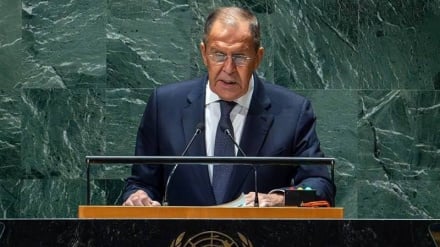
NATO agrees on measures to deter alleged Russian missile threat

The US-led NATO military alliance has agreed on a package of political and military measures to deter Russia from launching a cruise missile that NATO alleges to breach a Cold War-era deal between Washington and Moscow.
The Intermediate-Range Nuclear Forces Treaty (INF) was signed toward the end of the Cold War in 1987 by the then-US President Ronald Reagan and Soviet leader Mikhail Gorbachev. It banned all land-based missiles with ranges of between 500 and 5,500 kilometers and included missiles carrying both nuclear and conventional warheads.
The treaty, seen as a milestone in ending the Cold War arms race between the two superpowers, led to the elimination of 2,692 missiles from both sides, riding Europe of land-based nuclear missiles.
However, the US announced in early February that it would suspend compliance with the INF and formally withdraw in six months, on August 2, if Moscow did not halt its alleged violation of the pact by testing ground-launched 9M729 cruise missiles. The US-led NATO claims that the missile can fly at ranges banned by the agreement.
Moscow has strongly rejected the allegation, saying the maximum range of the missile, which NATO has named SSC-8, is 480 kilometers, thus it does not breach the INF.
Russia has also suspended the deal in response to the US decision.
On Wednesday, NATO defense ministers gathered at the alliance’s headquarters in Brussels, Belgium, to discuss how to deter Russia from potentially launch missile attacks on Europe at short notice if the INF collapses next month.
The development comes just over a week after Russia rejected as “unfounded” repeated US claims that Moscow conducted nuclear tests beyond the “zero yield.”
SS