BRICS New Development Bank: Growth driver for Global South countries
-
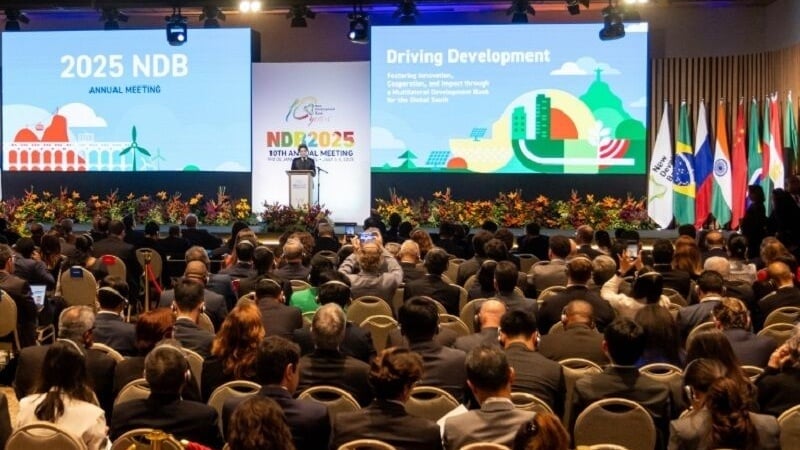
The BRICS New Development Bank (NDB)
Pars Today – On the eve of its second decade, the BRICS New Development Bank (NDB) has established itself as a multilateral financial institution committed to the development of the Global South. The bank has financed around 120 sustainable infrastructure projects in member countries, totaling $39 billion.
Founded in 2014, the BRICS New Development Bank (NDB) was a practical response to the need of developing countries for access to financing independent of traditional Western-led institutions. Initially established by the five founding members—Brazil, Russia, India, China, and South Africa—the bank has now expanded its reach and mission with the inclusion of new members such as Iran, Egypt, the UAE, and Indonesia.
The NDB’s primary goal is not profit, but reducing financial gaps and accelerating sustainable development in member countries through large-scale infrastructure projects.
This Pars Today news brief provides an overview of the NDB’s achievements as it approaches its second decade of activity.
A decade of achievements: Numbers and tangible impacts
Over ten years of activity, the BRICS New Development Bank (NDB) has approved around 120 projects totaling $39 billion. This financing has produced significant measurable outcomes, including an increase of 2,400 MW in clean energy capacity, an annual reduction of 14.7 million tons of CO₂ emissions, the construction of 1,400 km of tunnels and canals and 40,400 km of roads, the development of 35,000 housing units and 43 schools, as well as landmark projects ranging from green metro systems to high-speed rail networks.
The bank also focuses on strategic projects aimed at transforming critical infrastructure. Among these is the Delhi–Ghaziabad–Meerut rapid transit system in India, funded with $500 million, which significantly reduces travel time along the 82-kilometer rail corridor. In China, the Tianjin liquefied natural gas terminal plays a key role in providing clean energy and diversifying the country’s imported gas sources. Another notable project is Qingdao Metro Line 6 in China, an award-winning, driverless, and environmentally friendly metro line that serves as a model for sustainable urban transportation.
Geographic distribution and future priorities
In 2023 and 2024, the largest number of approved projects were in Brazil and India, with transportation and water supply emerging as the top sectors receiving funding. Russia has also benefited from long-term loans with favorable terms for judicial infrastructure, water supply, and tourism development projects. The expansion of membership—including Russia’s support for Iran’s accession—highlights the bank’s capacity to attract more countries from the developing world.
BRICS New Development Bank: An institution on a path of transformation
Over a decade of activity, the BRICS New Development Bank (NDB) has proven itself as a reliable financial source for large, transformative projects in the Global South. Its successes in tangible infrastructure projects have strengthened the credibility of this young institution. However, its sustainable future depends on addressing the dual challenge of financing low-return but essential projects and establishing integrated financial mechanisms independent of the traditional dollar-based system. Expanding membership and attracting countries like Iran can both increase the bank’s resources and reinforce a model of South–South cooperation.