Leader’s 7-point guidelines to President & Cabinet
Aug 29, 2016 10:09 UTC
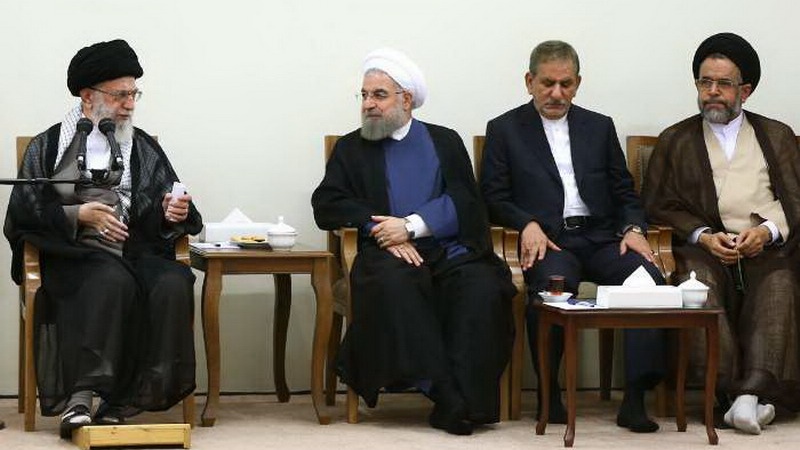
Leader of the Islamic Revolution Ayatollah Seyyed Ali Khamenei, granted an audience last Wednesday to President Hojjat al-Islam Hassan Rouhani and members of his administration on the occasion of Government Week marking the 35th martyrdom anniversary in a blast, of President Mohammad Ali Rajaei and Prime Minister Hojjat al-Islam Mohammad Javad Bahanor.
He said the Government Week offered a good opportunity for informing the people of the services provided by the president and his cabinet, and the new development projects being inaugurated. Ayatollah Khamenei gave necessary guidelines to the executive branch to be carried out during the last remaining year in office of the 11th Administration.
He highlighted important points categorized under seven topics, that is, Economy of Resistance; Foreign Policy; Science and Technology; Security; Culture; the 6th Five-Year Economic Development Plan that started last year; and Cyberspace – as the main priorities of the country.
The Leader of the Islamic Revolution paid tribute to the martyred president and prime minister, that is Mohammad-Ali Rajaei and Mohammad Javad Bahonar, who were the victims of a terrorist bomb blast in Tehran in 1981, by the MKO hypocrites supported by Global Arrogance, as part of the futile plot to overthrow the Islamic Republic system. He hailed Rajaei and Bahonar as "examples of purity, industriousness and popularity".
Referring to attempts by agents of Global Arrogance for whitewashing the blackened face of MKO terrorists, Ayatollah Khamenei said: "Unfortunately, certain [elements] are making efforts to rehabilitate these criminals who slew thousands of people, ranging from ordinary people to officials and prominent figures, but these mischievous and spiteful hands will not achieve their [desired] goals and they will fail like they did in the past."
He added that the main asset is people and winning of their trust and hope.
The Leader of the Islamic Revolution said the task of the Executive Branch was very tough given the extent and diversity of subjects and plentiful expectations as well as issues and problems. Noting that three years have passed so fast since the 11th Administration took office, he said: "By planning and with seriousness, the Administration must do its best endeavours during the remaining one year of its 4-year term." He advised the President and the cabinet ministers to steer clear of marginal issues, particularly the forthcoming general elections for the presidency. He said: "The Administration must by no means preoccupy itself with election issues; rather it must make efforts and plans for the resolution of problems until its last day in office and the best campaigning for the administration in office is its practical steps and action."
Ayatollah Khamenei said the Government Week was a good opportunity for a fair assessment of the performance of the administration by people and elite, adding: "Criticism is not harmful, but this criticism must be fair and endowed with correct solutions."
After expressing some preliminary points, the Leader went on to explain seven topics as the main priorities of the country and the roadmap for the 11th Administration.
"Economic issues and implementation of policies of the Economy of Resistance" was the first topic emphasized by the Leader of the Islamic Revolution, who said: "Today, economic problems and [Gordian] knots are the primary issue of the country that must be resolved and their resolution hinges upon the accurate and precise implementation of the policies of the Economy of Resistance."
He praised the report submitted by First Vice President Es'haq Jahangiri about the activities and actions of the Economy of Resistance Command Committee. Underscoring the necessity of serious and step-by-step follow-up on all projects for their materialization, he said: "The Economy of Resistance Command Committee must monitor and watch all massive and widespread economic activities in the state-run and private sectors and all these activities must be in harmony with the policies of the Economy of Resistance. We have to firmly block the continuation of projects or economic schemes which are not convergent with the policies of the Economy of Resistance."
Noting that the implementation of the policies of the Economy of Resistance requires using all potentialities in the sectors of agriculture and industry, Ayatollah Khamenei said: "An important requirement for the materialization of the policies of the Economy of Resistance is 'development of discourse' which would be possible by correct elucidation of these policies and their effects by officials." He said that the country's scientific drive in recent years and progress in aerospace, nano, nuclear and biotechnology sectors were due to the development of discourse for the scientific drive and software movement of the past 12 years, noting: "For the issue of the Economy of Resistance, such a discourse must take shape in the society too."
The Leader of the Islamic Revolution noted that implementation of the policies of the Economy of Resistance require measures beyond conventional steps taken by the Administration in the economic sector, adding: "For the policies of the Economy of Resistance to become practical, an urgent measure that would be outside ordinary and conventional everyday affairs must be taken."
He said "delegation of authority to the provinces for decision-making, funneling banking facilities and huge money supply to production, export incentives, on-time payment for agricultural produce, and serious attention to villages and conversion industries, were among fundamental and possible measures for implementation of the policies of the Economy of Resistance. Ayatollah Khamenei said the issue of "bureaucracy" and "administrative red tape for producers and entrepreneurs" was one of obstacles to the implementation of the policies of the Economy of Resistance. He added: "Another requirement for the materialization of the Economy of Resistance is to support knowledge-based companies. The projects that could be implemented inside the country by knowledge-based companies must not be assigned to foreign companies."
The Leader of the Islamic Revolution referred to the second topic, i.e. "foreign policy", and pointed to the fact that foreign policy has been one of the priorities of the Rouhani Administration. He said: "I agree with this issue and I have always believed in diplomacy, but we have to distribute our diplomatic potential in an appropriate and balanced form in the world." According to him: "Asia, Africa and Latin America must enjoy their proper share in the country's foreign policy." Underlining the necessity of adoption of an active position in foreign policy, he said: "In such issues as regional problems which are very complicated and intertwined, we have to jump to the fray carefully and vigilantly and [with reliance on] the power of thought, actively and effectively."
Ayatollah Khamenei also underscored the necessity of benefiting from diplomacy to make economic progress. He went on to note that behaviours shown [merely] in appearance in diplomatic exchanges were unreliable. He added: "The only thing that can be trusted upon in diplomacy is fixed, finalized, signed and arguable work." He said the Americans' breach of trust in the issue of the Joint Comprehensive Plan of Action (JCPOA) must serve as a lesson, adding: "This experience teaches us that we can trust none of the administrations in the US and we should not take any practical action in exchange for their [mere] promise. My criticism of the issue of the JCPOA pertains to the breach of promise by and the wickedness of the other party not our own elements because our negotiators exhausted their capabilities round the clock and we are grateful to them for these endeavours."
The Leader of the Islamic Revolution went on to highlight the issue of "science and technology" as the third topic in the roadmap for the Administration, saying: "The country needs science and technology to make progress and over recent years good progress has been achieved in the sector." He chastised the slowed growth of scientific drive in the country in recent years, adding: "The pace of scientific drive in the world is high and we are lagging far behind the world in scientific progress. Therefore, to make up for our losses, we have no option but to accelerate the growth of the scientific drive in the country and the discourse of national scientific progress must continue and should not stop."
Ayatollah Khamenei also underlined the necessity of higher budget allocation for research activities at universities and the full payment of the already earmarked meager budget as well as communications between universities and industries.
The fourth issue referred to by the Leader of the Islamic Revolution was that of "security". He said: "Thanks to God Almighty, under the aegis of appreciable efforts and endeavors of military and security forces, at a time when countries in the region are fraught with mishaps and insecurity, Iran is equipped with a fortified security shield." He said the "revolutionary and religious spirit of people" was one of the main elements of the country's fortified security shield, noting: "This national defense shield must by no means be breached."
Ayatollah Khamenei noted that military and security organs in the country constitute another element of the country's fortified security shield, adding: "These organs must be always assisted and applauded." He said defense equipment and facilities were the third composing element of the security shield, adding: "The enemy is worried with the country's enhanced defense and missile power. Therefore, we have to help enhance the defense capability [of the country] and support it."
The issue of "culture" was the fifth topic emphasized by the Leader of the Islamic Revolution as a priority in the country. To that effect, he said: “Culture includes literature, art, lifestyle, conduct and social mores and cultural organs are responsible in all these sectors.” He added: “I personally do not approve of dogmatism, pressure and suppression in the domain of culture. Rather I firmly believe in free thinking, but free thinking does not mean libertinism and letting enemy inflict harms.”
Referring to acceptable and useful activities by the pious and revolutionary youth in the country, he asked why certain films and shows which strike the roots of youth's faith are produced. The Leader of the Islamic Revolution gave assessed as weak the performance of cultural organs at both "offensive" and "defensive" levels.
Stressing the significance of dealing with diverse cultural issues and taking into consideration the motives and background of cultural figures, Ayatollah Khamenei said: "Shouldn’t cultural officials prefer those who have devoted their life to serving religion and the Islamic Revolution to those who have taken no step throughout their life for the religion and the Revolution and have even struck blows on certain occasions?" He said: "In culture, there must be the spirit of free thinking along with fair planning and cultural blows be headed off by steering and helping create good innovations."
The sixth topic of priorities for the country and the roadmap for the Administration was the significance of the 6th Five-Year Economic Development Plan and the necessity of its quick finalization. Referring to the delay in the submission of the 6th Development Plan, the Leader of the Islamic Revolution said: "Development plans give rise to coordination and synergy and they drive the country, like the links of a chain, to the objectives of the Vision Plan. Therefore, by speeding up the 6th plan, do not let it be delayed any further."
The seventh and last topic of the Leader’s guidelines for the President and the cabinet ministers was the issue of cyberspace. He said: "Cyberspace is a burgeoning, extensive and non-stoppable world that has big opportunities and threats both." Stressing the need for maximum benefit from the opportunities of cyberspace and heading off its threats, he highlighted the objective behind the establishment of the Cyberspace Supreme Council and said: "The creation and launch of a national network of data must be accelerated."
In the concluding part of his speech, Ayatollah Khamenei referred to the issue of exorbitant salaries. Noting that this issue must not be ignored easily, he said: "Public confidence has been largely harmed in this issue because people and educated youth compare their own salaries with these unjust pays and wonder for what criteria and privilege and for which specific job these salaries have been paid." Stressing the need for firm action in dealing with the issue of inflated salaries in all branches of government and organizations, the Leader of the Islamic Revolution said: "If needs be, the judiciary must also intervene and deal with the offenders."
At the start of the meeting, President Hassan Rouhani read out a report highlighting the importance of the Economy of Resistance, and said: “Economic stability and calm was the biggest achievement of the Administration over the past three years.” He expressed hope for the materialization of a 5% economic growth rate in the current calendar year to March 2017 and said another achievement of his administration was growth in national production. He disclosed: "In oil and gas [production], we have reached 2.579 mb/d of oil and gas condensate from 1.23 mb/d. Iran's oil production has increased from 2.7 mb/d to 3.85 mb/d.”
The President also referred to a 15.5% growth in agriculture sector, adding: "This year, we have become self-sufficient in wheat production and the country's wheat stocks have increased to 14 million tons, which is unprecedented." He said: "In this administration, 457 kilometers of railroad has been laid out and 700 kilometers more is under way."
Referring to the activity of 2,500 knowledge-based companies and provision of facilities to them, Rouhani said: "Through knowledge-based companies, 40,000 job opportunities have been created." He also referred to economic woes as the most important challenge to the issue of employment, adding: "In order to fully resolve the issue of joblessness we need to create one million new jobs a year." The government's debts to banks, shortage of water resources, serious challenges in the environment sector, pension funds' problems, unsuitable productivity, lack of balance in budget resources and allocations and lower oil revenues were among other problems highlighted by the President, who concluded: “All branches of government and organs in the country must help so that we can leave behind these problems together.”
In this meeting, First Vice President Eshaq Jahangiri referred to 120 plans and projects adopted by the Economy of Resistance Command Committee, saying: "The policies and plans of the Economy of Resistance are being pursued at the highest levels of all ministries, organs and provincial governors' offices seriously and regularly and today we can say for certain that the country's economy has started moving ahead."
At the end of the meeting, midday and afternoon ritual prayers were led by Ayatollah Khamenei.
AS/SS
Tags