Leader: Iranian talents capable of resolving economic problems
Apr 01, 2017 17:37 UTC
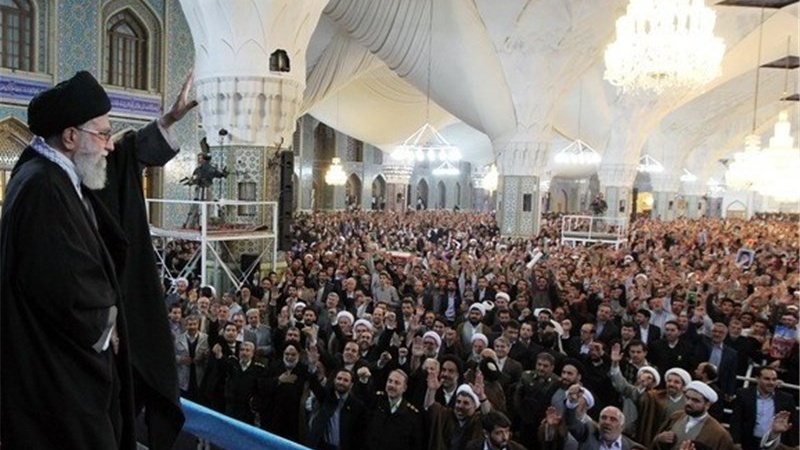
Leader of the Islamic Revolution Ayatollah Seyyed Ali Khamenei, on Tuesday, March 21 on the first day of the Iranian calendar year 1396 solar hijri, addressed a massive millions-strong gathering of pilgrims in Mashhad at the holy shrine of Imam Reza (AS), the 8th Infallible Heir of Prophet Mohammad (blessings of God upon him and his progeny).
He lauded the unity of the nation due to the people’s commitment and attachment to the Islamic Revolution’s values as well as religious tenets, noting that “livelihood and economic problems” and the forthcoming presidential and municipal “elections” in May were two important issues in the current year. He emphasized on the capabilities and skills of the Iranian people to make the country self-sufficient in all fields, saying unnecessary imports of foreign goods ought to be stopped in order to strengthen the national economy.
The Leader, emphasizing the necessity for finding solutions in the light of “religious, revolutionary, efficient and highly motivated management, to all problems facing the country”, noted: “If officials focus on domestic production, the road will be paved for solving many problems, especially ‘youth unemployment’, and during the year that has started, the dear nation of Iran will add to the dignity, might, power and prestige of Iran by materializing my main and important demand, which is enthusiastic participation of all eligible voters in elections, to show its grandeur in the face of enemies by brilliant participation in the elections.” He described the calendar year 1396 as important for the country because of the need for more economic activity and also due to the upcoming presidential election and elections for Islamic urban and rural municipal councils. Before explaining these two important issues, he offered a general assessment of the country’s situation in the past year and said, “Although the country was plagued with economic problems, the Iranian nation put up a brilliant performance.” Ayatollah Khamenei mentioned “people’s commitment and attachment to the values of the Islamic Revolution,” and “commitment to faith-based and religious issues” as two important indices in assessing the movement of the Iranian nation. He then added, “People’s exemplary resolution for enthusiastic participation in nationwide demonstrations on the 22nd Bahman (February 10, 2017) and in [other] religious gatherings during the past year, was stronger than any time before and free from various political tendencies, and flaunted the revolutionary and religious orientation of Iranian nation’s movement at both friends and foes.”
The Leader noted that “national unity” during the previous year was a sign of the unanimity of Iranians over fundamental issues despite differences that exist with respect to political and secondary issues, adding, “Iranian people are united and unanimous on the path of the Islamic revolution.” He also mentioned the loss of life of a number of “dear and sacrificing” firefighters as one of the bitter incidents in the previous year and noted, “Bitter developments are always there, but the important point is the existence of a promising and progressive determination among people and the need for maintaining this determination and national unity in the New Year as well.” He then turned to the most basic issue and foremost priority of the country, namely economy, and emphasized that the goal of the enemy is to mount economic pressure on the Iranian people in order to make them disillusioned and disappointed about the Islamic establishment. He added, “Of course, the ignorant and faithless enemy has been trying during long years to draw a wedge between the nation and the Islamic establishment, but it has not succeeded up to the present time and will not succeed in the future, too.”
Ayatollah Khamenei said all Iranians, especially officials, shouldered a very important responsibility in the face of this enemy plot and while explaining the enemy’s propaganda plot, said, “Through its vast propaganda, the enemy is trying to attribute livelihood problems and economic shortages to the Islamic Republic establishment to show that the Islamic establishment is not able to solve problems and facilitate people’s livelihood.”
Ayatollah Seyyed Ali Khamenei noted that a comparison between the remarkable infrastructural services, which the Islamic Republic has provided to people and conditions that prevailed under the previous monarchial regime, would prove the falsehood of the enemy’s spiteful propaganda. He added, “The Islamic Republic has been able, despite all-out economic pressure and sanctions by the enemies, to provide great and valuable services to people.”
Reading out part of the long and brilliant list of services provided to people by the Islamic Republic, the Leader pointed to the spectacular development of the infrastructure compared to the situation before the Islamic Revolution, adding, “’Sixfold increase in [the length of] the country’s roads’, ‘twentyfold increase in capacity of Iranian ports, ‘thirtyfold growth in capacity of reservoir dams,’ ‘raising the power generation capacity 14 times compared to pre-revolution figure’, ’thirtyfold increase in production of petrochemical products and growing the output of steel products 15 times’ are just part of infrastructural advances, which are necessary for economic activity and progress of the country.”
Ayatollah Khamenei also mentioned “25 times increase in the number of university students compared to early years of the Islamic Revolution,” “sixteen-fold increase in production of scientific papers,” “eye-catching figures on providing services to and development of villages,” and “amazing advances in the defense sector, which are a cause of anger and concern for the enemies” as another part of the list of the Islamic establishment’s remarkable services to the people.
Referring to a basic principle and experience, the Leader said, “Any time we have had revolutionary, active and energetic management, our projects have moved ahead, and any time there has been weak, incompetent, hopeless, un-revolutionary and inactive management, our projects have stood still or deviated [from their right course]. Therefore, managers must be more motivated and more efficient people and work more and this will happen through divine power and assistance.”
He emphasized, “There is no unsolvable problem in the country and if management in various sectors is ‘religious, revolutionary and efficient’, all problems will be solved.” The issue of the country’s active and potential capacities and capabilities was another point raised by the Leader. He noted that human and natural capacities and capabilities in the country were huge. He said, “From the viewpoint of manpower, the country has five million university students, ten million university graduates, and a 33-million-strong young workforce, and this is a huge wealth.” The Leader continued by saying that Iran was also developed and rich in terms of natural resources, adding, “While Iran's population is one-hundredth [percent] of the world’s population, when it comes to natural resources, the country ranks higher than one-hundredth percent [of the world].”
Ayatollah Khamenei pointed to Iran's first rank in terms of total oil and gas resources in the world as well as its first rank in terms of gas reserves, saying, “The reason why hegemonic powers, especially the US, have always had a covetous eye on Iran is these natural and human riches, but they will certainly take to the grave their wish to once again dominate Iran.”
The Leader by focusing on economic issues, asked: “what goal and status does the Islamic establishment seek for the country and the nation?” He provided the answer himself by saying: “The Islamic establishment seeks all-out progress, independence from global hegemonic powers, full growth of talents, ridding the country of social maladies and [realizing] national dignity and security and might.” He emphasized, “In addition to national unity and solidarity, revolutionary culture, [as well as] brave and active and hard-working officials, achieving these goals needs a strong economy and [domestic] production based on efficient management and domestic capabilities.”
Ayatollah Khamenei added, “Such an economy will increase the value of national currency, [enable the country to] influence global oil price and boost people’s purchasing power, the [final] result of which will be sustainable security and might [of the country].” Referring to measures taken by the executive branch of the government with regard to implementing the Economy of Resistance, he said, “Concerned organs have taken good steps for the implementation of the Economy of Resistance, but despite these efforts, we are currently witnessing big economic voids in the society.”
The Leader also noted that according to viewpoints expressed by economic experts, the main economic problems facing the country included “stagnation of production” and “unemployment.” He added, “The solution to these problems has been explained in the policies of the Economy of Resistance, which form a complete set [of policies], but clear timetables must be considered for [the implementation of] various parts of the policies of the Economy of Resistance, and during any given period of time, the focus must be put on part of solutions.”
The Leader lauded steps taken by officials with regard to the implementation of the Economy of Resistance during the preceding year, adding, “At the beginning of the 1395, the administration put on its agenda the issue of helping small - and medium-sized production units and decided to allocate 15,000 billion tomans out of [the country’s annual] budget to pulling 20,000 enterprises out of stagnation and certain steps were taken, though belated, but the important point is supervision and continuation of those steps so that all our efforts would reach their desired goals.” He pointed out, “Field studies show that steps taken by the administration to get small- and medium-sized production units out of stagnation have been relatively successful, but not commensurate with the money spent for this purpose.” Offering a picture of the country’s economic situation, Ayatollah Khamenei said, “Some economic indices of the country are good and some are negative. While the inflation index is going down, the unemployment index has risen and while [some] indices show positive economic growth, the growth in investment, however, is negative, and at the same time that we have progressed in the oil sector, we have been moving backward in such sectors as mines and housing.”
He emphasized that official statistics do not give the impression that the country is moving toward a resolution of the economic problems, noting, “Under these conditions, the most important priority for the resolution of economic problems is reliance on ‘national production and domestic production’.”
The Leader said his goal in making these statements was to remind the country’s officials about the main priorities in the first place, which included “national production and domestic production” and then “setting a direction for people’s demands” in this regard. The Leader added, “National production is a keyword and when it thrives, it will be followed by numerous effects and benefits in the society.”
Ayatollah Khamenei then pointed to some benefits of prosperity of national production and said, “’Job creation’ and ‘reduction of unemployment as one of the current problems of the country’, ‘growth of young people’s talents and initiative’, ‘preventing the country’s foreign exchange reserves from being spent on consumer goods’, ‘activation of scattered savings’, ‘bringing about a spurt in exports’, ‘putting a brake on the race for showing off foreign brands and trademarks as one of major social and moral and cultural blights in the society’, ‘doing away with or reducing the rate of social maladies’, ‘creating national vibrancy’ and ‘activation of the country’s mineral capacities’ are among important effects and benefits of a thriving domestic production.”
After enumerating the benefits resulting from prosperity of domestic production, he pointed to requisites for prosperity of domestic production and noted, “National production needs ‘manpower, investment and advanced work tools’. Part of these items potentially exists in the country and others are actively present.” He stated that a 33-million-strong young workforce that seeks jobs, among whom there are engineering experts and people with academic education, could supply the necessary manpower for production, adding, “Despite what they usually say that the necessary assets for production are lacking, we do have the necessary assets at our disposal.”
Explaining how to supply the necessary capital for prosperity of domestic production, Ayatollah Khamenei pointed to the establishment of the National Development Fund and added, “This fund was established in line with the general policies, which were notified a few years ago. During the first year of the fund, 20 percent of oil revenues were deposited in the fund and it was supposed that during later years, three percent would be added to that 20 percent on an annual basis. If this had taken place so far, 36 percent of the country’s oil revenue would have been deposited in the National Development Fund, because this fund is the best solution to get rid of dependence on the oil revenue.”
The Leader said, “Of course, two years ago, in the year 1394, executive officials cited a reduction in oil revenues and demanded the Leader use his power in order to allow three percent of the annual oil revenues not be deposited in the National Development Fund. In view of the urgency [of the matter] as explained by the officials, this step was taken.” He emphasized, “The National Development Fund and taking advantage of the private sector’s potentialities are, in fact, [two good sources of] the capital needed to bring prosperity to [domestic] production.” Ayatollah Khamenei then pointed to the third requisite for the prosperity of national production, that is, the work tool, and noted, “Some people say that we do not have modern tools for prosperity of production. However, I say that young Iranian scientists, who have been able to elevate uranium enrichment form 3.4 percent to 20 percent in a short period of time and break such a great ground, and also managed to take amazing steps toward the [domestic] manufacture of defense and missile equipment despite tough international sanctions, and caused both surprise and admiration of the Zionist enemy, can certainly take steps toward manufacturing modern tools for production as well.”
The Leader emphasized, “If we give space to young people, many [Gordian] knots will be cut and this is the reason for the emphasis I have put for many years and repeatedly on [the necessity of] cooperation between universities and industries. Of course, good measures have been taken in some sectors.”
The Leader said: “Three main requisites, which include manpower, capital, and modern tools, exist [in the country] in order to bring prosperity to national production, but the realization of this important goal hinges on certain requirements and duties, which are both incumbent on people and incumbent on executive, judicial, and legislative officials.” Before explaining those requirements, he underlined an important point and said, “I am saying this in order for everybody to know that we are in no deadlock with regard to economic issues and problems of the country and we can move ahead [despite those problems].”
The Leader then referred to requirements and duties of officials for bringing prosperity to domestic production and added, “Assignment of efficient, committed, vibrant, highly-motivated and strong managers by the country’s senior officials to production sectors is one of these requirements.” He added that according to policies related to Article 44 of the Iranian Constitution, encouraging people’s participation in boosting domestic production was another requirement, noting, “Just in the same way that during the [US imposed] war [against Iran], people entered the arena of the Holy Defense through proper management and the war ended in favor of the country, in the field of economy and production, [necessary] room must be given to people to play their roles.” Ayatollah Khamenei mentioned “development of exports and increasing the number of export partners” as another requirement for energizing national production and said, “A report that has been released on the country’s exports shows that [destinations for] our exports are limited to a few countries. This is against the policies of the Economy of Resistance and the resolution of this problem also needs more steps to be taken by officials, especially in the foreign policy sector.”
The Leader said “ensuring security of investment” by the Judiciary and judicial agents and security forces, in addition to ensuring “stability of policies and laws and removing cumbersome regulations” by the Islamic Consultative Assembly were other requirements for prosperity of domestic production. Ayatollah Khamenei then added, “In some cases of investment, publicity is launched and the case is [even] put forth by the IRIB [Iran's state-run radio and television organization], and people direct their capital toward that investment, but after a while, it becomes clear that cheating has been involved; such cases are among [those cases which can be blamed on] oversight with regard to [ensuring] security of investment.”
The Leader of the Islamic Revolution then turned to requirements and duties that are incumbent on people in order to bring prosperity to domestic production and noted, “I have always taken sides with people and people’s demands, but people must also feel responsibility and attach importance and give preference to national production and consumption of domestic products instead of foreign brands.” Ayatollah Khamenei said refraining from idleness and laziness by young people and going after work was another duty for people, adding, “Another important point with regard to people’s duties for bringing prosperity to domestic production is to prove that Iranians do the work in a good and correct way by exporting high-quality goods and merchandise and preventing the production of low-quality goods in the country.
Preventing excessive imports and smuggling, was the seventh requirement mentioned by the Leader of the Islamic Revolution for bolstering national production, adding, “Importing those commodities, which are adequately produced inside [the country,] must be considered as religiously and legally prohibited.”
Ayatollah Khamenei described import of those consumer goods, which are also produced in the country like foodstuff, garment, home appliances, and stationery as a “cause of shame” for the country before foreign producers and sellers of such goods, and noted, “Although some basic goods are not produced in the country, they can be produced. Therefore, their import to the country must be prevented by removing obstacles and producing them.” He pointed to high figures released on the volume of smuggling in the country, noting that a categorical and fundamental way to tackle this very destructive phenomenon was to fight major smuggling bands. The Leader added, “The highest quantity of contraband enters the country through official points of entry and free zones.” Ayatollah Khamenei criticized misunderstandings about the fight against smuggling and harsh treatment of small-time retailers or some dwellers of border regions, who make a living by carrying small amounts of contraband, adding, “Fighting smuggling does not include these cases, but [major] smuggling bands must be fought against.”
Elsewhere in his remarks, the Leader described the upcoming election for the next president as well as members of urban and rural Islamic municipal councils as very important and emphasized, “In the Islamic establishment, elections constitute one of the two pillars of popular religious rule and are a cause of pride for the Iranian nation in the world.”
The Leader said the effort made by enemies to ignore or vilify elections in Iran was a sign of the importance of this issue and added, “[Holding] elections is a pride-inspiring phenomenon and a cause of dignity and more prestige for Iranian nation.” Referring to the fact that people and scholars in various countries have been infatuated with the idea that was presented by the Father of the Islamic Revoluton, the Late Imam Khomeini, that is, popular religious rule, which is manifested in the Islamic Republic, Ayatollah Khamenei added, “Popular religious rule is based on elections and the nation must really shine in the [upcoming] elections.” The Leader mentioned high turnout and presence of all eligible voters on the day of voting as his main and important demand and emphasized, “Everybody must enter [this arena] and bring about enthusiastic elections.” He also underlined the need for abiding by the exact stipulations of law in elections, noting that the result of the nation’s vote will be credible and legal no matter what. The Leader added, “I never interfere in elections and do not say for whom people should or should not vote, but if anybody wants to stand against people’s vote or rig people’s vote through any act of disruption, I will interfere and stand against them.”
The Leader of the Islamic Revolution invited people to take part in the forthcoming elections in high numbers, saying, “With divine assistance, elections [which are scheduled to be held on May 19, 2017] will be lively and overarching and, God willing, the result of both elections will lead to the content of the Almighty God.” Concluding his remarks, the Leader emphasized, “By holding good elections, the Iranian nation will once again hold its head high and will continue to move ahead, and the enemies of the nation cannot do a damn thing as has been the case during past years.”
AS/SS
Tags