Iranians and Jews throughout the Course of History
Apr 03, 2017 05:13 UTC
The Zionist regime’s premier, Benjamin Netanyahu, has resorted to a string of baseless accusations and fabrications in the recent years in order to somehow justify the enmities of the usurper Israeli regime toward the Iranian nation and government.
The Zionist regime’s premier tried to falsely portray the Iranian nation and Iran’s political ruling system as enemies of Jews. Meanwhile, what are the historical facts on the view of Iranians toward the followers of divine religions, including Judaism?
According to valid historical documents, the name of Iranians and Israelites has been tied to the courageous measures of Cyrus, the founder of Achaemenid Dynasty. Cyrus, who was the founder of the first empire in the history of mankind, conquered Babylon in the year 539 BC. Throughout the conquest of Babylon, Cyrus issued an order which was later popularly known as the first human rights charter. Based on this instruction, which was rather unique, the Iranian king urged his troopers not to massacre civilians and not to insult the deities of conquered regions. This instruction was issued by Cyrus, while the carnage of defeated nations and disrespect toward the deities of crushed nations was a common practice at the time. Nonetheless, Cyrus, as the representative of Persians, preferred to kindly treat the residents of the conquered city. Meanwhile, the residents of Babylon were not the only ones, who benefitted from the kindness and compromise of Persians, and the Israelites were also liberated from the yoke of centuries of slavery. In this manner, the King of Persians, Cyrus, became popularly known as the savior of Israelites throughout the course of history.
In the history of Jews, there is a narration which once again establishes a bond between Iranians and followers of this divine religion. Based on this narration, which has been mentioned in the Book of Esther; the Jews were liberated from the conspiracy of their massacre by the Persian Kingdom’s chief minister, and thus they convene the Festival of Purim. Based on the story of Esther, a twist of fate destines this Jewish orphan toward the Persian royal court, where she is crowned as the queen. Esther, who had hidden her religion from the Persian king, becomes aware of the conspiracy of the chief minister for the massacre of Jews and informs the Persian king of this plot. The Persian king, who was fond of his queen foils this conspiracy, and does not allow the carnage of Jews. It is said that in retaliation of this conspiracy, the Jews were permitted to kill their enemies. In this manner, upon the permission of the Persian King, instead of massacre of Jews, the enemies of Jews are punished.
Meanwhile, some have cast doubts over the originality of the Book of Esther, considering the life story of Esther as the sole imaginations of the author of this book. However, even in the case of correctness of a part or the entire text of the Book of Esther, which is the most sacred text of Jews, after Torah, it is shown that Iranians did not allow the massacre of Jews. The Persian King, Ahasuerus, which is said to be Xerxes I, did not allow the massacre of Jews. After the entry of divine religion of Islam to Iran, Iranians continued to respect the followers of other Abrahamic religions. After the entry of Prophet of Islam, Mohammad (Blessings of God upon him and his progeny), to the city of Medina, in which Prophet Mohammad established the first Islamic ruling system in history, the Jews of Medina concluded a number of agreements with Muslims, which allowed Jews to trade and observe their prayers based on the teachings of Judaism. This behavioral role model more or less continued in the next centuries, and in contrast to Europe, anti-Semitism never took shape in Islamic lands.
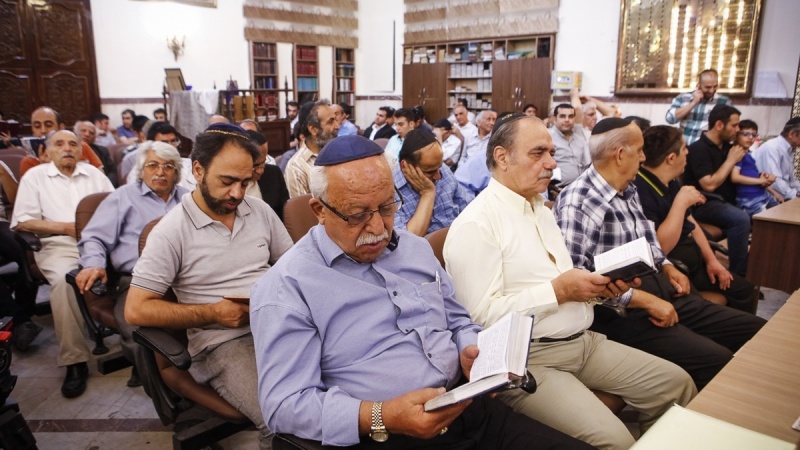
History attests that Muslim Iranians maintain a glittering record in acceptance of followers of divine religions. One of the prime examples of this conduct is the invitation of Armenians by the Safavid King, Shah Abbas, to live in the city of Isfahan, which was the glorious Capital of Iran in 16th Century AD. At the time, Christian Armenians lived in Armenia, which was part of Iran’s territory. They had become familiar with modern sciences due to their interactions with Europeans, and were considered as skilled craftsmen. The Safavid King, Shah Abbas, invited Armenians to Isfahan and delegated important duties to them in construction and development of Isfahan, irrespective of the fact that Armenians were not followers of divine religion of Islam. Armenians were warmly welcomed in the Capital of Iran, rendering valuable services. The followers of all Christian denominations were respected by Muslim Iranians. They were allowed to have their own churches and to behave based on Christian teachings in personal matters. This was also the case for Jews. Iranian Jews have had their synagogues throughout the course of history, with some of them making major scientific, cultural, and economic achievements. Throughout the Constitutional Revolution in Iran, in early last century, Christian and Jewish Iranians were granted parliamentary seats.
The first half of the 20th Century in Europe, was a bleak phase for Jews. At the time, anti-Semitism reached its peak in Europe. The 2,000-year history of relations between Christians and Jews has always been turbulent. For centuries, Christians blamed Jews from Crucifixion of Prophet Jesus. Also, the European Christian kings and aristocrats have always encroached upon the wealth and assets of Jews. Meanwhile, the common people in Europe, in compliance with kings and some of the Church officials, persecuted Jews in Europe. In the Middle Ages, many Jews were burnt alive upon the instruction of the Church and their belongings were seized. The 16th Century play, The Merchant of Venice, which was authored by William Shakespeare, details the hostility between Christians and Jews in Europe. This enmity led to organized massacre of Jews in the first half of 20th Century in Europe, upon the domination of fascist ideology in that continent.
Meanwhile, amid World War II in Europe, Iran, as an Islamic country in West Asia, turned into a refuge for Jews, who had fled horrific massacres organized by Christian European governments. In those years, Iranians were mired in poverty, and suffered from famine and contagious diseases as the consequence of occupation of Iran by European states. Nonetheless, Iranians warmly welcomed war refugees, including thousands of Jewish Poles; and did not allow a group of individuals to be massacred by hostile European states, solely because of their religious beliefs. The humane behavior of Iranians with Christian and Jewish refugees led many of them to remain in Iran for good after the termination of World War II in Europe. Meanwhile, unfortunately, the emergence of a deviated current in Judaism, under the heading of Zionism, overshadowed the amicable relations between Muslim Iranians and the true followers of Prophet Moses. Even prior to victory of Iran’s Islamic Revolution, Iranians were against the occupation of Palestinian territories by Zionists. In the view of Iranian nation, Palestine belongs to its true original residents, who are the Muslims, Christians, and Jews that have lived peacefully alongside each other for centuries. In fact, the original residents of Palestine should not pay the price of the horrific crimes, which were committed by European governments against Jews in Europe. Meanwhile, it should also be reminded that tens of thousands of Iranian Jews have their own synagogues, schools, and associations, and maintain a parliamentary seat in Iran’s Majlis.
In contrast to the false allegations of Zionist regime’s premier, Iranians have always maintained amicable ties with Jews. History attests that Iran rescued and saved Jews at least three times in history; once during the rule of Cyrus; another time based on the narration of the Book of Esther; and on another occasion throughout World War II.
MR/MG
Tags