Iranian islands of Persian Gulf (16)
Apr 03, 2018 09:45 UTC
The Greater and Lesser Tunb Islands are two Iranian islands, which are located in Persian Gulf waters.
The military nature of these islands does not permit snapshots and presence of tourists in them. Greater and Lesser Tunbs are beautiful islands, within the centers of which one can observe sunrise and sunset, both.
Upon reference to Arabic language lexicons, one realizes that the term Tunb is not an Arabic term. This name is a 100% Farsi and Iranian name, which has been commonly used in the region as of the Acaemenian era, meaning "hill".
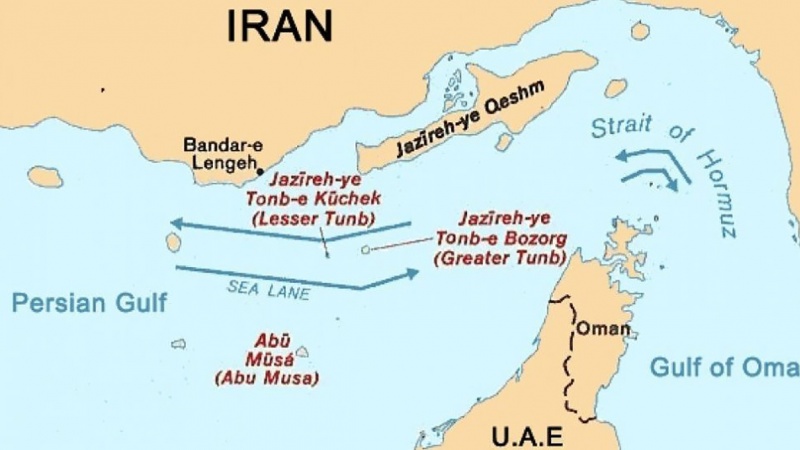
The Greater and Lesser Tunb Islands are situated north of the city of Bu-Musa, in Hormuzgan Province. Greater Tunb Island is located 31 kilometers south of Qeshm Island; less than 50 kilometers from Bandar Lengheh Port; and 53 kilometers from Bu-Musa Island. This island is nearly round in shape, with a relatively four kilometer diameter. The island maintains a dry soil, and a number of hills are observed in the island; the highest one of which is 53 meters in height. There are a number of plant species in the southern region of this island, which are grazed by local livestock.
The drinking water of this island is supplied from two water wells, which are situated in the southern region of the island. Locals make a living out of fishing and hunting pearls. Clay mines exist in Greater Tunb Island.
Sea water, with its chemical and mechanical reactions, and via the sediments left, has created numerous scenic landscapes in the Greater Tunb Island.
This island maintains a very poor flora. In the waters surrounding this island, many types and edible and inedible fish can be spotted such as eels, and sawfish; in addition to sharks, dolphins, squids, sea turtles, and crabs. A lighthouse is situated in the northern corner of this island, which has been constructed in the year 1953.
There are also many birds in this island, such as swallows, doves, and nightingales. The mammals living in this island are mainly rodents such as rats, and hares. Reptiles such as snakes and crocodiles are spotted in the island. Moreover, many scorpions live in Greater Tunb Island.
This island maintains an airport runway for small propelled planes, and a pier in its eastern corner for berthing small and fishing boats. The Fishery Organization maintains a cool house in this island. The island is scarcely populated, with locals originally from Bandar Lengheh Port. The residents of this island make a living out of fishing, hunting pearls, farming, and horticulture. Fruit orchards and palm groves can be spotted at the western region of the Greater Tunb Island.
The Lesser Tunb Island is situated 12 kilometers west of Greater Tunb Island, and at a 45-kilometer distance from Bandar Lengheh Port. Lesser
Tunb Island is triangular in shape, with its width stretching to roughly one kilometer in its southern region. A large rock with a height of 32 meters is located northwest of this island, which also marks the highest location in Lesser Tunb Island. This island is uninhabited and doesn’t maintain drinking water. A number of plants grow in the island. This island covers an area of 2.5 square kilometers. The nearest Iranian port to this island is Bandar Lengheh, which is at a 75-kilomtere distance from the Lesser Tunb. Iran's military fortifications and equipment are stationed in this island, which also accommodates a relatively small pier and a small airport runway that have military functions.
The Greater and Lesser Tunb and Bu-Musa Islands maintain especial geopolitical and strategical importance. A significant part of crude oil needed by world countries, pass through the waters surrounding these islands. In fact, once every few minutes, an oil tanker which carries crude oil passes through the waters surrounding these islands.
Many Islamic historians and geographers, such as Tabari and Masoudi, have pointed out that all of the islands of Persian Gulf belong to Iran. the English traveler and diplomat, James Justinian Morier, who traveled to the vicinity of Greater and Lesser Tunb Islands on February 20, 1811, has also pointed out these islands' Iranian names and has emphasized that these islands have been situated in the Iranian region of Persian Gulf.
These islands were occupied by Britain from 1903-1971, and were illegally handed over to Sharjah and Ras al-Khaimah, which were the official protectorates of Britain. These islands have always been under the sovereignty of Iran. the re-establishment of the sovereignty of Iran over these Iranian islands took place within the framework of three years of negotiations between Iran and Britain, and conclusion of a memorandum of understanding in the year 1971.
Based on valid historical documents and sources, Greater and Lesser Tunb, and Bu-Musa Islands have always been an integral part of Iran's territorial integrity and sovereignty. Claims made by the United Arab Emirates, and the covert and overt support of the regional and trans-regional powers for UAE claims are in fact considered as interference in Iran's internal affairs.
MR/EA
Tags