Millions attend funeral procession for Iran’s martyred Leader: Messages and implications
-
Millions attend funeral procession for Iran’s martyred Leader: Messages and implications
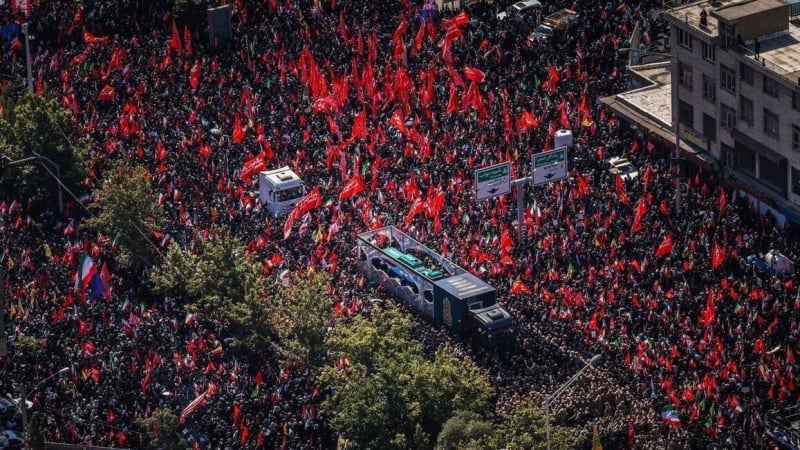
Pars Today – The body of Ayatollah Khamenei, the martyred Leader of the Revolution, was carried in funeral processions in Tehran and Qom, attended by millions of Iranians as well as people from some neighboring countries.
The participation of millions conveyed important messages. One of the most significant messages of this massive turnout, according to the report, was that Iranians believe the martyred Leader dedicated his entire life to safeguarding Islam, the Revolution, and the dignity of Islamic Iran. The large-scale participation was a gesture of appreciation for his efforts and sacrifices, which continued until the end of his life and extended to his family.
Another key message of the millions-strong funeral procession was the emphasis by participants on the continuation of his path and ideas in the new era. The turnout was portrayed as a sign that, despite all pressures and threats, the Iranian people remain committed to the ideals of the Islamic Revolution.
In this regard, Reuters described the funeral of Ayatollah Seyyed Ali Khamenei as more than a national farewell, calling it a sign of Iran’s resilience and the emerging regional order. The British news agency reported that the “sea of mourners” in Tehran sent a message to the United States and Israel that efforts to weaken the Islamic Republic had failed.
Reuters further wrote that Iran, rather than appearing weakened after the war that began with U.S. and Israeli attacks on February 28, presented itself as resilient, united, and determined to shape its own future.
Another major message of the millions-strong turnout at the funeral procession for the martyred Leader was the renewed demonstration of the inability of U.S. and Israeli officials to accurately understand the Iranian people.
The report states that while the United States and the Israeli regime launched two wars lasting 12 and 40 days based on the incorrect assumption that the Iranian people did not support the government and that the government had limited social support, the massive funeral turnout not only disproved that claim but also showed that the people remain the Islamic Republic of Iran’s most important source of strength.
The participation was described as carrying a significant message: that opponents of the Islamic Revolution—particularly the United States and Israel—still lack an accurate understanding of Iranian society and continue to base their analyses on false information and narratives promoted by hostile groups. It added that they should now seek a more accurate picture in the streets of Tehran, Qom, and other Iranian cities.
Another key message highlighted by the report was the high level of security during the ceremonies. It stated that despite former U.S. President Donald Trump’s claim during the 40-day war that Iran would be pushed back to the “Stone Age,” millions of people participated in the funeral processions in Tehran and Qom without any security incidents, while the ceremonies were held under the highest level of security.
The millions-strong participation in the funeral procession for the martyred Leader of the Islamic Revolution also had important implications.
One of the key functions of this massive turnout was to demonstrate the deterrence power of the Islamic Republic of Iran. Deterrence is traditionally defined in military, intelligence, and technological terms, but the report argues that public presence and the strength of popular participation have now become additional dimensions of deterrence.
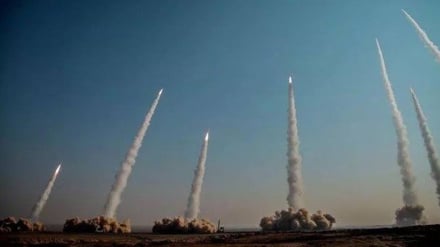
Another implication was that the Islamic Republic demonstrated its ability both to ensure security during a massive public gathering and to firmly confront external threats at the same time. It stated that while millions attended the funeral ceremonies, Iran’s armed forces responded decisively to terrorist groups along the borders and prevented U.S. attempts to establish new arrangements for maritime traffic in the Strait of Hormuz.
Another function of the large-scale public participation was having an impact on negotiations. The report stated that Iranian negotiators can now enter talks with broad public backing, resist excessive demands from the other side, and convey the Iranian people’s demand for retribution to their American adversaries.
In conclusion, the millions-strong funeral procession for the martyred Leader represents the beginning of a new era for Iran—one that challenges narratives promoted by opponents and presents a true image of Iran as a regional power with unparalleled popular support.