Caliph closure: ‘He died like a dog’
Nov 02, 2019 06:24 UTC
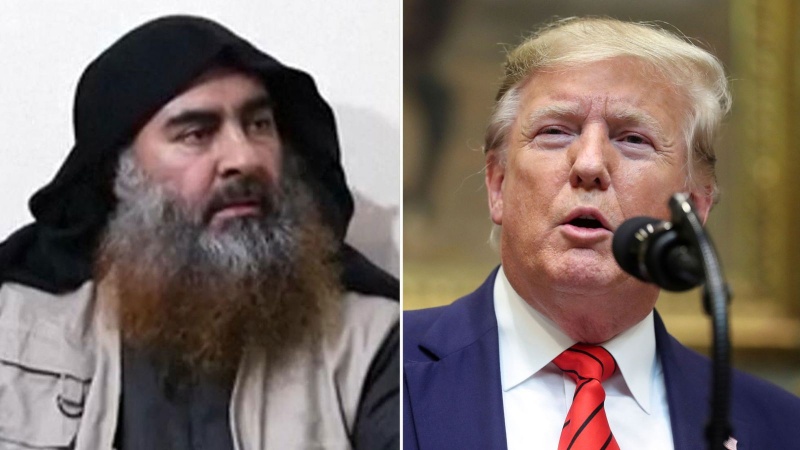
U.S. President Donald Trump’s victory-lap movie version on the reported killing of the notorious Abu Bakr al-Baghdadi, the leader of the macabrely murderous terrorist outfit, Daesh, is intended to bury the embarrassing story of his deploying of tanks of the uninvited American troops on the pretext of ‘protecting’ Syrian oilfields.
The following is an article that appeared in this regard on the ‘Asia Times’ site by investigative Brazilian journalist Pepe Escobar.
“He died like a dog.” President Trump could not have scripted a better one-liner as he got ready for his Obama bin Laden close-up in front of the whole world.
Abu Bakr al-Baghdadi, fake caliph, and the most wanted man on the planet, was supposedly “brought to justice”. Trump brags that under his watch “the dead dog” is now positioned. He claims this as the ultimate foreign policy winning trophy ahead of his bid for re-election in 2020.
The climatic scenes of the inevitable-as-death-and-taxes movie or Netflix series to come are already written. Trump claims: I “watched it like a movie.” He further boasts: Cowardly uber-terrorist cornered in a dead-end tunnel, eight helicopter gunships hovering above, dogs barking in the darkness, three terrified children taken as hostages, coward detonates a suicide vest, tunnel collapses over himself and the children.
If reports are to be believed: A crack forensic team carrying samples of the fake caliph’s DNA apparently does its job in record time. The remains of the self-exploded target – then sealed in plastic bags – confirm it: it’s Baghdadi. In the dead of night, it’s time for the commando unit to go back to Irbil, a 70-minute flight over northeast Syria and northwest Iraq. Cut to Trump’s presser. Mission accomplished. Roll credits.
This all is supposed to have happened at a compound only 300 meters away from the village of Barisha, in Idlib, rural northwest Syria, only 5km from the Syria-Turkish border. The compound is no more: it was turned to rubble so it would not become a (Syrian) shrine for a renegade Iraqi.
The self-styled caliph was already on the run, and arrived at this rural back of beyond only 48 hours before the raid, according to Turkish intelligence.
But a serious question is what al-Baghdadi was doing in northwest Syria, in Idlib – a de facto cauldron-like Donbass in 2014 – which the Syrian army and Russian airpower are just waiting for the right moment to extinguish.
There are virtually no Daesh terrorists in Irbil, but lots of Hayat Tahrir ash-Sham, formerly Jabhat an-Nusra, as al-Qaeda in Syria calls itself, and is known inside the American Beltway as “moderate rebels,” which includes the hardcore Turkmen brigades from Central Asia, and who previously were weaponized by Turkish intelligence.
The only rational explanation is that the so-called caliph might have identified this Idlib backwater near Barisha, away from the war zone, as the ideal under-the-radar passport to cross to Turkey.
The question is: Did the Russians knew?
The plot thickens when we examine Trump’s long list of “thank yous” for the seemingly successful raid. Russia came first, followed by Syria – presumably Syrian Kurds, not Damascus – and then Turkey and Iraq.
As a matter of fact, Syrian Kurds were only credited with “certain support,” in Trump’s words. Their commander Mazloum Abdi, though, preferred to extol the raid as a “historic operation” with essential Syrian Kurd intelligence input.
In Trump’s press conference, expanding somewhat on the “thank yous”, Russia again came first (“great” collaboration) and Iraq was “excellent”: the Iraqi National Intelligence Service later commented on the break it had gotten, via a Syrian who had smuggled the wives of two of Baghdadi’s brothers, Ahmad and Jumah, to Idlib via Turkey.
There’s no way US Special Forces could have pulled this off without complex, combined Turkish, Iraqi and Syrian Kurd intelligence. Additionally, President Rajab Tayyeb Erdoghan accomplishes one more tactical masterpiece, juggling between performing the role of dutiful, major NATO ally while still allowing al-Qaeda remnants their safe haven in Idlib under the watchful eye of the Turkish military.
Significantly, Trump said, about Moscow: “We told them, ‘We’re coming in’ … and they said, ‘Thank you for telling us.’” But, “they did not know the mission.”
They definitely didn’t. In fact, the Russian Defense Ministry, via spokesman Major General Igor Konashenkov, said it had “no reliable information about U.S. servicemen conducting an operation to ‘yet another’ elimination of the former Daesh leader Abu Bakr al-Baghdadi in the Turkish-controlled part of the Idlib de-escalation zone.”
And on Trump’s “we told them,” the Russian Defense Ministry was emphatic: “We know nothing about any assistance to the flight of U.S. aircraft to the Idlib de-escalation zone’s airspace in the course of this operation.”
According to ground sources in Syria, a prevalent rumor in Idlib is that the “dead dog” in Barisha could be Abu Salama, the leader of Haras ad-Din, a minor sub-group of al-Qaeda in Syria. Haras ad-Din has not issued any statement about it.
Daesh anyway has already named a successor: Abdullah Qardash, also known as Haji Abdullah al-Afari, a former Saddam military officer. There’s a strong possibility that upon secret American signals, Daesh and myriad subgroups and variations of al-Qaeda in Syria will now re-merge, after their split in 2014.
There’s no plausible explanation whatsoever for Abu Bakr al-Baghdadi, for years, enjoying the freedom of shuttling back and forth between Syria and Iraq, always evading the formidable surveillance capabilities of the U.S. government – if not collaborating with the Americans.
Well, there’s also no plausible explanation for that famous convoy of 53 brand new, white Toyota Hi-Luxes crossing the desert from Syria to Iraq in 2014 crammed with flag-waving Daesh terrorists on their way to capture Mosul, also evading the cornucopia of U.S. satellites covering West Asia 24/7.
And there’s no way to bury the 2012 U.S. Defense Intelligence Agency (DIA) leaked memo that explicitly named “the West, Persian Gulf monarchies, and Turkey” as seeking a “Salafist principality” in Syria (opposed, significantly, by Russia, China and Iran – the key poles of Eurasia integration).
That was way before Daesh’s ascension. The DIA memo was unmistakable: “If the situation unravels there is the possibility of establishing a declared or undeclared Salafist principality in eastern Syria (Hasaka and Der Zor), and this is exactly what the supporting powers to the opposition want, in order to isolate the Syrian government, which is considered an ally of Iraq and Iran.
True, the fake caliph has been proclaimed definitely dead at least five times, starting in December 2016. Yet the timing, now, could not be more convenient.
The facts on the ground, after the latest ground-breaking Russia-brokered deal between the Turks and the Syrian Kurds, graphically spell out the slow but sure restoration of Syria’s territorial integrity. There will be no balkanization of Syria. The last remaining pocket to be cleared of terrorists is Idlib.
And then, there’s the oil question. The “died as a dog” movie literally buries – at least for now – an extremely embarrassing story: the Pentagon deploying tanks on the pretext of “protecting” Syrian oilfields. This is as illegal, by any possible interpretation of international law, as is, for that matter, the very presence in Syria of US troops, which were never invited by the government in Damascus.
Persian Gulf traders told me that before 2011, Syria was producing 387,000 barrels of oil a day and selling 140,000 – the equivalent of 25.1% of Damascus’s income. Nowadays, the Omar, ash-Shaddadi and Suwayda fields, in eastern Syria, would not be producing more than 60,000 barrels a day. Still, that’s essential for Damascus and for “the Syrian people” so admired within the Beltway – the legitimate owners of the oil.
The mostly Kurdish People’s Protection Units (YPG) did in fact take military control of Deir er-Zor when they were fighting Daesh. Yet the majority of the local population is Sunni Arab. They will never tolerate any hint of a longtime Syrian Kurd domination – much less in tandem with a U.S. occupation.
Sooner or later the Syrian army will get there, with Russian air power support. The Deep State might, but Trump, in an electoral year, would never risk a hot war over a few, illegally occupied oilfields.
In the end, the “died as a dog” movie can be interpreted as a victory lap, and the closure of a historical arc languishing since 2011. When he “abandoned” the Syrian Demoratic Forces Kurds, Trump effectively buried the Rojava question – as in an independent Syrian Kurdistan.
Russia is in charge in Syria – on all fronts. Turkey got rid of its “terrorism” paranoia – always having to demonize the Syrian Kurd PYD and its armed wing YPG as a spin-off of the Kurdistan Workers’ Party (PKK) separatists inside Turkey – and this may help to settle the Syrian refugee question. Syria is on the way to recover all its territory.
The “died as a dog” movie can also be interpreted as the liquidation of a formerly useful asset that was a valued component of the gift that keeps on giving, the never-ending Global War on Terror. Other scarecrows, and other movies, await.
AS/MG
Tags