Open letter to “human rights defenders” on Aleppo
Jan 12, 2017 05:31 UTC
Let there be no mistake: this is by no means a criticism of human rights as an ideal to work for. The complete title should be “Open letter to those who invoke human rights selectively in order to justify the Western Powers’ policy of intervention in the internal affairs of other countries.”
Indeed, the only issue to be discussed about Syria is not the situation on the ground, but the legitimacy of the interventionist policies of the U.S. and its “allies”, Europeans, Turkey, and the Persian Gulf states in that country.
For decades, the principle on which international law is based, that is, equal sovereignty of States implying non-intervention of one State in the internal affairs of another, has been systematically violated, to the point of being practically forgotten, by champions of the “right of humanitarian intervention”. Recently, a number of such advocates of humanitarian intervention, self-identified as stalwart leftists, have joined the chorus of the Washington war party in reproaching the Obama administration for failure to intervene more in the military efforts to overthrow the government of Syria. In short, they are blaming the Obama administration for not having sufficiently violated international law. Indeed, just about everything that the US is doing everywhere in the world violates the principle of non-intervention: not only “preventive” invasions, but also influencing or buying elections, arming terrorists, or unilateral sanctions and embargoes aimed at changing the target country’s policies.
In February 2003, shortly before the invasion of Iraq, the Non-Aligned Countries’ summit meeting in Kuala Lumpur adopted a resolution stating that:
The Heads of State or Government reaffirmed the Movement’s commitment to enhance international co-operation to resolve international problems of a humanitarian character in full compliance with the UN Charter, and, in this regard, they reiterated the rejection by the NAM of the so-called “right” of humanitarian intervention, which has no basis either in the UN Charter or in international law.
It is obvious that such “interventions” are only possible on the part of strong States against weak States. It can only be a case of might makes right.
However, even all strong states are not equal among each other. Let’s imagine for a moment that the right of intervention is accepted as a new principle of international law. What would happen if Russia tried to overthrow the regime in Riyadh because of “human rights violations” in the country? To understand the “unacceptable” character of interventionist policies, it is enough to think of the American establishment’s shrieks of alarms following the alleged Russian hacking of certain emails made public by Wikileaks. Note that the reality off this hacking remains to be proven and that, even if it were true, it would only mean that the hacking enabled the American public to become aware of some maneuvers by its leaders, which is a peccadillo compared to American interventions in Latin America, West Asia or Indochina.
The consequences of US interventionist policies are multiple and catastrophic. On the one hand, you have the millions of deaths due to American wars
Moreover it would be a mistake to imagine that the victims of interventions will not react to the threat of intervention by building alliances and trying to defend themselves by increasing internal repression. When the US was attacked on September 11, 2001, Washington introduced unprecedented security and surveillance measures and, far worse, invaded and destroyed two countries. How can one imagine that Syria, Iran, Cuba, Russia or China will not take measures to protect themselves from foreign subversion?
Thereby one enters into logic of unending wars. Indeed, after having themselves intervened in Ukraine and Syria, the Western powers then entered into conflict with Russia and China because of the measures that those countries took in response to those interventions. Far from being a source of peace, the UNSC becomes the scene to express endless acrimonies.
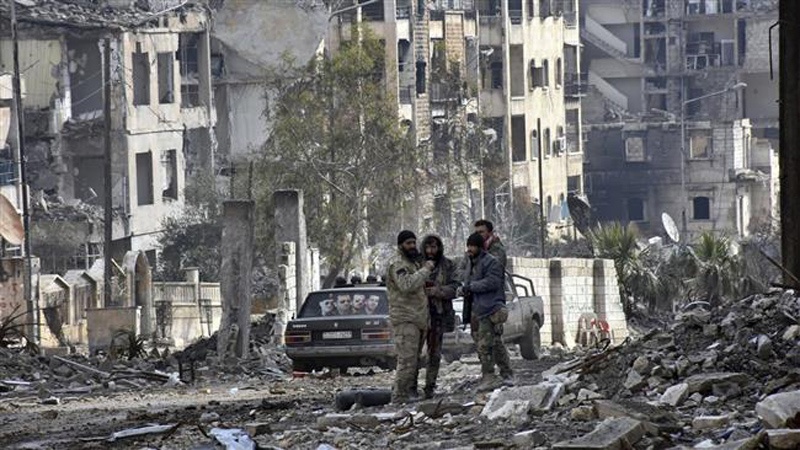
In the case of Syria, if, at it now seems, the insurrection ends up being defeated, the Western policy of intervention by arming the rebellion will be shown only to have prolonged the suffering of the population of this land. The “human rights defenders” who defended this interventionist policy bear a heavy responsibility in that tragedy.
We are warned against a perfectly imaginary Russian influence in Europe and we are told not to consult the “Kremlin media”.
Leaving aside “Russian propaganda”, such “human rights defenders” seem unable to pay attention to the following study: “Possible Implications of Faulty US Technical Intelligence in the Damascus Nerve Agent Attack of August 21, 2013.” This study, done by a former UN arms inspector Richard Lloyd concludes that the gas attack near Damascus in August 2013 that almost resulted in all-out war against Syria, could not be due to the Syrian government. It is difficult to imagine that experts in such positions would deliberately lie in order to “support Assad” or that they are incompetent concerning relatively elementary questions of physics.
The “human rights defenders” also question whether it is still possible to talk with Putin “after Aleppo”. But the U.S. “war on terror”, including the invasion of Iraq, with its millions of deaths, has never prevented anyone from talking to the Americans. Actually, after that 2003 war that France disapproved, France became more integrated into NATO and followed the U.S. more faithfully than ever.
Besides, the European “human rights defenders” are in a particularly absurd situation. Consider, for instance, the alleged use of chemical weapons in 2013 by the Syrian government. There was wide agreement in France over the need to intervene militarily in Syria. But, without American intervention, such a purely French one turned out to be impossible. The Americans suffer from “war fatigue”. The only possibility for the European “human rights defenders” is to have their own peoples accept massive military spending in order to create a relationship of force that would make the interventionist policies possible. States can support other States by giving them weapons and money. But individuals, or social movements, like an antiwar movement, cannot do that.
In every war, there is massive propaganda in favor of those wars. Since present wars are justified in the name of human rights, it is obvious that the war propaganda will concentrate on “violations of human rights” in the countries targeted by interventionists.
Therefore, all those who are opposed to the interventionist policies have to provide full information to counter that propaganda, for example, the study concerning the use of poison gas in 2013, or the testimonies about Aleppo that contradict the dominant discourse.
It is quite remarkable that some, who are very critical of their mainstream media when it comes to domestic policies, swallow almost entirely the western “narrative” when it comes to Russia or Syria. But if the media distort reality in the western countries, why wouldn’t they do the same when it comes to foreign countries, where things are harder to verify?
The only practical suggestion that was made was to create a “no fly zone” that would prevent the Russian air force from helping the Syrian army. But that would be one more violation of international law, since Russia was invited to Syria by the legal and internationally recognized government of that country, in order to combat terrorism.
To illustrate the hypocrisy, compare the situation in Syria and in Yemen. In Yemen, Saudi regime is committing numerous massacres, in total violation of international law. If you are indignant because nothing is done about Syria, why don’t you do something yourselves about Yemen? Moreover, there is a big difference between the two situations. In the case of Syria, a military intervention might lead to war with Russia. In the case of Yemen, on the other hand, it would probably be enough, in order to put pressure on Saudi regime, to stop delivering weapons to the regime.
For the “human rights defenders” political realism and the consequences of their actions have no importance: what matter to them is to show that they belong to the “camp of Virtue”. You imagine yourselves as being free, while following at each step the indications of the dominant media as to what should be the object of your indignation.
Those were excerpts from an article authored by Jean Bricmont. Jean Bricmont teaches physics at the University of Louvain in Belgium. He is author of Humanitarian Imperialism.
MR/ME
Tags