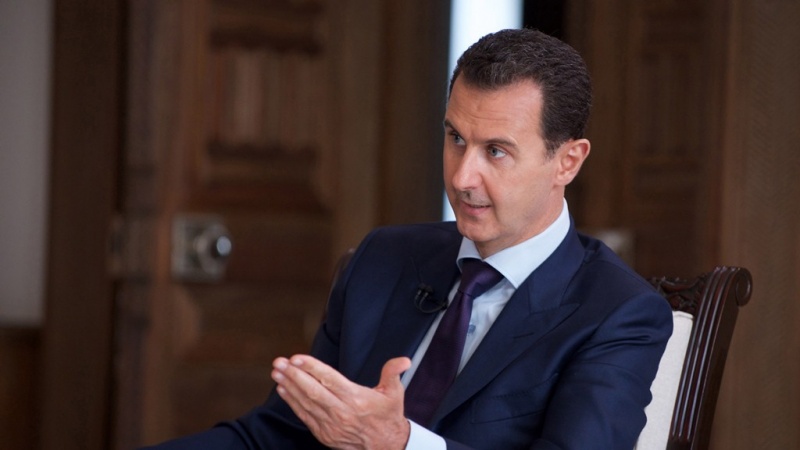
TF1 TV & Europe 1 Radio interview with Bashar Assad (1)
Mar 09, 2017 06:37 UTC
President Bashar al-Assad affirmed that victory in Aleppo is an important step in the way to defeat and to eliminate the terrorism from his country, adding “we don’t think that we can talk about winning the war unless we defeat the terrorists everywhere in Syria.”
The president added in an interview given to French TF1 TV and EUROPE 1 Radio that the west supported terrorists in Syria under the name of “moderate,” but it was supporting the same basis of al-Qaeda and Daesh. This is the first part of the interview enacted in our radio.
Journalist: Good morning, Mr. President, Bonjour Monsieur Le Président.
President Assad: Good morning.
Question 1: A simple question to start with: after the fall of Aleppo two months ago, can one say that you have won the war?
President Assad: No, we don’t think that we can talk about winning the war unless we defeat the terrorists everywhere in Syria. It’s just an important step in the way to defeat and to eliminate the terrorism from our country, but I think it’s going to be a long way for one reason, a simple reason; because they still have the support of many Western countries including France, including UK, including Turkey and Saudi Arabia and Qatar in our region.
Question 2: You talk about a long way; can you summarize from a military point of view the objectives that you have still to reach?
President Assad: Definitely, when I talk about eliminating the terrorists from our country, it means to take over every inch of our country, to bring it back under the control of the government, and that’s the duty of any government; is to take control of every place.
Question 3: In which part of Syria particularly, which town?
President Assad: You mean next after Aleppo?
Journalist: Yes.
President Assad: Of course, now you have to, and we are, we continue our campaign in the area surrounding Aleppo, just to make Aleppo more immune against any other terrorist attacks from the western and northern part that’s been supported by Turkey directly, by the Turkish army.
Question 4: But the next step is Idlib? This is what people say; next big battle will be Idlib.
President Assad: Could be Idlib, could be Raqqa or anywhere. Now, it depends on the situation on daily basis, because you change your plans. So, we didn’t put that plan before finishing Aleppo as city and rural area. So, it’s still early to talk about which is next. That depends on the development of the battles in the different areas.
Question 5: But the situation is far better off now for you as it used to be, militarily speaking.
President Assad: Of course, every place you can liberate from the terrorists means the situation is better, but it’s not enough for us.
Question 6: Sir, for France, the main terrorist threat is Daesh, there’s no question about this. For you, all armed groups, or most of them, are terrorists. Why is Daesh not a specific threat for you?
President Assad: Let me answer you about two points: the first one, it’s not for us, when we say they are terrorists, not for us as government; it’s for the law, and for the international law. Whoever carries a machinegun in my country or in your country and starts killing people and destroying properties is a terrorist. This is an international concept, so it’s not for us. For us, whoever wants to give up his armament is not a terrorist anymore, according to the law. But if you talk about Daesh, I think when you say that the French people or the Europeans worry about Daesh, I think this is misunderstanding of the situation; Daesh is a product, it’s not the problem. The problem is the ideology of Daesh, which is the same for al-Nusra, the same for many other organizations, like-minded organizations in Syria, and maybe in Libya or any other country. So, you should be worried about those terrorists; they don’t care about being Daesh or al-Nusra, they carry out what their ideology is telling them to do, mainly terrorist acts.
Question 7: So, there’s no difference between Daesh and other groups?
President Assad: Definitely, in Syria the grassroots are the same; the same people who were in Daesh were in al-Nusra before, now they are moving from organization to organization, because it’s the same ideology: it’s Wahhabi ideology, this is the source of this terrorism.
Question 8: This is the same enemy for you. Are all the terrorists the same?
President Assad: Yeah, of course, according to the law, not for me. As I said, according to the law and the international law, no one has the right to hold armaments except the army and the police in any country. I think the same in France, unless I’m wrong, you can tell me, but that’s what I think, everywhere in the world.
Question 9: So, Raqqa, which is the heartland of Daesh, where the terror attacks in France were prepared, Raqqa is not a priority target for you?
President Assad: No, again, they’re not necessarily prepared in Raqqa. Raqqa is a symbol of Daesh.
Journalist: It’s a symbol.
President Assad: You have Daesh close to Damascus, you have them everywhere, you have them in Palmyra now, you have them in the eastern part of Syria, so no, it’s not about al-Raqqa; everywhere is a priority, depending on the development of the battle, but for us all the same: Raqqa, Palmyra, Idlib; all the same.
Question 10: Sir, you present yourself as the main shield against terrorism. Some people, in the West in particular, would think that Daesh on one hand and your regime on the other hand are the two sides trying to crush any form of democratic and free expression. What would you answer to them?
President Assad: First of all, we’re not a regime; we are a state, institutions. Second one, that’s the demonization of the Western mainstream media and political strata regarding Syria, Syrian government and Syrian army, because they supported those “moderates” at the very beginning, and at the beginning they said they are “peaceful demonstrators,” then they said “they’re not peaceful, they are fighters but they are moderate,” but they couldn’t recognize that they were supporting the same grassroots of Al Qaeda and Daesh. That’s why they say that we are trying to promote those terrorists and to use them as alternative so the West cannot choose. First of all, the West doesn’t have to choose between me and Daesh: my people have to choose, because this is a Syrian issue, to be frank with you. So, we don’t care about what the Western officials think about this; they have to worry about their people and to protect their people from terrorist attacks that have been happening because of their policies.
Question 11: Sir, of course we are extremely shocked, particularly in France, by the horror of terrorism, but we are also horrified by a report from Amnesty International released a few days ago, last week. It’s about the prison of Saydnaya. It’s not far from here, not far from Damascus. 13,000 executed prisoners, massive hangings, torture. Amnesty speaks – I read the report – of a place where the Syrian state silently slaughters its own people, the Syrian state, your government. Mr. President, is everything permitted in order to win the war? Can you do everything that you want?
President Assad: No, everything legal. You cannot do anything…
Journalist: But according to Amnesty report, seems to be illegal.
President Assad: No. There’s difference between me and you talking about facts in this… in Syria, or talking about allegations. If you want to talk about allegations, we can spend the time talking about allegations, never-ending allegations. Anyone can say whatever he wants, and we can discuss it, but in that case, we’re not going to talk about facts. But if you want to talk about Amnesty, because Amnesty is known around the world, it’s shameful for such an organization to build a report on allegations. If you take any allegations to a court in your country, you have court, you have judicial system, could they take any decision regarding allegations, or they have to look for the evidence? This report is built on allegations, not a single shred of documents, not a single piece of evidence. They didn’t say 13,000; they said between 5,000 and 13, which is double and half the number, it means it’s not precise. There’s no mentioning of names, of anyone who is from the victims; only 36 out of those thousands, and there are many flaws. They said, for example, the Grand Mufti is endorsing the execution. The religious figures in Syria have nothing to do with any judicial process. The execution in Syria is legal, it’s part of the law since the independence, so the government can execute anyone legally; why to do it illegally?
Journalist: Can you tell us that there’s no torture in the prison of Saydnaya as Amnesty said?
President Assad: The question is torture for what? I mean, if you want to say that we are committing torture, for what? What do I get? Why? Just for sadism? Are we sadists? What is it for, to get information? We have all the information, so we don’t use it, it’s not our policy, because for a simple reason: if we commit such atrocities, it’s going to play into the hands of the terrorists, they’re going to win. It’s about winning the hearts of the Syrian people. If we committed such atrocities at any stage of this conflict, we wouldn’t have the support after six years. It’s a very simple fact. But again, if you go back to the reports, reports should be built on fact. There’s not a single fact in that report, and they have to prove it, they cannot.
Question 12: But Amnesty suggests sending international observers to the detention centers in Syria, to get some proof, or to prove that you’re right, and that there’s no crime being committed. What’s your answer to this proposal?
President Assad: I think we need an investigation on the Amnesty itself, when they adopt a report based on allegations. This is a shame, shame on such an organization that has never been impartial. It’s always biased.
Journalist: Testimonies of former guards and prisoners?
President Assad: It’s about the sovereignty. If you have allegations every day and reports every day, you can spend the time receiving delegations. Would you accept now, if you ask your government, to send a Syrian delegation to investigate why your army, through Sarkozy and later Hollande, attacked the Libyans and killed tens or hundreds of thousands? Can we go investigate the money that Sarkozy got from the Libyan leader? It’s a matter of sovereignty. No, we’re not going to allow Amnesty to be here, for any reason. I’m not talking about that report, but you have to – as mainstream media – investigate; that report is based on what? Just allegations? You don’t take it seriously.
Journalist: So, your answer is no to the visit of international observers.
President Assad: Definitely, no, no. We don’t care about such a childish report based on nothing, just allegations. And they said they interviewed a few witnesses who are opposition and defected, so it’s a biased report.
Question 13: But you acknowledge that there are some executions, official and legal executions going on in Syria.
President Assad: Since the independence, you have it, since the independence. It’s part of the Syrian law, execution, if there’s a killing act, there is execution. So, it’s not about the crisis, not about that report, it’s not about that prison. You have legal ways to do it, and it’s a judicial way.
RM/ME
Tags