What’s behind Saudi invitation of Iraqi Premier?
Oct 24, 2017 09:46 UTC
Iraq’s Prime Minister, Haider al-Ebadi, whose visit to Riyadh on Saturday was the second such trip to Saudi Arabia in the space of a few months, has raised speculations on the goals behind the invitations to the head of a Shi’a-majority country by a Wahhabi regime, notorious for its hostility towards the followers of the Ahl al-Bayt of Prophet Mohammad (blessings of God upon him and his progeny).
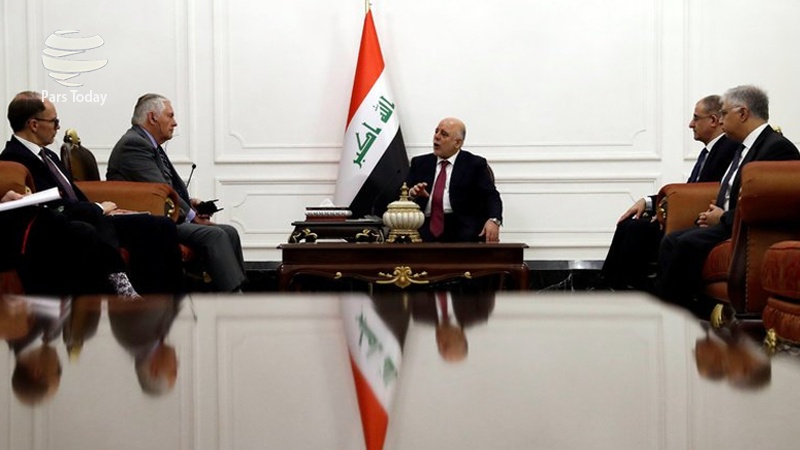
Moreover, the presence in Riyadh of US Secretary of State and the trilateral meeting between senior officials of the US, Saudi Arabia and Iraq, with Rex Tillerson’s usual raving and ranting against the Islamic Republic of Iran, leaves no doubt about American designs in the region. The question is: Will Washington’s plot succeed this time? The following is a commentary in this regard that appeared on the ABNA website.
The Iraqi premier’s trip was reportedly aimed at forming a coordination council between the two Arab countries to assess the political and economic relations between Iraq and Saudi Arabia. The goal of the council is to improve the bilateral relations as Riyadh and Baghdad saw their ties frayed over the course of past few decades.
US Secretary of State Rex Tillerson joined the two countries' representatives on Sunday in Riyadh and insisted on an unnatural alliance between Saudi Arabia and Iraq, which during the reign of terror of Saddam’s repressive Ba’th minority regime was a staunch ally of the Wahhabis against the people of Iraq. As usual he also talked rubbish about Iran, which betrays American fears about the growing influence of the Islamic Republic in the region.
Haider al-Ebadi and King Salman discussed a series of economic issues like investment in oil sector, re-opening the commercial air travel, opening consulates, and also completing a border crossing linking the two neighbors.
But the significance of the visit that comes at the invitation of Saudi Arabia goes beyond the bilateral economic cooperation, mainly lying in the kingdom’s new approach towards Iraq that largely derives from the Saudi internal changes, limitations and losses of the regional agenda, and siding with Washington’s regional policies in West Asia region. The restrictions now push Riyadh to seek a shift in its relations with Baghdad.
One of the main drives for change of attitude towards Baghdad is the Saudi Arabia's defeat in competition with Iran in Iraq, Syria, and Yemen that makes the terrorist-supporting Wahhabi regime take some tactical steps to get toehold in the target regional countries for the so-called objective of curbing the expansion of the Iranian sway in the region.
Seeing its policy to restrict the Iran-led Axis of Resistance in the region foiled despite multi-billion spending, Saudi Arabia has decided to renew its presence in Iraq to affect the country's internal developments.
The new approach is meant to help Riyadh return to the Iraqi politics and establish new links to the various Iraqi groups and parties in a bid to allure the Iraqi officials into stronger relations with the kingdom. This is mainly viewed as part of the Saudi intention to build its own regional hegemony in which Iraq, as one of the closest and most important allies of Iran, holds a special place.
There are internal drives for that, too. Saudi Arabia feels an urgent need to organize its badly damaged foreign relations as Riyadh aims at paving the way for Mohammad bin Salman, the current heir apparent, to take his father’s place as king. As part of his pretentions to be pragmatic, Bin Salman wants to send the message that his foreign policy will revolve around interactions with the neighbors and bolstered bilateral ties. His success in improving political and economic ties with Iraq is slated to help the would-be king burnish his and his powerful orbit's image at home.
Still there is an international reason why this visit is taking place, that is, Saudi Arabia's moving in line with the US to shore up influence in Iraq. The sway, once sought to penetrate to the Sunni groups, tribes, and political factions, now is intending to include also the Shi’a groups of Iraq. The new Riyadh attitude tries to establish relations with such Shi’a factions as the Sadrist Movement, the secular parties led by Ayad Allawi, and even other groups close to Iran like Islamic Dawa Party.
In fact, Saudi Arabia has put aside the “everything or nothing” approach in relation to Iraq. After fall of Saddam in early 2000s, Saudi Arabia went to great lengths to block rise of democratic government in Iraq in which the Shi’a Muslims, naturally due to their population majority, hold more power than others. To this end, Riyadh provided wide support for terrorist attacks across Iraq for over a decade, leaving massive Iraqi casualties and damages.
The Daesh terrorist group, Saudi Arabia’s last in a line of anti-Iraqi projects done in association with the US, proved to be a loss, too.
In the current conditions, both Saudi Arabia and the US are intending to bolster their foothold in Iraq through fine-tuning their approach and developing partnership with Baghdad. The new attitude seeks winning the Iraqi leaders' trust, though the reality is that only methods, and not the essential goals, have changed. However, being the main culprits of Iraqi massive human losses and infrastructure devastation for over a decade, Saudi Arabia and the US cannot easily paint themselves as friends of the Iraqi people.
AS/MG
Tags