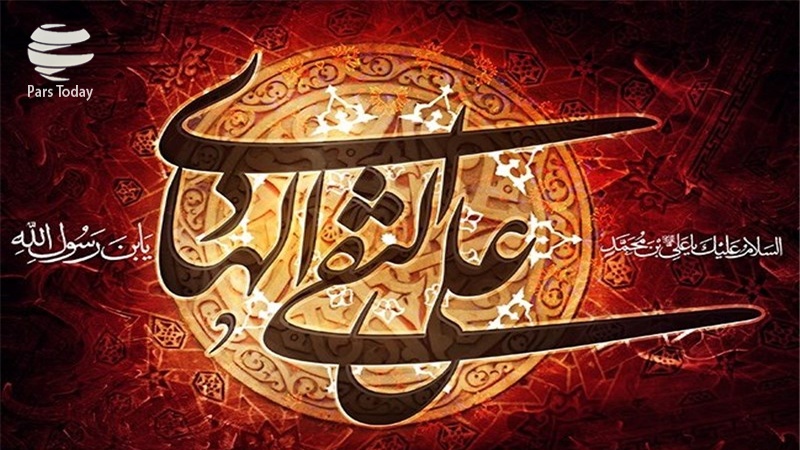
Martydom of Imam Ali al-Naqi (AS)
Mar 10, 2019 06:14 UTC
Today is the 3rd of the month of Rajab, the day of martyrdom of the Tenth Infallible Heir of Prophet Mohammad (blessings of God upon him and his progeny). Before presenting to you a special programme on the life and times of Imam Ali an-Naqi, we invite you to listen to a mind-stimulating aphorism from this great personality: “This life (of the world) is a market in which some people gained and others lost.”
A wonderful statement indeed! It is food for thought. It guides us to engage in a trade whose profits are neither ephemeral nor restricted solely to the transient life of the mortal world. These words shows us the path towards lasting gains that outlast life and bring blissful reward in afterlife.
This aphorism speaks of the insight and the foresight of the farsighted person who expressed it. Who was he? Did he achieve immortal gains in the market of the transitory world? Are his opponents in permanent loss?
The answers to these questions are obvious, especially since today is the 3rd of Rajab, the day on which in the year 254 AH (corresponding to 868 AD), the person who pronounced this golden maxim, sealed his transactions in the world market with a perpetually profitable deal, while those who robbed him of his 42-year life in the vain hope of prolonging their power, soon fell into the abysmal depths of the sorrowful inferno – permanent loss indeed.
Volumes, not a brief radio programme, are required to pen the virtues of the 10th Infallible Heir of the Almighty’s Last and Greatest Messenger to mankind, whose epithets “an-Naqi” or the Spotlessly Pure, and “al-Hadi” the Divinely-Designated Guide, are indicative of the peerless personality of this person.
Born in the holy city of Medina in the year 212 AH, he was orphaned at the tender age of 8 years, when his father Imam Mohammad at-Taqi al-Jawad (AS) earned everlasting gains in Baghdad, where the Abbasid caliph, Mu’tasim, had him martyred through a fatal dose of poison.
The blighted Abbasid tyrant, who plunged into permanent loss through this murderous act, appointed the well-known poet al-Junaydi as tutor to the son of his victim in the vain hope of brainwashing a member of the Infallible Ahl al-Bayt, whom God has referred to in the holy Qur’an as “Rasekhouna fi Ilm” or Repositories of Divine Knowledge.
To the horror and further loss of the enemies of the Ahl al-Bayt, when Junaydi was asked about the progress of his student, he said: “I am the student and he is the teacher. I now know what real knowledge is. What I say is because of what I have been taught by the (boy) Imam.”
The stupefied Mu’tasim was in total loss. He had no clue, and vented his frustration on the Iranians by removing them from the administrative apparatus and replacing them with his maternal kin, the Turks – his mother Marida was a Turkic concubine of the tyrant Haroun Rasheed.
In the meantime, as the Abbasid capital was moved to Samarra from Baghdad, the young Imam found some respite in holy Medina to reopen the Madrasah of the Ahl al-Bayt and revive the academic atmosphere at the Prophet’s Mosque – similar to the days of his illustrious ancestor, Imam Ja'far as-Sadeq (AS) – in order to teach the faithful how to acquire eternally profitable gains.
As the Imam of the age, Imam Hadi (AS) enlightened minds and souls. When Yahya ibn Aksam, the old Mu’tazalite ideologue who two decades earlier had stammered for words during the famous debate with the 9th Imam in the court of the self-styled caliph Mamoun, thought of compensating his loss by writing complicated questions to the 10th Imam in the hope of confusing him, he was again stupefied.
To his surprise, Imam Hadi (AS) provided rationally sound answers to all queries, including complicated questions of jurisprudence and theology that Ibn Aksam’s crafty mind could think of.
In 236 AH, the Tenth Imam’s relative peaceful preaching was disturbed when the new ruler, Mutawakkil, strove to outdo the crimes against God and humanity of his ungodly sire and ancestors. He forced Imam Hadi (AS) to come to Samarra. The Imam’s popularity alarmed the tyrant, when masses came out on the street to greet the Prophet’s righteous successor during the brief halt in Baghdad.
On reaching Samarra, Imam Hadi (AS) was kept under virtual house arrest. He also had to patiently endure the news of the blasphemous destruction of the holy shrine of his ancestor Imam Husain (AS) in Karbala, when Mutawakkil’s high-handed measures, such as levying of heavy taxes and even amputation of limbs, failed to deter the faithful from pilgrimage to the Chief of Martyrs.
Nevertheless, through the foolproof system of “wikala” or representation, Imam Hadi (AS) continued to provide valuable guidelines to the believers. Soon Mutawakkil was killed by his Turkic guards, who installed and removed within the space of five years two more caliphs, before placing Mu’taz on the throne.
This new tyrant intensely hated the Ahl al-Bayt, and aware that the neo Muslim Turks were beginning to realize as to who actually was the righteous heir of the Prophet, he finally hatched the plot to martyr the Imam through a fatal dose of poison, in a vain bid to prolong his power.
Mu’taz was totally wrong. The 10th Imam, like his illustrious ancestors, had ensured the earning of perpetual profit – not just for himself, but also for his followers, who would continue to visit his shrine even when Takfiri terrorists blasphemously blew its dome and minarets through bomb blasts.
As for the assassin, Mu’taz, soon the Turkic guards most humiliatingly beat and kicked this self-styled caliph to death after exposing him to the torrid sun, and throwing away his corpse to rot.
Today, there are no signs of the graves of the Abbasid caliphs, let alone their palaces, while it is the Grand Shrine of Samarra which, continues to attract pilgrims from all over the world.
Here are some bezels of wisdom from the 10th Infallible Imam (AS):
“Better than the good deed, is its doer, and nicer than the nice utterance, is the one who utters, and more virtuous than knowledge, is the one who has the knowledge, and worse than the evil, is the evil-doer, and uglier than terror, is the one who terrifies.”
AS/MG
Tags